
Canada’s northern Yukon territory has terminated WSP as engineer on the Nisutlin Bay Bridge replacement project, according to media reports.
Yukon Highways and Public Works Minister Linda Benoit said that “different expertise” is needed to move the project forward and that a new engineer has not yet been hired to replace the outgoing contractor, WSP.
According to a report by the CBC, Canadian Broadcasting Corporation, the Yukon government in 2022 called the project at Teslin the largest capital project in the territory. The old Alaska Highway Bridge, built by the federal government’s Department of National Defence, opened in the mid-1950s.
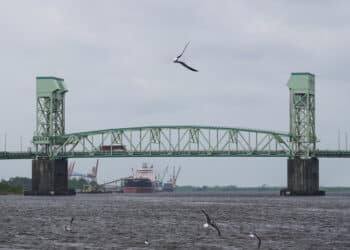
The replacement for that is being built beside the old one which the Canadian government is still safe and operational. The existing Nisutlin Bay Bridge is a critical link along the Alaska Highway and an important landmark for the community of Teslin.
Construction planning for the 483m-long two-lane bridge began in 2021 and was supposed to be finished this year. Construction work was initially awarded to Graham Infrastructure at a cost of $160 million, including around $84 million in federal support. But environmental issues – the river is an important migration route for chinook salmon – have pushed up the cost by nearly $24 million, plus a $10-million change order.
Key features of the 13.4m-wide bridge include a wide shoulder for cyclists and an LED-lit sidewalk for pedestrians. There is also a walkway beneath the bridge to facilitate safe crossing for snowmobiles and pedestrians.
The CBC report said that WSP provided an e-mail statement, saying that it continues to collaborate with the Yukon government to support the project going forward.
Meanwhile, the southern province of Ontario has requested federal government financial support for the expansion and upgrades of provincial Highways 11 and 17. The province – Canada’s most populous – has also asked the federal government to streamline approval processes that could delay construction work.
Highway 17 is Ontario’s longest highway, at round 2,180km and Canada’s second-longest provincial highway, narrowly surpassed by British Columbia Highway 97. It runs from near the Canadian capital Ottawa to Ontario’s neighbouring province of Manitoba to the west. Highway 11 is the second longest highway in Ontario, running 1,785km from Toronto in the south to the northwest border with Manitoba.
The two highways are key segments of the cross-country Trans-Canada Highway and run through northern Ontario. They are critical to moving goods and supporting economic growth and together can carry more than US$91.53 million in goods and about 2,000 trucks daily.