Thank you for taking the time to discuss sustainability. First of all, how does Ammann Group define sustainability?
Ammann views sustainability as a commitment to creating plants, machines and processes that minimise environmental impact. We also consider the safety of those on the jobsite and at Ammann manufacturing facilities as the ultimate sustainable priority.
Is it increasingly difficult or easier to measure progress towards achieving sustainability?
Not surprisingly, the answer is both. First of all, why is it becoming easier? For Ammann, having clear, timed targets is an essential way to measure sustainable progress. In other words, to have a target of ‘achieving X’ by the ‘timeframe Y’ is a good measuring tool:
When standards, for example for emissions, are mandated, our goal is always to go above and beyond – something we consistently achieve.
We are convinced that we will reach our target of using 50% of renewable electricity by 2035 much earlier than that year. Besides this, we want to reduce by 2035 also our Scope 1 and Scope 2 CO2 emission levels by 30%.
By 2050, we are committed to using 100% renewable electricity and achieving net-zero Scope 1 and Scope 2 CO2 emissions [see below].
External benchmarking is another method. Tools like EcoVadis [see below], which recently awarded Ammann a ‘Committed Badge’, provide standardised frameworks and outside validation. Receiving such a certification is a meaningful measurement.
Secondly, why is it not becoming easier?
Sustainability includes resource use, waste reduction, recycling processes and longer-term impacts that can be difficult to compare and quantify.
There is not a single universal metric that captures all aspects of sustainability.
Long-term effects are difficult to measure. It can take decades for the impact on an ecosystem to surface.
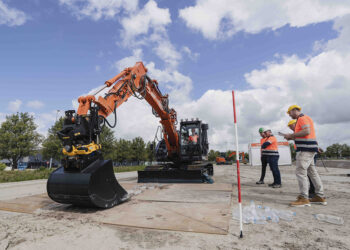
Ammann has promoted work safety through many innovations such as Birds-Eye View [BEV] for machinery, which helps operators observing their working area to detect objects and avoid collisions on the jobsite. The Ammann Safe Brake Assist [ASA] is an active safety assistant system designed to prevent collisions. It’s hard to quantify the accidents prevented by these systems – yet the importance can’t be overstated.
Is there too much emphasis on specific climate goals and too little about reduction in material use?
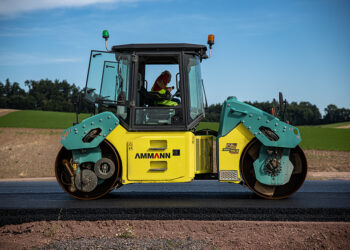
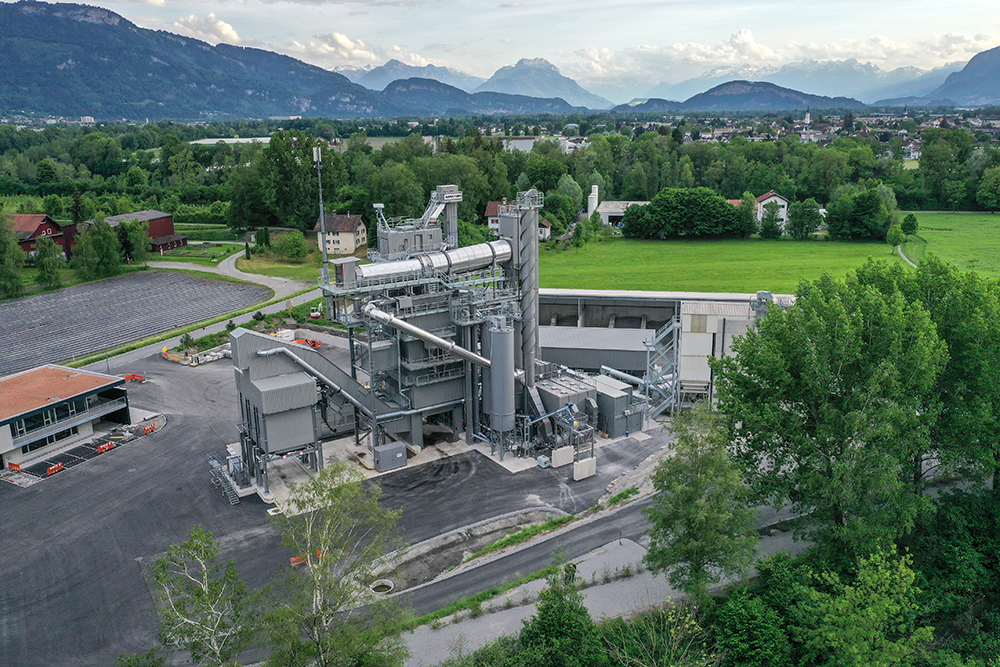
Ammann is following the four-pillar approach according to the CECE [Committee for European Construction Equipment], which means improving machine/plant efficiency, process efficiency, operation efficiency and exploring alternative-energy sources. Assistant functions like the line assist on asphalt rollers or burner control on asphalt plants will impact several mentioned topics.
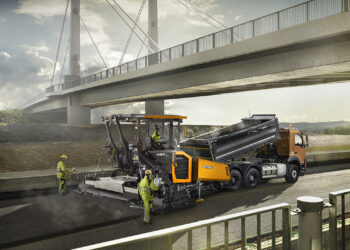
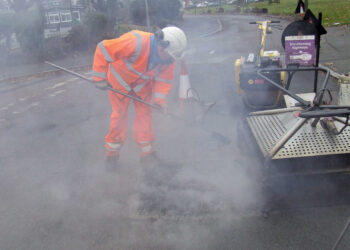
Using low-temperature asphalt will have an impact not only on asphalt production – where Ammann has been working for a long time on a solution with foam bitumen or adding additives – but also the process and operation efficiency on the job site must be increased. The ABG Pavers using adjustable double tamper solutions will definitely provide the same or even better quality road surface but with reduced operation times, whereas the ACE Pro solution helps reduce compaction time for an optimally compacted road.
Ammann is a leader in the provision of solutions using reclaimed asphalt , with up to 100% use in some cases, minimising the use of primary resources. As well as alternative-energy sources such as battery and electric power to reduce CO2 emissions from machines, there are other options. Consider using HVO [hydrotreated vegetable oil biofuel] for machinery as well as for plants. Wood dust or hydrogen burners are also viable as alternative-energy sources. There are many solutions for increasing safety and efficiency on construction sites through participation in the Autonomous Operation Cluster [AOC] and, as already mentioned BEV and ASA.
EcoVadis is a globally recognised sustainability-rating platform that assesses a company’s environmental, social and ethical performance. It evaluates four themes: Environment, Labour/Human Rights, Ethics and Sustainable Procurement. By analysing policies, actions and results, EcoVadis delivers a scorecard that highlights strengths and areas for improvement, enabling businesses to benchmark their performance and drive continuous improvement. Companies provide basic information, including industry, size and location, to tailor the assessment to their specific context. A customised questionnaire is completed, requiring documented evidence to support responses. This ensures the assessment reflects actual practices and performance. EcoVadis analysts review the submitted information, considering both internal documentation and external sources, to evaluate the company’s sustainability management system. Companies receive a scorecard with scores ranging from 0 to 100, along with badges (platinum, gold, silver, bronze) that recognise their sustainability achievements. Meanwhile, EcoVadis badges and medals help simplify sustainability for stakeholders. For procurement teams, they offer a quick way to screen suppliers. For investors, they provide a snapshot of risk and performance. And for customers, they build trust and brand value. More information is available at:https://transformacy.co.uk/articles/how-does-the-ecovadis-scoring-work
Scope 1, 2 and 3 emissions are greenhouse gases that are released across an organisation’s entire value chain. Scope 3 emissions are the most complex, as they are released before and after a product is delivered or consumed.