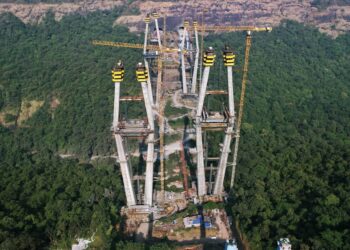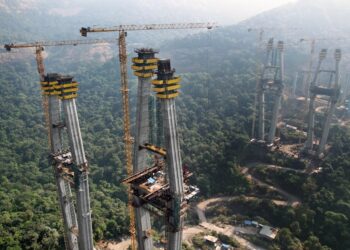
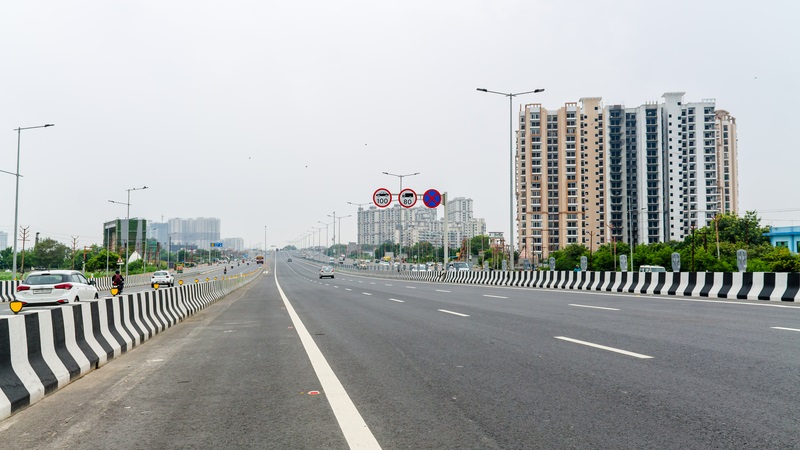
India’s massive Ganga Expressway link in the north of the country has cost $3.93 billion to construct and is open for drivers. Located in Uttar Pradesh, the expressway link was built in four main stages, measuring around 130km, 152km, 156km and 157km.
The project has been part of a plan by the Uttar Pradesh Expressways Industrial Development Authority (UPEIDA) to develop an industrial corridor along the route, which features 12 commercial zones. These will be located in Meerut, Hapur, Bulandshahr, Amroha, Sambhal, Budaun, Shahjahanpur, Hardoi, Unnao, Raebareli, Pratapgarh, and Prayagraj.
The project was proposed originally in 2007 but work only started in 2021. The expressway features 19 entrances and exits along the route and uses a closed tolling system determining the entry and exit point so that drivers will only be charged once. The project was carried out under the EPC model while the route has been built with three lanes in either direction and with a design speed of 120km/h. With the route now in use, journey times between Meerut and Prayagraj are being reduced from 10-12 hours to from 6-7 hours. The new highway also provides a faster connection to the Meerut-Delhi expressway, reducing journey times between the East of Uttar Pradesh and India’s capital.
Meanwhile, construction is now being started for a 104km stretch of NH-43. This will form part of the wider project for the 627km Raipur-Dhanbad economic corridor. The project is being managed by the National Highways Authority of India (NHAI), with key features including the construction of seven large bridges.
And in Jammu and Kashmir (J&K), a rural road project is being planned worth $376.3 million, while $376 million will be provided to upgrade 330 new roads totalling 1,600km in the state. Road development in the state since 2000 has seen the total network expand to 19,851km, while 257 bridges have been built.