Hyundai is planning to develop its presence in the global off-highway machinery sector, consolidating its already strong base. In Europe the firm has become a major player, building a strong market share in the earthmoving segment and brand image since its first entry in the late 1980s. And from being regarded as a cheaper option in the past, Hyundai has become recognised as a premium brand.
Sanho Shin was recently appointed CEO of Hyundai Construction Machinery Europe and intends to further boost the firm’s presence. He said: “We want to be a leading construction equipment manufacturer.”
Despite the current economic challenges posed by international conflict, Shin said: “We still maintain a cautiously optimistic view of Europe.”
The company has seen a significant growth in revenue in Europe in the first quarter of 2026 compared to the same period in 2025.
The firm has aggressive targets for the further growth of its market share with its Project 2030 programme. Meanwhile, Shin said that digital solutions are crucial to the future of the construction machinery segment and added: “We believe Hyundai is a leader in digitalisation.”
He said that the pace of change in digitalisation remains high and added: “There are still lots of ways to be developed.”
There are limitations on the use of technology, and the prospect of fully autonomous equipment being used widely on construction sites remains some years in the future. He said: “It’s not easy to have fully AI-controlled equipment.”
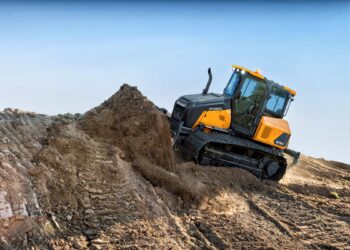
With its view to expanding its share of the construction machinery market, Hyundai has made key launches in its range. The firm has made a major introduction of new earthmoving machines with its next-generation excavators, new wheeled loaders, a 15tonne bulldozer and a novel twin-axle ADT with a 41tonne capacity.
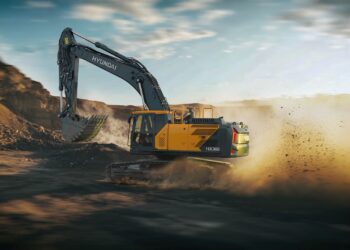
The first of the next-generation excavators introduced to Europe are the HX360 and HX400, launched last year. These have now been followed by the new HX230, HX260 and HX300. In addition, the firm offers a special HX520 high-reach demolition machine. All of the new HX models have engines that meet the Stage V/Tier 4 Final emissions requirements for Europe and North America and benefit from advanced new hydraulic systems.
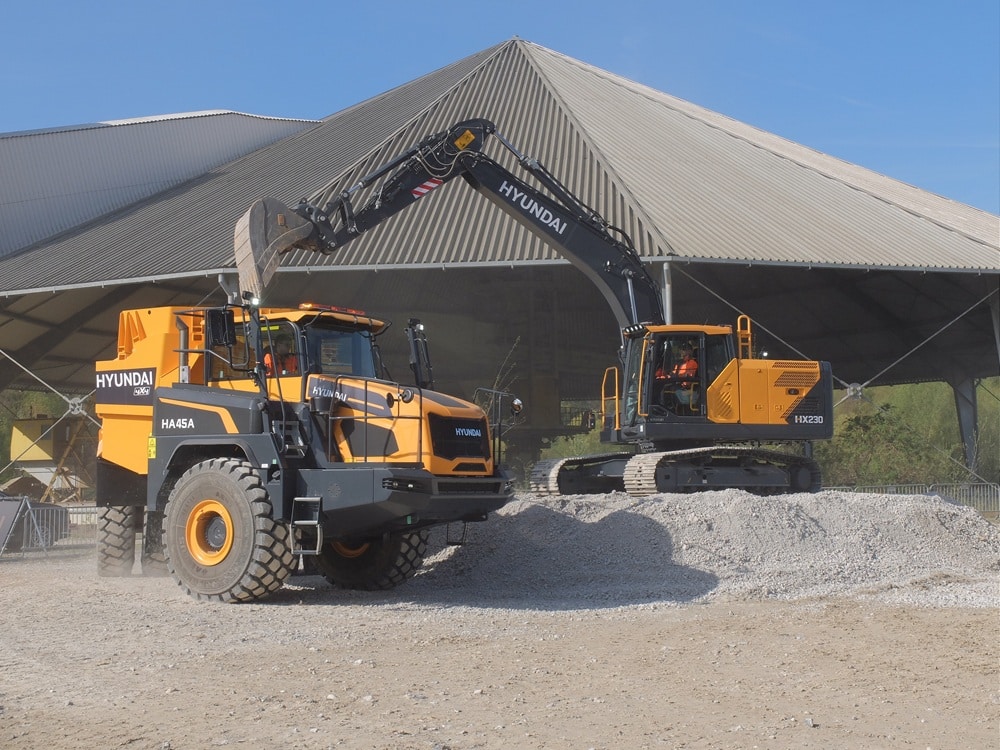
Power for the HX230 excavator comes from a four-cylinder DX05 diesel, delivering 141kW that uses 6% less fuel than the six-cylinder unit from the earlier generation machine while delivering 10% greater productivity. The new HX260 is also powered by a DX05 diesel, though rated at 171kW. The machine offers the best-in-class tear-out and a heavier counterweight than the previous model which helps boost stability and digging ability. The new HX300 has power from a DX08 diesel that delivers 207kW, while using 1litre/hour less fuel than the machine being replaced.
The HX300 is offered with standard long-crawler or narrow-crawler options as well as the choice of a mono boom, two-piece boom and long-reach boom.
The machines are fitted with Grade Assist and Lift Assist systems as standard, allowing more precise digging to grade and bucket weighing and truck-load determination, respectively. The company also fits an e-boundary system that can limit the working movements of the machine if it is operating close to power lines or buildings or other obstructions, instead of a customer having to fit more expensive, third-party hardware. Also fitted is an advanced detection system that will sound an alarm, slow operation or even stop the machine entirely should site personnel come too close to working equipment.
Ben Gorton, product management at Hyundai Europe, said that the next generation HX machines benefit from a range of improvements. “We’ve doubled the alternator capacity from 90A to 180A. We’ve redesigned the upper structure and we’ve redesigned the lower structure and we’ve doubled the oil and service hours from 5000 to 1,000 hours.”
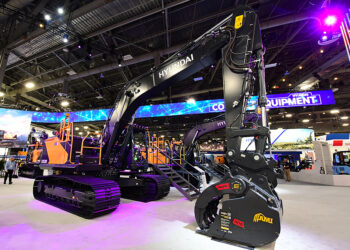
The HX520A HRD model is another new departure for the firm. Gorton said: “It’s the first demolition machine from us.”
This can handle a 3tonne attachment (including device, adapter plate and coupler) at a height of 27m and reach of 16m. It features a 35° tilt for the cab as well as effective dust suppression and reinforced glass and a Level 2 guard for extra protection. The modular quick-change boom design allows for the use of a standard earthmoving boom, straight boom or the long-reach unit.
The HL970A is one of the firm’s latest generation wheeled loaders and weighs 24tonnes in standard form. Power comes from a Cummins L9 diesel rated at 242kW which meets Tier 4 Final/Stage V emissions requirements, allowing a top travel speed of up to 40km/h where legislation allows. Standard buckets for the machine range from 3.6-4.2m3 and it offers a dumping height of 3.57m and features a tipping load of 18.35tonnes.
Safety features for the HL970A include the advanced around-view monitoring (AAVM) system which provides all-round vision by offering nine views. This system also includes intelligent moving object detection (IMOD). In addition, the HL970A has a reverse-drive radar system that alerts the operator to obstacles at the rear of the machine at all times.
Manufactured in Norway, the HA45 dump truck widens the firm’s range of ADTs which already includes three conventional three-axle models. The new HA45 is said to combine the versatility of an ADT with the efficiency of a rigid truck. This twin-axle machine has twin tyres at the rear and offers a 41tonne payload, suiting use on long hauls on large construction projects or quarry sites. Front and rear suspension offers a smooth ride on rough ground and permits travel speeds of up to 55km/h, significantly faster than would be achieved with a conventional three-axle ADT of the same payload, boosting productivity.
While not offering quite the same rough-terrain capability of the three-axle ADT, the 4×4 drive means it is able to handle rougher conditions than a conventional rigid truck. The body has a profile similar to that fitted to a rigid truck and offers a capacity of 25.7m3.
Power comes from a six-cylinder Scania diesel, delivering 368kW and 2,476Nm of torque which meets Stage V/Tier 4 Final emissions requirements. The engine drives through an electronically governed and well-proven ZF transmission and the truck has a hydraulic transmission retarder with four modes to help manage speed on downhill slopes. Limited slip differentials are fitted at the front and rear while the truck also has a longitudinal differential that is locked manually to maximise traction on very poor ground. With the turning ring in front of the articulation joint, truck stability and weight distribution are said to be good.
The spacious cab has large windows for high visibility and an ergonomic driving position, as well as a clear display showing working parameters.