The Mount Rainier National Park in the US is a highly protected area in Washington State, with strict regulations on what can and cannot be carried out within its area. Popular with tourists, the National Park attracts many visitors every year, although the site can be challenging and present hazards even to those experienced with the conditions.
Covering some 95,660ha, the area was awarded National Park status in 1899, making it the fifth such in the US. Mount Rainier, for which the park is named, is a 4,392m-high active volcano, the highest peak in the Cascades Mountain Range as well as in Washington State. The mountain is monitored continuously as it is considered one of the most dangerous volcanoes anywhere in the world due to its level of activity and the potential threat it poses for the surrounding area. As is sometimes the case for volcanic areas, the park provides an impressive habitat for nature and is known for its wide diversity that includes forest areas, glaciers and a huge array of animals, birds, insects and plantlife.
Popular with lovers of nature as well as hikers and climbers, the park is accessed by numerous roads, with the highest point accessible by car located at an altitude of nearly 2,000m.
However, with an extensive network at such an altitude, maintenance of the roads has presented an ongoing challenge for the authorities running the park. The combination of high altitude, low winter temperatures and heavy snowfalls at times has meant that the roads have had to be monitored carefully to ensure that they are in good condition. And because of the remote location, any damage to roads could present serious safety hazards to those entering the park.
To ensure access across the park could be optimised, the authorities decided to bring in specialist help to deliver the necessary road maintenance works. Preventing any small cracks in the existing road surface from propagating and becoming large cracks or potholes provided one consideration. Another priority factor was to ensure skid resistance was sufficient to allow for safe driving conditions, something of high importance in a National Park with many remote areas and where any driver’s loss of control could prove even more dangerous than in more conventional locations.
The solution was to use proven micro surfacing techniques. And the US Federal Highways Administration has a long history of successful performance of micro surfacing in US National Parks. A contract worth nearly $7.7 million was awarded for the project to maintain the park’s road network.
VSS International won the package of works to carry out the micro surfacing job using its own equipment, while a team of other specialists was brought in to carry out specific tasks. Quality control was carried out by Asphalt Testing Services, while patch paving was handled by Puget Paving & Construction, road striping was carried out by Pavement Surface Control, crack sealing by BCV and traffic control by Advance Government Services.
Matt Ferguson is vice president Construction at VSS International and he explained that using micro surfacing technology at the Mount Rainier site provided a practical solution for road upgrading. He said, “They’re hours away from resources.”
Ferguson explained that the road crew were working a long way away from any hot mix plants that would have been able to supply asphalt on a cost-competitive basis. This fact alone would have made a conventional asphalt paving operation extremely costly and also complex in terms of logistics. He added that micro surfacing provided a more logical solution on this basis, “It saves them a lot of money.”
Using micro surfacing also allowed a greater distance to be resurfaced in a shorter space of time than using conventional milling and paving to refurbish the road surface. The time factor was highly important. Ferguson said, “When you’re doing micro surfacing in a national park, you’re saving months.”
Work started in mid-May 2025 and was completed by the end of September 2025. In addition to the micro surfacing, the project scope included pavement repairs, crack sealing and striping replacement, with these parts of the contract being handled by the other specialist firms in the team.
There were major environmental benefits from employing micro surfacing in this application, a key reason that the authorities chose this option. Sending a series of asphalt shipments in tipper trucks through the National Park would have been highly undesirable from an environmental perspective. This was something the park authorities wished to avoid, both to prevent disturbance to any wildlife and also to cut diesel particulate emissions in a sensitive location.
There were other advantages too. Micro surfacing can provide a long working life for road rehabilitation, as long as the materials are specified correctly to best suit the location and conditions and high-quality methods are used for application. Ferguson said that a 10-year working life can be expected typically for micro surfacing in most applications and that the technology has shown that it can last far longer in some instances.
CEO at Reed Family Companies, Jeff Reed, said that both Type 3 and Type 2 micro surfacing layers were used for the project in different areas of the park, according to need. The Type 3 micro surfacing was placed on the main roadways throughout the park, due to its larger size and thicker application rate. Meanwhile, the Type 2 micro surfacing was used in the parking areas and minor roadways, due to its smoother finish and also for its aesthetic qualities.
Reed explained that to provide an improved surface, the firm laid around 900tonnes of the Type 2 micro surfacing and just over 5,500tonnes of Type 3 micro surfacing. Approximately 50km of mainline Type 3 micro surfacing was laid , and 154,700m2 of Type 2 micro surfacing in parking lots, campgrounds and minor roadways. And the company applied micro surfacing up to the Paradise welcome centre parking lot, at around 1,800m.
The size of the park, the remoteness of some of the road sections and the altitude all presented challenges in terms of logistics for the contracting team. According to Reed, the materials were shipped and stored in a variety of stockpile locations throughout the project. But some of the stockpile sites used were small and did not have a lot of space for storage. This required the road crew to manage the supply and use of materials scrupulously, with daily deliveries that had to be placed and used within a day.
Working in a National Park meant that the contractors had to meet strict environmental restrictions. This applied to all aspects of the operation and Reed said that VSS had to make sure that all of the materials were contained within the stockpile areas and that nothing was spilled off the roadways.
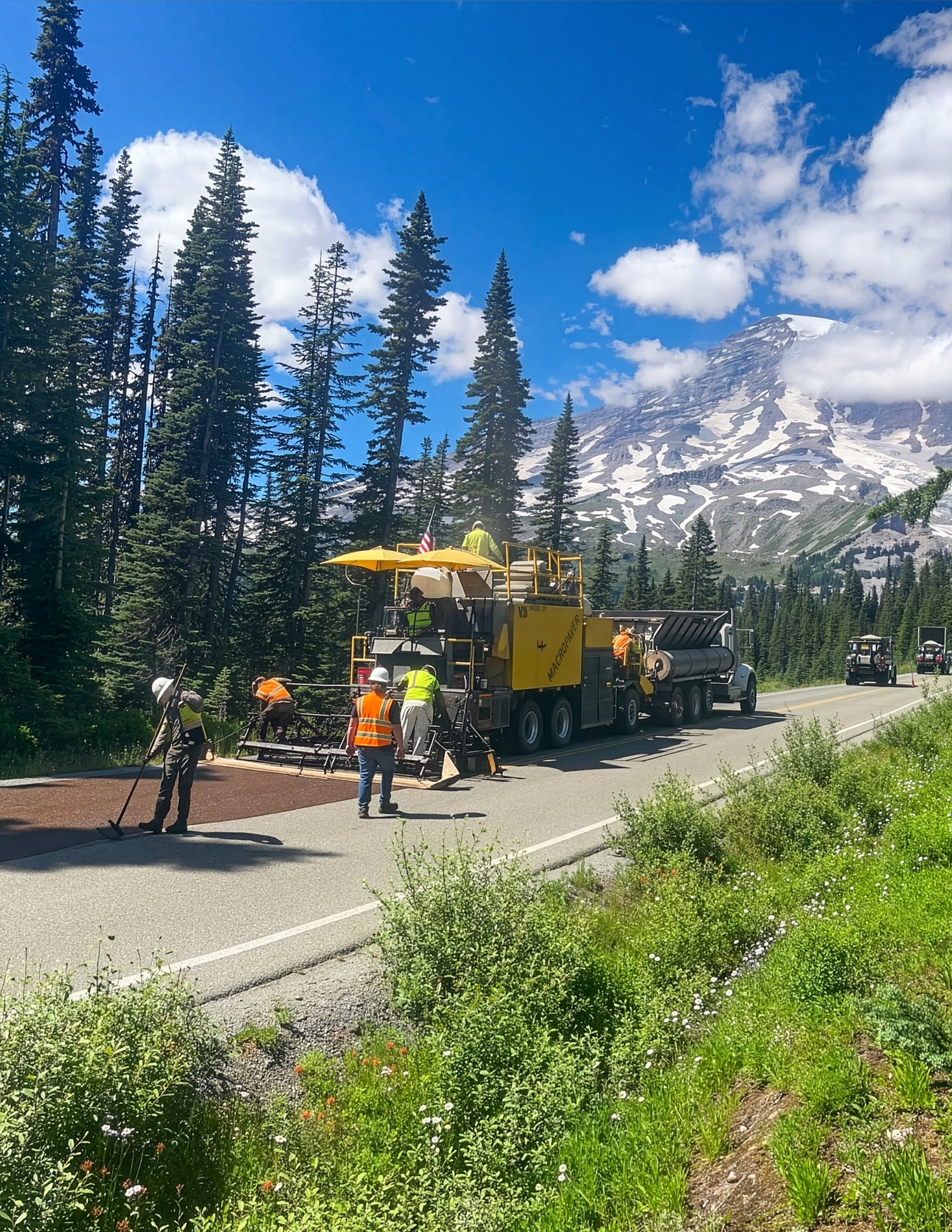
Most of the mainline work was for lanes approximately 3.96m (13’)-wide and the firm used a variable width box for the job, manufactured by sister company VSS Macropaver.
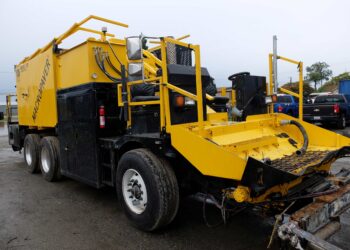
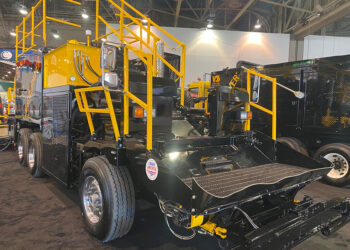
Different equipment was used for the contract. Reed said that the Type 3 micro surfacing material used on the roadways was placed using a VSS Macropaver CR continuous machine. Meanwhile the Type 2 surfacing was placed using VSS Macropaver 12-EX truck-mounted machine.
According to Reed, all of the micro surfacing was put down in a single lift. The Type 3 was placed using approximately 10.6-11.37kg/m2 (28-30lbs/yd2), reflecting the need for more material to cope with the higher stresses of vehicle traffic for the roadway application. Meanwhile, the Type 2 was placed at approximately 6.4-6.85kg/m2 (17-18 lbs/yd2) due to the lesser need for such quantities because of the lower stresses imposed by vehicles in the parking areas.
Doug Hogue is vice president and general manager at VSS Macropaver. He said that the sophisticated design of the VSS machines ensures precision and quality. An onboard computer system ensures that material quantities remain constant, no matter the travel speed of the machine speed. And the computer means that the driver no longer has to keep adjusting the equipment to ensure that the correct mix ratio is maintained as this task is carried out automatically. As well as simplifying the task for the operator, this means that the quality of the surface laid is maximised.
Using micro surfacing provides an even surface with good skid resistance properties. The technology extends the life of an existing road surface and is highly suitable for road rehabilitation, as long as the underlying road structure has no major issues.
The conditions in the Mount Rainier National Park do present challenges for road improvement works. But despite the tough winter climate at this high altitude site, the firm is confident in its micro surfacing solution proving long-lived. Ferguson said, “We’ve seen multi-layer systems perform just as well as milling and paving.”
Although Mount Rainier is a very demanding test for a micro surfacing application, Reed says that the expectation is that the new wearing surface will last for at least 8-10 years.