US firm VSS is offering pavement-preservation technology that has benefited from a series of steady improvements over the years. The company builds its machines at a facility in California, offering a product range to suit different requirements and applications.
Doug Hogue is vice president and general manager at VSS Macropaver. He explained that the company has been working continuously on developing its surfacing systems, making incremental upgrades in many cases.
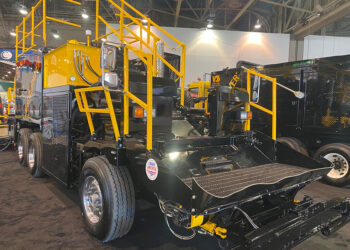
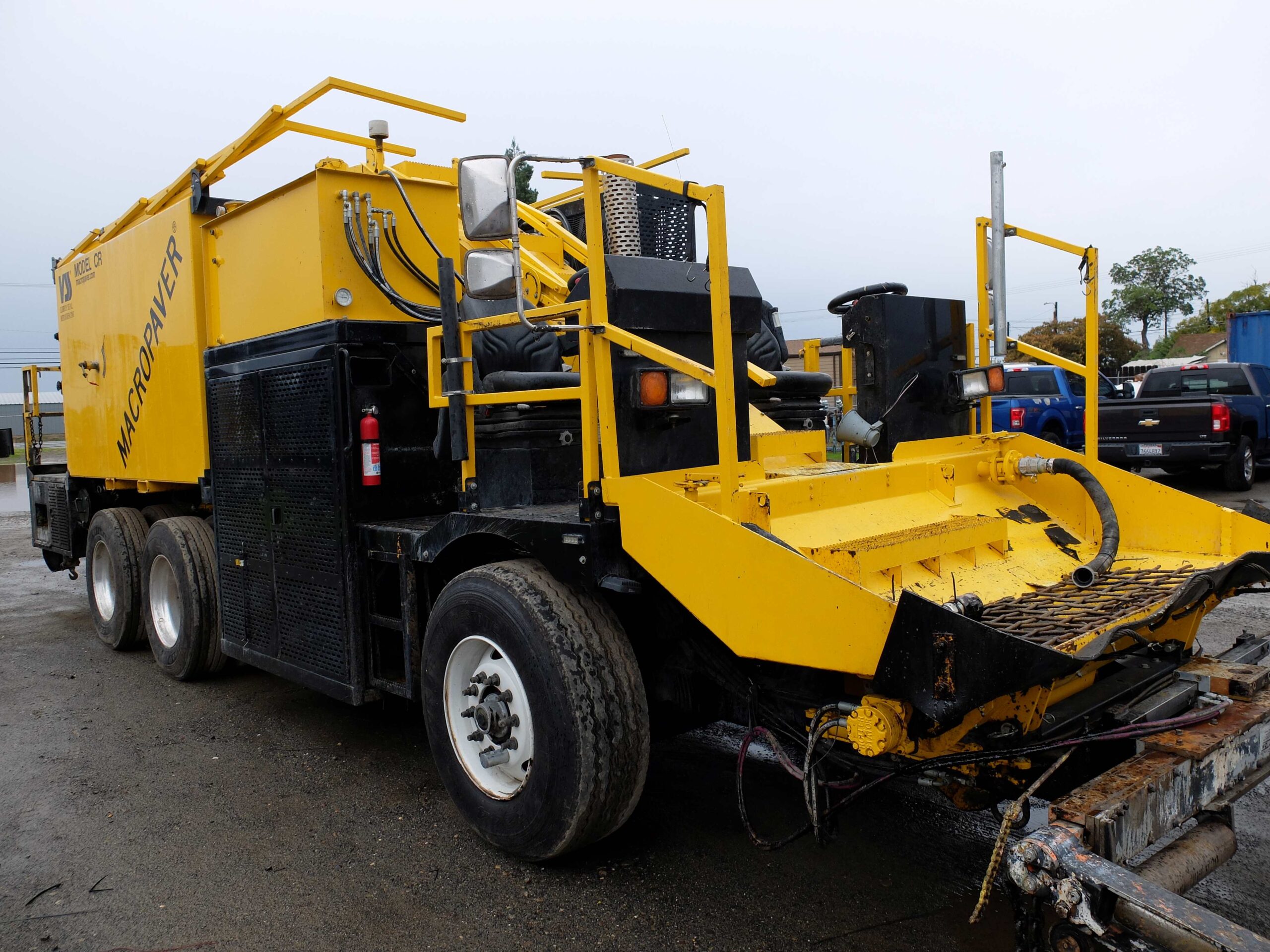
The firm’s latest continuous machine is fitted with a conveyor and benefits from a large material capacity which boosts efficiency. According to Hogue, the design of the machine offers some major benefits for users. He said: “You have a lot less seams in the road.”
The machine features a hydrostatic drive but is mounted on a truck chassis. For use in the US, this is limited to a speed of 40km/h (25mph) on the road but can be driven at 60km/h in Canada. The drive system offers a key benefit over competing models too, which only allow speeds up to 26km/h (16mph). The machine also has an exhaust brake, unlike its competitors, which helps boost operating safety.
Two hydrostatic motors are mounted on standard truck differentials and Hogue said: “We’ve a few patents on the drive on the machine.”
The computer system ensures that the material quantities remain constant, no matter the machine speed. The computer guarantees that all the mixes are optimised with the necessary mix ratio. “All materials are linked through the computer control system. You only have to speed it up or slow it down,” said Hogue.
This delivers a significant advantage according to Hogue, considerably simplifying the workload for the operator. This system ensures that surfacing quality remains continuous and constant. “Now the operator can focus on what goes on the road,” he added.
The machine has dual driving stations at the front, while the firm can mount a cab, as is required for the Canadian market.
Using the equipment does offer considerable advantages for road life and Hogue said that this does hold up to the extra loads imposed by heavy traffic. Trucks and oxidation cause road wear but pavement preservation extends the road-surface life while ensuring skid resistance is optimised, said Hogue.
Small investments in road maintenance can extend the life of the road indefinitely according to Hogue. He added: “If you keep doing this, the asphalt road has an indefinite life.”
Hogue continued, saying that the National Asphalt Paving Association (NAPA) is very interested in pavement maintenance these days. And VSS says that there is a growing awareness of the need for a stable and sustainable system for road maintenance, with techniques such as microsurfacing taking a stronger role. This offers a cost-effective means of preserving, developing and prolonging the life of roads without the need for costly reconstruction.
This road-repair solution can meet strict environmental requirements and is less invasive than resurfacing because it requires fewer machines. VSS says that its pavement-preservation methods can also provide a more sustainable way to extend road life, while causing less traffic disruption and requiring the use of fewer construction materials than in conventional repaving work.