When Ammann announced its plan to buy the ABG asphalt paving business from Volvo CE in late 2024, this was a major addition to its operations. The ABG brand has had an excellent reputation in construction for many years as a leading name in asphalt paving.
During the 17 years that Volvo CE owned the ABG facility the firm had invested in the production facility in Hameln, installing new welding robots as well as building a new manufacturing hall for the pavers for example.
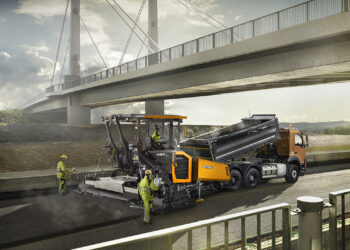
Perhaps the most significant project in recent times was Volvo CE’s development of an electric highway class paver. This machine fitted in well with Volvo CE’s drive towards electric construction machines but has been equally well received as part of Ammann’s own sustainability goals. With several trials of the electric paver having been carried out on working construction sites, Ammann is convinced that the machine will offer customers an effective solution for asphalt paving.
The new electric paver retain many features of the ABG designs that have been well proven over many years. As with other new generation pavers from Ammann, the electric machine also benefits from new features. One of the most notable is a variable stroke double tamper system.
The standard setting for tamper bar movement is 6mm from the factory, although a full 10mm is available on the earlier designs when manually adjusted. But the complexity and time consuming nature of changing the tamper bar stroke on the existing screeds means that the vast majority of customers never adjust this feature.
However, the new screed design means that customers can now adjust the tamper bar stroke easily, just by changing a setting on a touchscreen. This is a key feature.
For paving tight corners for example, the paving crew can adjust the tamper bars to deliver increased stroke on the outside of the radius so as to match the compaction on the inside of the radius. This will ensure a more event level of compaction across the mat, so that density levels will be more homogenous throughout, with a significant benefit for the wearing life of the corner or roundabout. This system is enabled through the use of a specially-developed planetary gearbox that means the stroke can be adjusted steplessly when needed.
Meanwhile, the adjustable tamper stroke will also have a major advantage for paving warm mix asphalt grades. This will ensure more effective compaction with the screed prior to the rollers being deployed. It will assist the time critical compaction process with warm mix type asphalt and as the use of this material will become a requirement in many areas (from 2026 in Germany for example), the ability to ensure effective pre-compaction use a tamper bar screed will be a major selling point to the paver customer base. Another use for the variable tamper bar stroke would be for varying material thicknesses also.
Frank Dörrie at Ammann’s ABG facility commented, “They don’t use it at this time because it’s difficult and takes time but today we are making this possible with this adjustment system.”
Dörrie added, “We are convinced customers will use this a lot in future.”
Another novel design feature now being offered by Ammann’s ABG pavers is the ability to raise and lower the screed ends quickly and easily. This system allows the paver crew to vary the crown adjustment on the move, as well as raising just one side of the screed as required, should the machine pass a side road or inspection cover in the roadway. The selection of a hardened steel grade for the tamper bars will boost wear life, particularly for paving more abrasive materials. Dörrie commented, “We’ve doubled tamper bar life because of the use of hardened steel.”
This is a key issue also for some of the pavers being built for use in the US. These machines are often supplied without heating systems but featuring tamper bars for use in RCC applications. The firm was supplying an 8820 model, the largest in the range, featuring a 12m fixed screed to a customer in the US for use in RCC paving. The aggressive nature of the concrete means that machine wear rates are higher than for paving asphalt, so boosting the tamper bar life with the use of hardened steel will make a significant cost saving for maintenance in this specific application.
A pressurised greasing system for the screed auger drive, as well as multiple seals, ensures that no bitumen contaminants can enter into the bearing, which would reduce its wear life. And a new short Super Ski system featuring five sonic sensors is offered that allows customers to track mat thickness accurately. This is more compact than previous systems as well as offering a higher level of measurement accuracy according to the firm.
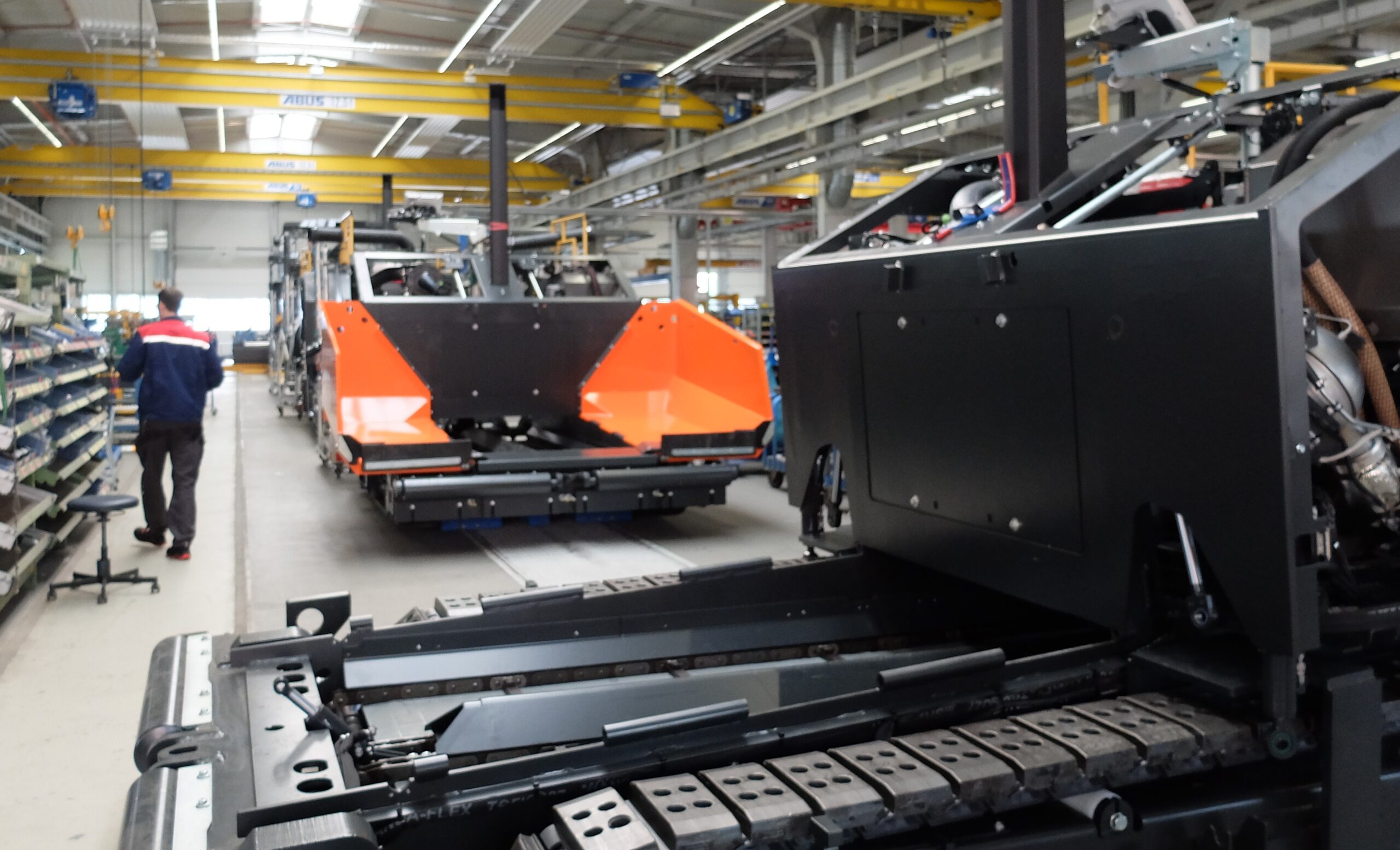
The pavers are assembled on a U-shaped line that produces all of the pavers in the range. Turntables at the end of each line allow the machines to progress further, while there is also a siding so that any machines awaiting specialised parts for example can be put to one side until they arrive, allowing other machines to continue progressing along the line.
The personnel on the production line have been trained to be able to switch roles as required. Meanwhile, operations are also digitalised to ensure all assembly processes are recorded. Sub-assemblies are put together at the side and then moved into place when required. At the end of the production line, all of the machines are given a three hour warm test to ensure that every function operates correctly, prior to shipment.
Around 80% of the pavers built are tracked machines but the firm also offers wheeled models. These are favoured by many customers in markets such as the UK and Italy, as well as for use in mountain areas where roads often have tight turns, suiting the use of wheeled machines.
The tractor chassis is supplied by a neighbouring firm in Hameln but a significantly high percentage of the other components (apart from the engines and tracks) are made in-house. According to ABG, this is a key difference from other paver manufacturers which rely on suppliers for key parts. The firm says this ensures high quality.
From order to delivery takes around eight weeks usually, although this can be reduced to six weeks if parts have been pre-ordered.
The huge facility covers a large area in the town and currently employs around 350, although in previous times the workforce was as high as 2,000 at the site.