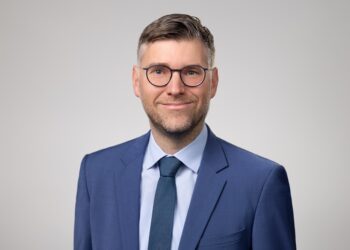
VDMA president Bertram Kawlath recently rounded on red tape as part of what is currently ailing Germany’s export-oriented machinery and construction equipment manufacturers. The sector is operating to only 75 per cent of production capacity, but there is some hope on the horizon. In the first half of this year, orders received increased by 2 percent in real terms, said Kawlath, speaking during a press conference at the 15th German Mechanical Engineering Summit in Berlin.
Wars, both trade and military, as well as political paralysis and uncertain investors have left a significant mark on the German sector. All of this is reflected in the current economic situation and the outlook for the industry.
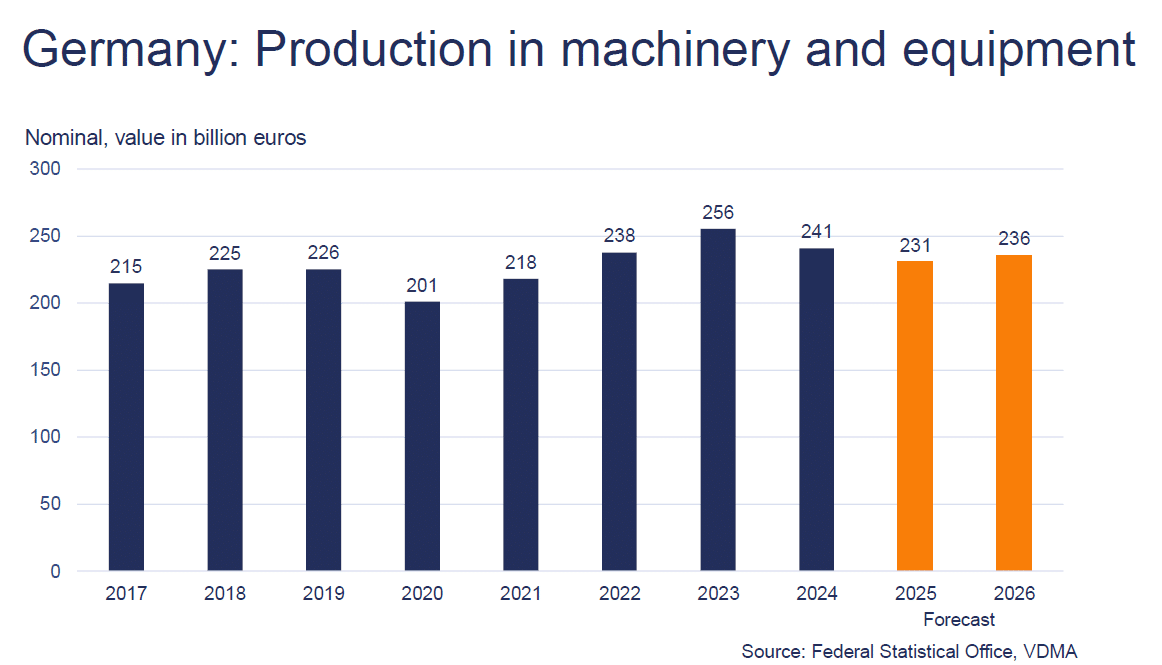
In the first half of the year, real production output in machinery and equipment manufacturing in Germany fell by 4.5 percent compared to the previous year. This momentum has recently intensified. The decline in the second quarter of 2025 reached 4.9 percent, which was greater than in the first quarter.
“At least there are initial glimmers of hope in order intake,” said Kawlath. “From January to July inclusive, orders received increased by 2 percent in real terms.”
However, technical capacity use in July was only 77.6 percent on average for the industry, “clearly too low”. This mean that the VDMA has revised its forecast for production this year downwards. “Previously, we had assumed a decline of 2 percent, but now we expect a decline of 5 percent for 2025,” said Kawlath.
VDMA economists expect a slight recovery in the machinery and equipment manufacturing sector in 2026, provided that the reforms announced by politicians actually take effect. “Technological innovations and advancing digitalisation offer growth potential, as does the strengthening of the European single market,” explained Kawlath.
At the conference, the VDMA and its partner McKinsey presented a study entitled “Competitiveness in a new era – success factors, trends, and approaches in European mechanical and plant engineering”. Among other things, the study describes eight success factors, ranging from operational excellence and innovation to geopolitical resilience, which will determine the future growth and profitability of companies. It also identifies six key ways with which companies can secure and expand their competitiveness – from consistent cost management and the development of new markets to the strengthening of service and after-sales business.
“The task now is to unleash the industry’s innovative power, not only in products, but also in processes and business strategies,” explained Dorothee Herring, author of the study and senior partner at McKinsey. “The key here is to focus limited resources such as capital, employee capacity and management attention. Only through relentless analysis and the determined implementation of improvements can companies strengthen their position in the long term,” she said.
The VDMA president note that the EU could also establish itself as a safe haven for investment, which would encourage increased investment in equipment – although, as a late cyclical industry, mechanical engineering would only benefit from this at a later stage. “However, there are also considerable risks,” he warned. These include a further intensification of trade conflicts, new tariffs and geopolitical escalations. Rising government debt and inflation rates, as well as the resulting higher interest rates, will keep figures down. The threat remains of the US extending punitive tariffs on steel and aluminum to other machinery products.
“In view of this difficult situation, we are currently only slightly optimistic about the coming year. We expect a price-adjusted increase in production of 1 percent for 2026,” said Kawlath.
The VDMA president made it clear that the “autumn of reforms” must focus above all on increasing the competitiveness of Germany and Europe. “Only an industrially strong Germany can secure prosperity here and in Europe,” he said.
Germany as a business location has a major cost problem. These are bureaucracy, taxes, non-wage labor costs and energy. Action must be taken everywhere and tough measures are inevitable.
“But a welfare state whose tax ratio is heading ever closer to 50 percent is not sustainable,” he warned. What is needed is a clear political agenda that shows how the economy, jobs and the welfare state are to be secured. “Call it Agenda 2030 or something else. But this course must be decided now and pursued with determination. There is no more time for long debates in committees or for coalition disputes. We need an autumn of action,” he emphasised.
A strong domestic market is essential, especially for export-oriented machinery and equipment manufacturing industry. This applies to Germany as well as to Europe. “We must make Germany and Europe more successful in international competition because the wind is blowing ever harder in our faces, even in the world’s important markets,” said Kawlath.
“China has risen to become the largest global competitor in machinery and equipment manufacturing. This is because Chinese companies have caught up enormously. But it is also because they are unfairly subsidised by the Chinese state. We ask ourselves where is the political response, where is the new federal government’s China strategy.”
This is because trade with the EU’s most important partner outside the EU, the US, is now also experiencing turbulent times. “Punitive tariffs and threats are poison for long-term investments, which play a crucial role in our [EU’s] industry in particular,” he said. The latest expansion of US tariffs is hitting European machinery industry hard. Around 40 percent of machine imports from the EU to the US are now subject to a 50 percent tariff on the metal content of the product.
Kawlath said that this leads to two serious problems for German companies. On the one hand, the list is reviewed by the US authorities every four months and can be expanded at any time. He called this situation “a ticking time bomb for our industry”. The planning security for future business that was hoped for as a result of the tariff deal has thus been effectively eliminated.
“On the other hand, the biggest challenge for our companies now is to calculate and document the metal content and trace the origin of the steel and aluminium used. For many companies, this is simply not possible because they have numerous suppliers and some of them do not provide such detailed data,” he said.
In the worst case, there is now a threat of a 200 percent tariff on the entire product. “That’s why some companies are stopping their exports, the risk is simply too high,” Kawlath said. “The European Union must make it clear to the US that our machines enable American production and exports and should therefore be exempt from punitive tariffs.”
The VDMA president therefore clearly contradicted the statement by EU Commission President Ursula von der Leyen that the tariff deal would ensure stability and predictability in trade. Overall, the economic policy impulses in the latest “State of the Union” speech were “very modest,” he added. “The EU Commission is strengthening trade policy, which is a very positive approach. But now the EU must also implement its agenda and, above all, finally bring the Mercosur agreement into force,” Kawlath demanded. Further agreements, for example with India, must also follow quickly.
Von der Leyen’s announcement of a roadmap for completing the single market and continuing the simplification agenda should be viewed positively, added the VDMA president. “But here, too, the various omnibuses must reach their destination without taking on too much ballast along the way,” Kawlath warned. “If the EU Parliament undoes the announced simplifications and deregulation, the promise to make Europe more competitive will remain nothing more than lip service.”
It is not only politicians who are called upon to strengthen the competitiveness of the location -companies also have a responsibility in this regard. They are required to secure their competitiveness for the coming years through their own measures. This means putting established business models and value chains to the test and making them fit for a world in which digitalization and artificial intelligence in particular are playing an increasingly important role.
The machinery and equipment manufacturing industry needs a strong Europe and, therefore, strong European representation of its interests by powerful industry associations. With more than 400 member companies outside Germany, the VDMA is the most important voice of the European mechanical and plant engineering industry and wants to make this even more visible to the outside world in the future. To this end, the general assembly decided last October to change the name: The addition “Verband Deutscher Maschinen- und Anlagenbau” was removed and the association has since been officially known as VDMA e.V.
“We are confident in adding that we are Europe’s largest association for machinery industry,” said Kawlath. In addition, the VDMA has adopted the slogan “Advancing Europe’s Machinery Industry” as well as a new logo and a more modern image. “All of this stands for the European strength of the association and its industry, which we want to continue to expand in the coming years.”
The VDMA represents 3,600 German and European companies in the mechanical and plant engineering sector. The industry stands for innovation, export orientation, and small and medium-sized enterprises. The companies employ a total of around 3 million people in the EU-27, more than 1.2 million of them in Germany alone. This makes mechanical and plant engineering the largest employer among the capital goods industries, both in the EU-27 and in Germany. It accounts for an estimated turnover of around 870 billion euros in the European Union. Around 80 percent of the machines sold in the EU originate from a manufacturing facility in the internal market.