

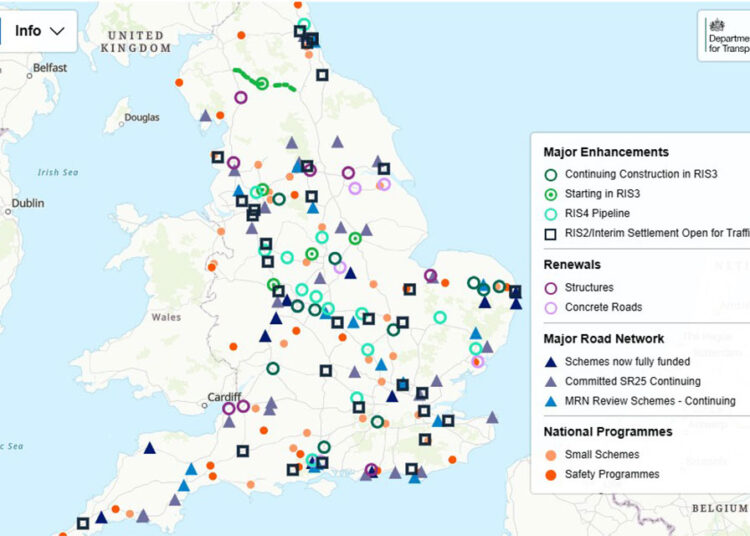
Titled the Road Investment Strategy (RIS3), the programme will target major schemes that unlock growth and improve connectivity across the country and allow National Highways (NH) to resurface over 9,000kilometres worth of motorway and major A-road lanes, almost 25% of the network.
Upgrades include the dualling of the A66 between Cumbria and North Yorkshire. There will also be government support to bring private investment into the Lower Thames Crossing, which will reduce congestion and improve connections across the South East.
A record £8.4 billion will be used for repairing and renewing England’s motorways and major A-roads before problems arise. And £7.3 billion has already pledged by government at the Spending Review for local authorities to fix potholes and invest in long-term measures to maintain local roads.
The green light is being given to a further 16 road schemes on the major road network and local roads, supporting thousands of new jobs and homes in communities across England.
The schemes, including bypasses and junction improvements that local authorities could not deliver alone, have been chosen on their value for money and long-term deliverability, ensuring taxpayers’ money goes into projects that will deliver growth for left behind communities.
Transport Secretary, Heidi Alexander, said: “For too long this country has failed to tackle and fix our crumbling infrastructure, but this huge £27 billion investment in our roads will secure the future of our road network for years to come. Not only are we investing in renewing our roads, meaning smoother and faster journeys for drivers, we are getting on with investing into brand new projects and fixing potholes, which will deliver benefits across the country from Norwich to Manchester.”
Roads and Buses Minister, Simon Lightwood, said: “This government is firmly putting its money where its mouth is, and this new funding will be transformational for the millions of drivers and thousands of businesses that rely on our motorways and A roads every day. By investing in existing infrastructure and new schemes, such as the Lower Thames Crossing and long-awaited dualling of the A66, we are giving everyone the confidence they can get from A to B faster and smoother than ever before.”
National Highways Executive Director Elliot Shaw said: “This major investment will help boost economic growth by improving and maintaining motorways and major A roads which keep the country moving. When roads are well maintained, businesses and communities feel the benefit, so this funding enables us to tackle an ageing network head-on and keep drivers safe.”
The £27 billion investment supports the government’s central mission of kickstarting economic growth, giving businesses and regions the long-term certainty they need to invest and create jobs. Improved road reliability will also help keep supply chains moving and support the freight networks that keep goods and prices stable for consumers.
RIS3 sets stretching targets for National Highways on safety, journey reliability, network condition and environmental performance, allowing the government to hold them to account on delivery over the 5-year period. While the government has committed to tackling potholes on motorway and major A-road surfaces, it also recently committed to investing over £7 billion over the next four years to help councils tackle their potholes.
Karl Horton, data services director at BCIS, said: “The £27 billion commitment under Road Investment Strategy 3 is a significant and reassuring signal from the government at a time of heightened geopolitical uncertainty. With pressure on interest rates and investor confidence potentially mounting, long-term public investment of this scale provides much-needed stability for the infrastructure pipeline.”
BCIS forecasts point to robust growth in the infrastructure sector over the next five years, underpinned by major transport and energy programmes. But attracting private finance remains challenging in the current climate. Clear, sustained public sector commitments, particularly to essential assets like the strategic road networks, is one of the most effective ways to mobilise private investment and maintain momentum across the sector.
David Giles, Chair of the Asphalt Industry Alliance (AIA) said: “The Government’s commitment to another five-year funding package for the strategic road network (SRN) is great news for users of England’s motorways and major A roads.
“RIS3 continues to provide National Highways, which manages the SRN, with sustained and targeted investment supported by a long-term funding horizon, allowing it to implement a planned, proactive approach to the maintenance of this infrastructure – exactly what we’ve been calling for local roads.
“In her Ministerial Foreword, Secretary of State for Transport, the Rt Hon Heidi Alexander MP, said: ‘By investing in the SRN, we will reduce regional inequalities, ensuring that all parts of the UK benefit from free running, safer and more reliable road travel.’ I think most road users would agree that achieving the same ambition on our local road network – which makes up more than 97% of roads in England – is a very, very long way off.
“RIS3 sets out a target of maintaining the SRN so that at least 96.2% is in good condition; a target that National Highways is able to meet, in part, due to structure of its funding. In contrast our recent Annual Local Authority Road Maintenance (ALARM) survey reported that only 52% of local roads in England are in good structural condition – the legacy of decades of underfunding and short-term cash injections.
“The Government’s pledge to allocate £7.3 billion over the next four years to local roads is an important step forward. However, it will be some time before the impact of increased funding levels, if fully delivered, will be noticed by the public. However, the dial could be moved quicker if the Government’s commitment to additional funding was frontloaded, rather than ramping up in the years to 2030.
Ian Spellacey, Market Director Strategic Highways at global engineering and project managment company AtkinsRéalis said: He said: “We welcome the publication of the Roads Investment Strategy today and the certainty that it provides to organisations across the sector. More funding for renewals and improvement will improve England’s strategic roads network and support economic growth around the country. It is particularly positive to see investment into major projects, where it will help to de-risk early-stage investment and bring forward private finance to support the scale and breadth of renewal mapped out over the next five years and beyond.
“We look forward to supporting and working with our National Highways colleagues and delivery partners through RIS3 and beyond to develop truly sustainable solutions to today’s infrastructure and mobility challenges and improve connectivity across the country.”