
Skanska is the lead contractor for the project, which will provide an important link between the M1 and M11 motorways and is intended to bring benefits to road users. A great deal of the construction work for the scheme is focused around the A428 between St Neots and Caxton Gibbet. This is the only stretch of single carriageway between the M1, near Milton Keynes, and Cambridge. It forms a key link between the M1 and the M11, connecting Bedford, St Neots, Cambridge and Cambourne.
The improvements are required as around 25,000 vehicle/days travel between Cambridge Road and Caxton Gibbet. With local housing and job growth expected, traffic is predicted to grow to around 35,000 vehicles/day by 2040. People that use the A428 regularly experience congestion and delays, especially during rush hour. The situation is made worse by the lack of alternative routes. Amongst the improvements the scheme will aim to deliver includes providing quicker, safer and more reliable journeys. When operational the improved link will cut journey times by more than a third at peak times.
The new dual carriageway will increase capacity, reliability and safety on the road network. It will also cut congestion on the existing road, removing the temptation for drivers to use local roads to avoid delays. When complete, it is hoped that there will be up to 4,000 fewer cars/day on local roads.
As well as improving journey times and the lives of the local inhabitants, the scheme aims to deliver a host of environmental benefits. The scheme also has a goal of maintaining biodiversity whilst improving air quality, and at the same time, reducing noise for the local communities. Furthermore, key features of the scheme also aim to improve travel for walkers, cyclists and horse riders, with safe crossing points and reconnections for disrupted rights of way.
A major feature of the scheme will be a new three tier junction located at the Black Cat roundabout near Bedford which links the A1 with the A421 and the A428. This will allow traffic to flow freely on to the A1 by travelling under the junction, and on the new dual carriageway over the junction. Following construction of the 16km dual carriageway between the Black Cat junction and the Caxton Gibbet roundabout near Cambourne, the existing A428 will become a local road serving communities between St Neots and Caxton Gibbet.
New junctions will also be located at Caxton Gibbet and Cambridge Road which will connect the new dual carriageway to the existing A428. A new Roxton Road link to connect Wyboston and Chawston will see new bridges crossing over the new dual carriageway at Roxton Road, Barford Road and Toseland Road. New bridges are also planned over the River Great Ouse and East Coast Main Line railway.
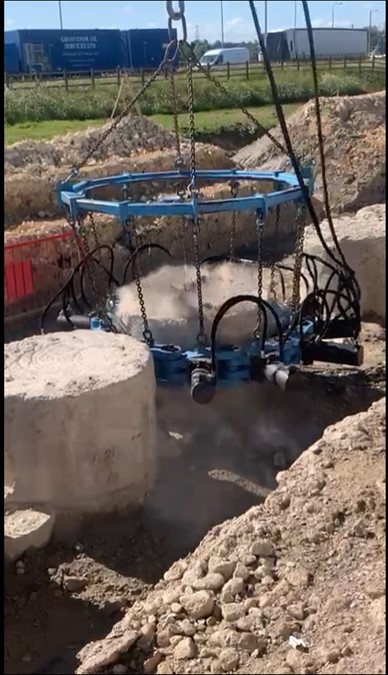
The project required a manufacturer and service provider of hydraulic pile croppers which could provide the right equipment and have the necessary know-how and customer support. “There were many thousands of 1,300mm diameter secant piles that needed cropping, and the cropping had to be done to exacting and demanding deadlines which cannot be missed. This meant that not only that we had to supply the hydraulic pile croppers but also ensure that the croppers were supported in the field to the exacting standards required by the contractors,” explained National Pile Croppers director Lee Aston.
In order to provide the best solution, National Pile Croppers used 12.5 heavy duty CFA links. These are a linked modular cropper which can be adjusted to suit required pile sizes. By using the National Pile Croppers provided lifting frame, the cropping benefits from minimal restriction. It is also a flexible solution as the CFA Cropper can adjusted to suit different pile sizes on site, with adjustments of 100mm at a time being achieved easily by adding a half link without any hydraulic interference.