
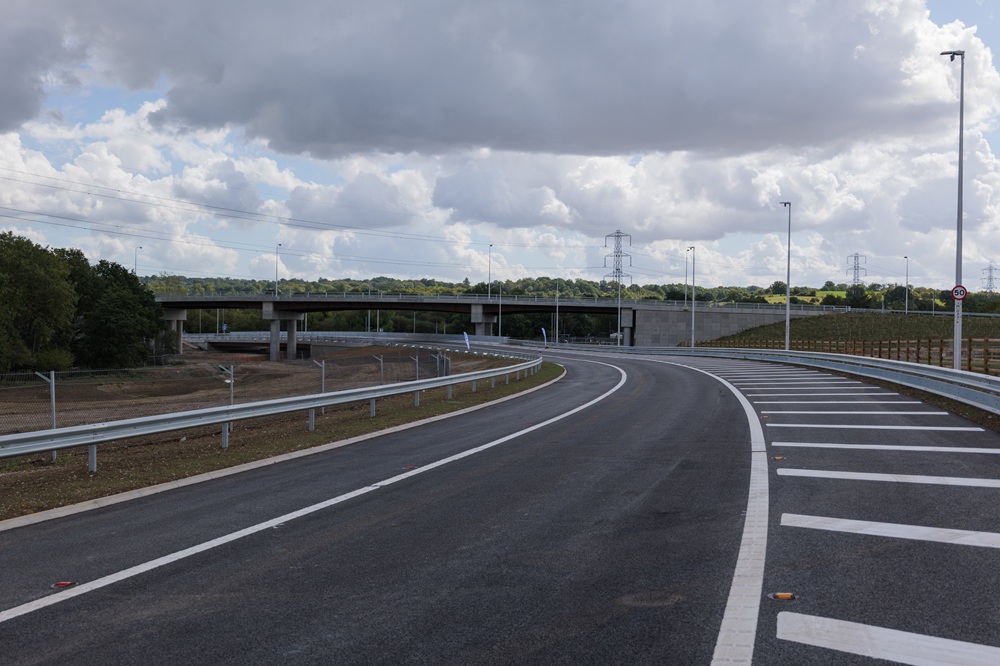
The project to upgrade a key stretch of the UK’s busy M25 motorway is nearing completion. National Highways started work on this stretch in 2022 to increase capacity, reduce congestion and improve safety for drivers at Junction 28, which connects London with Essex. The work will also boost capacity for the area, ahead of the construction of the planned Lower Thames Crossing link.
Graham Construction has handled the contract for €146 million upgrade of Junction 28, connecting the M25 with the A12 to the North-East of London. The Junction 28 scheme has been a complex construction project that has involved installing several bridges and gantries and realigning the existing slip roads. It has also seen a new two-lane loop road built for traffic travelling from the M25 onto the A12 eastbound towards Brentwood. Road markings have been added and engineers are now in the process of testing technology and adding the finishing touches to the loop road before it can open for public use in the coming weeks.
Zachary Pepper, National Highways Project Manager, said:“We are delighted to have reached the final stage of the M25 Junction 28 scheme, which will improve safety and support faster and more reliable journeys. We are hugely grateful to the local community for their patience while we have developed this project and have made sure we are providing benefits beyond just road journeys through our wide-ranging social value work. This includes marking the incredible history of this site, which I know is treasured by many both locally and further afield.”
Hugh McNally, GRAHAM Project Manager, added: “Reaching the final stages of the M25 Junction 28 upgrade marks a significant milestone for our team. From the construction of the new two-lane loop road to the installation of bridges, gantries, and the realignment of slip roads, every element of this scheme has required meticulous planning, technical expertise, and close collaboration. Enhancing one of the UK’s busiest junctions while minimising disruption has been no small feat, and we’re incredibly proud of the improvements made to traffic flow and safety.”
As the project has progressed, new light has also been shed on Maylands aerodrome, which previously sat on the site of the junction before it was destroyed by fire in 1940. Maylands was once home to Hillman’s Airways, a pioneer of air taxi work and package holidays that later became part of British Airways. Archaeologists digging on the site as part of the National Highways project uncovered a host of artefacts from the aerodrome’s heyday, including glass bottles, lapel badges and remnants from the hangar fire. Pioneering pilot Amy Johnson, the first woman to fly solo from England to Australia, also used the site regularly.