Some ways of deterring and detecting wrong-way driving are better than others. Recent pilot programmes by California’s department of transportation – Caltrans – and a university research centre highlight two effective measures that have been taken on board by the US state. The pilot was developed following 10 wrong-way driver related collisions on freeways around the cities of Sacramento and San Diego in the first six months of 2015. Caltrans engaged the University of California’s Davis Advanced Highway Maintenance and Construction Technology (AHMCT) Research Center to gather data on the rare but often deadly wrong-way driving collisions.
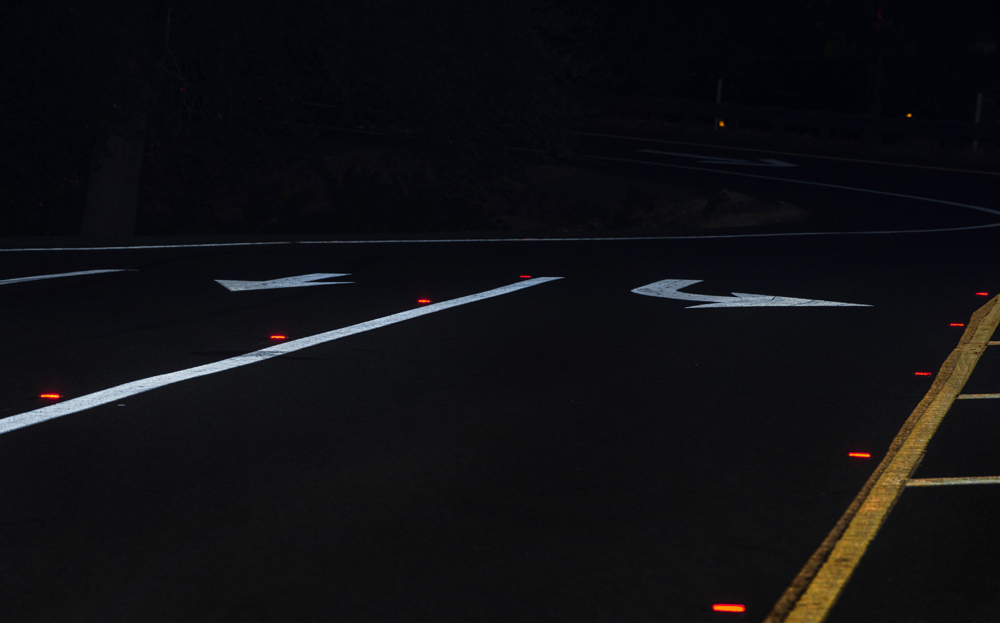
One of the prevention measures included in the three-year pilot programme was reflectors that alert drivers entering the roadway in the wrong direction. In the city of San Diego, the number of wrong-way drivers decreased by 44% after reflectors were installed.
“Adding the two-way reflective markers proved to be so effective that Caltrans updated its state-wide design standards,” said Toks Omishakin, Caltrans director. On this basis the reflective markers have been installed on hundreds of miles of highways.
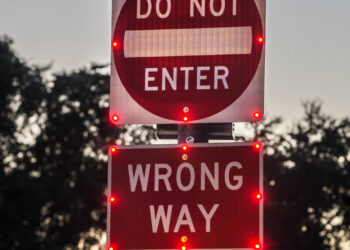
During the study, Caltrans installed and tested different ways to deter wrong-way drivers along exit ramps in San Diego as well as the city of Sacramento. Among the systems were two-way reflective pavement markers that show white or yellow to right-way drivers and red to wrong-way drivers. Also, “Wrong-way” signs were placed at the off-ramp.
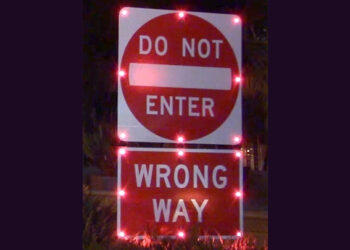
Meanwhile, “Do Not Enter” signs were equipped with LED lights flashing 24 hours a day. Active monitoring systems that use radar to detect wrong-way drivers were set up. The systems activate a secondary set of LED signs when a wrong-way driver enters the ramp. It sends real-time alerts and photos to Caltrans and the California Highway Patrol.
Caltrans monitored the exit ramps throughout the pilot and learned the two-way reflective pavement markers were an effective measure against wrong-way drivers. The department is installing them as it performs maintenance or repaving. The flashing LED signs showed promise at preventing wrong-way collisions. Caltrans said it will continue to monitor their impact to determine whether to expand use at exit ramps across the state.
Driving behaviour
During the pilot programme, UC Davis AHMCT researchers conducted a second study using a Vision-Based Site Monitoring (VBSM) system in Sacramento to better understand the actions that lead to wrong-way driving incidents.
“Our hypothesis was that some of the causes of wrong-way driving start before a driver enters the ramp,” said Ty Lasky, a researcher and AHMCT co-director, who helped lead the study. “In order to test this, we wanted to extend our field of view to capture as much of the roadway around the exit ramp as possible.”
The VBSM system consisted of a camera, analytical software, solar panels and a modem mounted on poles near exit ramps. The system recorded video when the camera detected a wrong-way driver. This allowed the team to study a vehicle’s path before, during and after a wrong-way driving incident.
“The video gave us a more comprehensive understanding of driver behaviour and factors that contribute to wrong-way driving,” said Bahram Ravani, UC Davis Distinguished Professor and AHMCT co-director. “This opens the door for further deployment of our system across the state.”
Rare
Wrong-way collisions on divided highways in California account for about 1% of all crashes on state highways. However, on average, 37 people are killed in wrong-way collisions each year. Most of these incidents are caused by severely impaired drivers and occur in the left-hand lane for vehicles travelling in the correct direction.
“Wrong-way crashes do not happen very often but when they do, they are typically head-on crashes, resulting in death or severe injuries,” said Warren Stanley, commissioner with the California State Patrol. “Information obtained through this pilot program is being used to help prevent these crashes and save lives on California roadways.”
“Seeing someone driving in the wrong direction is a scary sight and a clear danger to other road users,” said Barbara Rooney, director at the Office of Traffic Safety, a state agency that annually funds over US$80 million in innovative, evidence-based education, enforcement programmess and technologies to make California’s roadways safer. “Maintaining safe driving behaviour is critical in preventing crashes that have tragic consequences.”
The Advanced Highway Maintenance and Construction Technology Research Center is part of the UC Davis Department of Mechanical and Aerospace Engineering. The centre develops and tests new and advanced technologies to improve the safety, reliability and efficiency of highway maintenance and construction tasks. n
• The two reports by Caltrans and the UC Davis centre can be downloaded free from the Caltrans website: https://dot.ca.gov/programs/traffic-operations/wrong-way