The paving industry is in the midst of transformation, moving beyond incremental gains in efficiency to full-scale precision driven by integrated digital workflows. Leveraging technology to maximise output and quality has become paramount as global pressure mounts to maintain existing road networks in the face of budget constraints.
This transformation centres on how civil-construction solutions connect the entire project lifecycle – from the earliest days of bidding through final-project verification – to deliver verifiable, millimetre-level paving accuracy.
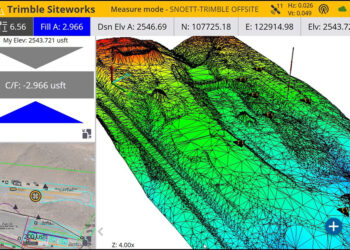
Connected workflows eliminate typical bottlenecks such as the spreadsheet-driven process that connects estimating to field operations. Instead, construction software creates a direct data flow from bid to blueprint and on to field execution and project completion. The data bridges the gap between design, pre-construction and field execution. This establishes a single source of truth that provides field crews with up-to-date design information and site conditions in real time. Project teams can verify volumes and confirm surfaces to meet tolerance specifications.
This digital-verification loop transitions quality control from a reactive, post-construction testing approach to a proactive methodology where crews adjust operations based on quantifiable data.
Accuracy and surface symmetry
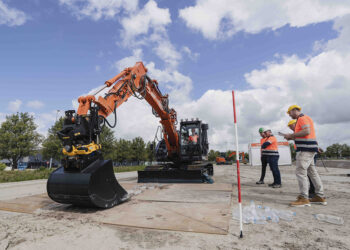
Central to the field execution phase is implementation of 3D machine control which has fundamentally reshaped conventional paving and grading. Solutions designed for civil specialty construction enable contractors to achieve surfaces that meet or exceed stringent requirements, such as those guided by the IRI (International Roughness Index).
Key components for achieving this precision include:
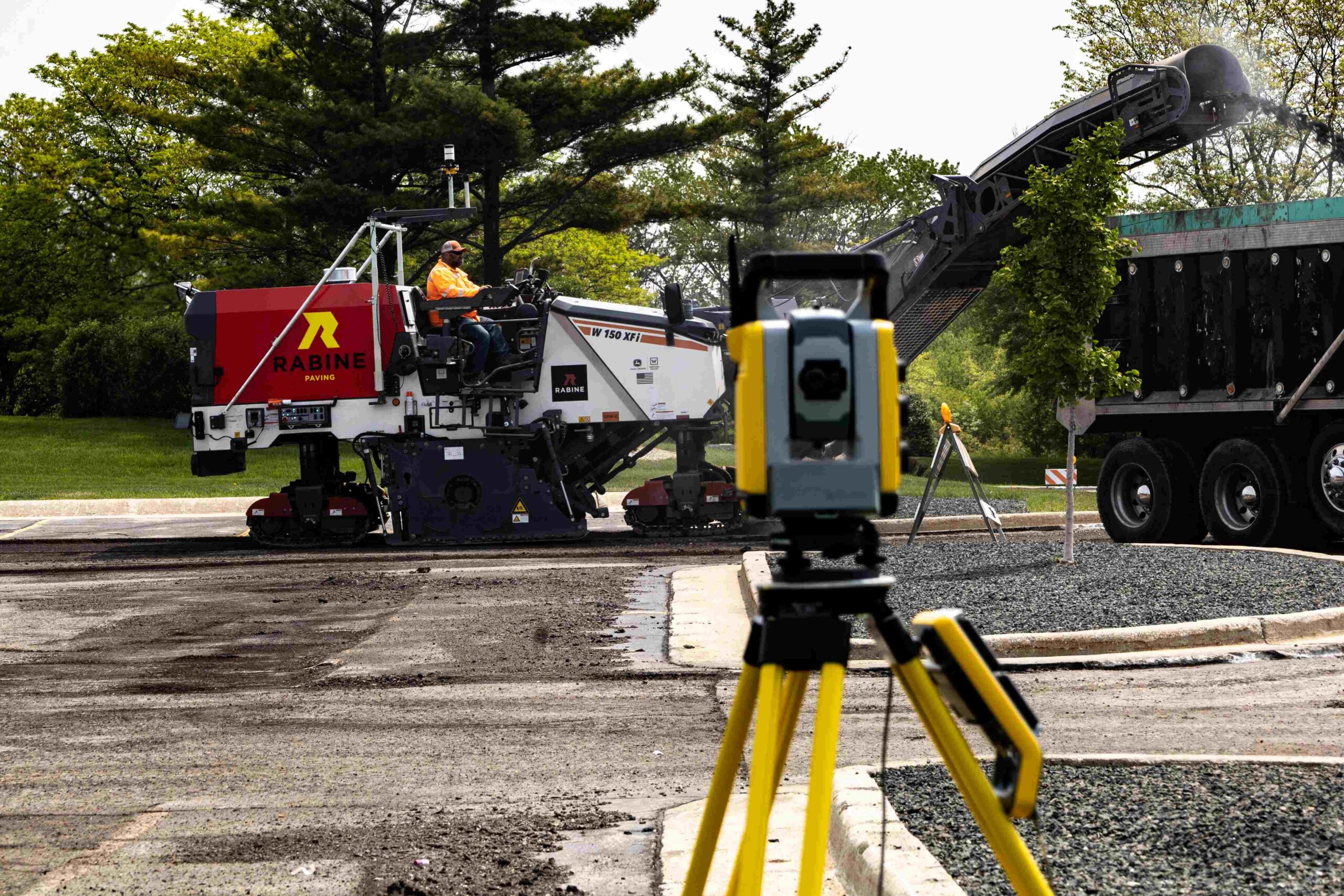
● Universal total stations (UTS): Systems using a UTS can achieve high-precision measurements, accurate to around +/- 3mm horizontally and +/-1mm vertically. The instrument acts as a survey tool and machine-control guide.
● 3D modelling guidance: Motor graders and milling machines with 3D guidance know exactly where they are and what they are cutting. This technology drives execution, analyses the amount of material to lay and provides seamless guidance for the operator.
● Eliminating obstacles: A practical benefit is the elimination of traditional survey stakes and string lines, making the jobsite safer.
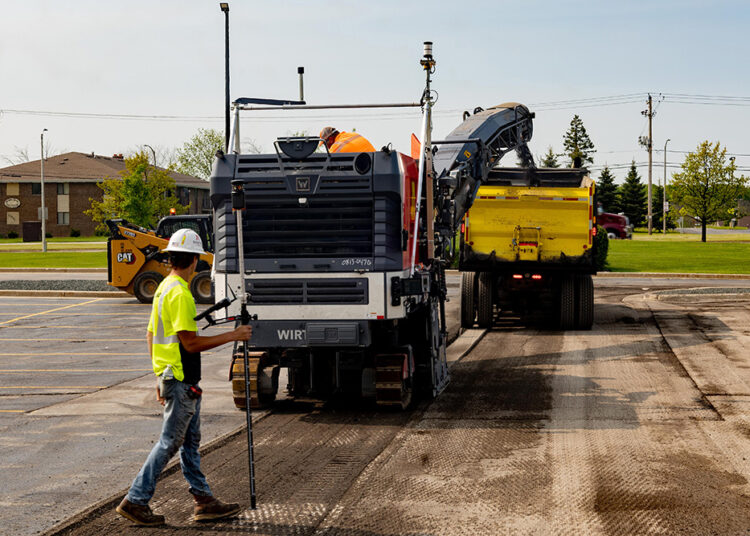
Rabine Paving
Rabine Paving is a full-service pavement maintenance, design, construction and construction-management firm. It specialises in large, commercial and industrial parking-lot and utility-restoration projects. Rabine adopted a paving-control platform for its mills and cold planers.
“When it comes to pavement restoration, surface smoothness, drainage and ADA adaptations are the primary challenge,” says Kyle Miller, director of operations at Rabine. “We have great operators who are able to adjust to these complexities and deliver optimal results, but we’re always looking to give them every advantage.”
A visual display of the 3D design shows the operator a comparison of the actual drum position and slope against the ideal grade. The system then automatically guides the milling drum to cut the defined depth and slope without the need for manual adjustments or string lines. A parking lot with complex slopes and a roundabout proved the system’s ability because the software automatically and quickly adjusted to the required radius. Automation allows the operator to focus on critical decisions. One operator noted the 3D mill technology allowed him to complete the job with increased speed and accuracy.
The 3D milling workflow is straightforward: data collected from the site (edges, curves, basins) is used to create 3D milling plans. This allows for in-field decisions and the ability to verify that it has slopes that are ADA-compliant (Americans with Disabilities Act) ahead of production. This investment ensures smooth profiles with minimal waste – even in the most complicated lots.
Jorge Chávez Airport
A new 270,000m² modern passenger terminal at the Jorge Chávez International Airport in Lima, Peru, required placing 70,000m³ of concrete and asphalt for the airside airplane-parking areas around the terminal. “One of the main concerns was synchronising design data and information flow between the field and office,” says Carlos Ruiz Miranda, chief surveyor with SACYR, a construction company based in Spain.
Implementing a cloud-based common data environment (CDE), Ruiz created a centralised collaboration platform. Design data moved automatically from development of a building information model (BIM) through remote data-transfer software to machine-guidance files on graders and pavers. Real-time field data flowed back through jobsite productivity-tracking software, creating predictive capabilities that optimised resource allocation. The team used machine control for base and subbase layers, paving 1cm accuracy, well below the 1.8cm requirements. This integrated workflow achieved zero non-conformities from the client.
Buck Brothers
Buck Brothers, based in Toledo in the US state of Ohio, struggled with manual methods for fine grading stone base, calling it “guess-and-check”. However, they implemented a workflow using a UTS and 3D modelling software. On a 100,000-square-foot parking-lot reconstruction, the crew regraded the area to a precision of 1/16. The finished surface, working directly from as-built conditions, ensures drainage and transitions are exactly right.
In just two months, the company was able to fine grade more than 300,000 square feet of stone base, cutting preparation time in half. Knowing everything paved is at the right thickness and will drain correctly means greater materials efficiency.
Precision achieved through connected workflows delivers multiple downstream benefits. For example, using a 3D modelling workflow ensures contractors are not “over on asphalt”. The precision maximises material yield and prevents overuse. Leading contractors track a 10-20% material-waste reduction. The system can be used for subgrade or finished grade to guarantee yield and help manage costs.
Another benefit is through proactive risk prevention. 3D machine guidance keeps surveyors and crews away from active equipment and live traffic. Thanks to digital ticketing platforms, field personnel no longer approach trucks to collect paper tickets, thus reducing close-quarter interactions in high-risk areas. Furthermore, eliminating traditional string lines removes a significant tripping risk.
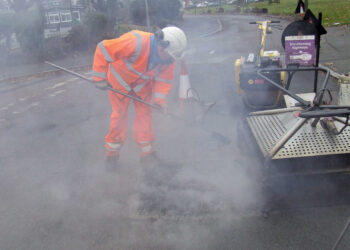
Precision placement means getting the work right, first time. For ongoing quality control, infrared camera technology on pavers monitors mat temperature to ensure material is within the correct temperature window for compaction. These advances boost efficiency. They also offset the skilled labour shortage by automating repetitive tasks and allowing operators to focus on critical, judgement-based decisions. Contractors also note the use of 3D technology as an important element in workforce development, helping bring new or less experienced operators up to speed more quickly and thus attracting new talent who wish to work with the latest technology.
Competitive asset
For Rabine, the commitment to 3D milling solutions represents not only a road to efficiency, but an important element in the contractor’s workforce development. Miller stated that technology allows the company to be more competitive because of increased production.
Beyond the immediate execution phase, 3D milling provides detailed, as-built conditions data. This data provides lasting value, especially considering that the company earns much of its work from repeat customers. If Rabine has milled a particular site in the past, they already have a surface file that they can reference. This practice of using completed survey models and as-built data to inform more accurate future estimates is a core benefit of digital transformation.

Miller also sees investment in paving-control technology as a key step toward Rabine expanding its services, particularly into new construction. The value of the solution extends beyond the mill, with Miller envisioning its use for subgrade or finished grade as a way to guarantee yield and improve quality.
*Kevin Garcia is general manager of civil specialty solutions at Trimble where he leads innovation for road-construction applications. He has extensive experience in machine control, digital workflows and construction automation. Garcia works directly with contractors and departments of transport to implement safety and efficiency improvements on paving projects across the globe.