Novocarbo reports that it is working with Hansa Asphalt in Germany to create a more sustainable asphalt mixture using biochar.
Novocarbo, which specialises in permanent CO₂ removal through biochar, says biochar has been successfully used in asphalt. The test provides promising insights into technical performance and lays the foundation for possible new standards in road construction.
“If we manage to turn road construction into a carbon reservoir, then a completely new perspective for the infrastructure sector will emerge,” said Caspar von Ziegner, chief executive of Novocarbo. “Biochar can not only relieve the climate, but also bring functional advantages.”
Biochar is a high-carbon, fine-grained residue that is produced via pyrolysis. Pyrolysis involves the separation of covalent bonds in organic matter by thermal decomposition within an inert environment without oxygen. It is the direct thermal decomposition of biomass in the absence of oxygen, which prevents combustion, and produces a mixture of solids (biochar), liquid (bio-oil), and gas (syngas) products.
Biochar is basically a form of charcoal, sometimes modified, that is intended for organic use, as in soil. It is the lightweight black remnants remaining after the pyrolysis of biomass, consisting of carbon and ashes.
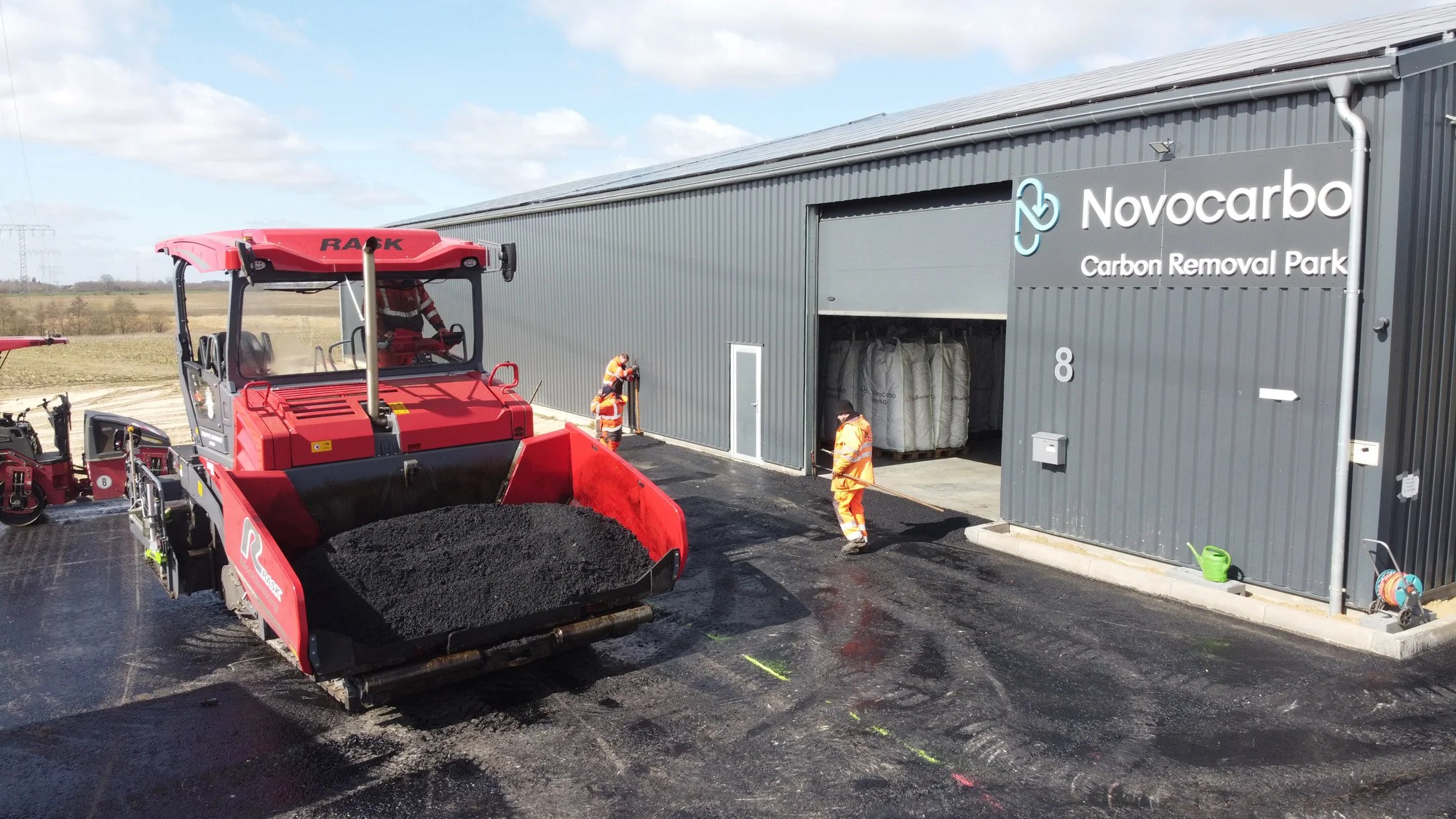
The test by Novocarbo and Hansa was carried out at the Baltic Sea Carbon Removal Park in the north-east German state of Mecklenburg-Western Pomerania. The Hamburg-based start-up Novocarbo opened the Carbon Removal Park Baltic Sea (CDR-Park Baltic Sea) in Grevesmühlen in October 2023. There, pyrolysis technology from German plant manufacturer Pyreg is used to process biogenic residues into biochar.
Fine-grained biochar (<5mm) was introduced into the surface course of a traffic route in a dosage of 3% – a total of around 7 tonnes. The results show several positive effects, including increased material efficiency. More area was covered with the same mix volume.
Also, there was a substitution of rock powder, crushed sand or, in the future, bitumen. There can be long-term carbon storage through Carbon Removal Credits.
Further work will be carried out focussing on a drill core analysis investigate the durability of the process, such as increased temperature and aging resistance, as well as resistance to rutting
Studies and initial laboratory results support the results from the field, says Novocarbo. In suitable mixtures and appropriately adapted formulations, biochar increases the viscosity of the asphalt binder.
Around 75kg of CO₂ equivalent per tonne of asphalt were permanently bound in the project – around 17.5 tonnes calculated on the entire test area. For this reason, Novocarbo generates corresponding CO₂ certificates, Carbon Removal Credits, for this quantity and certifies them by international auditors. These credits are then sold to companies to offset fossil emissions. The combination of technical function and climate impact makes biochar an interesting lever for sustainable construction projects.
A product launch is scheduled for this autumn. In parallel, Novocarbo is planning further tests and partnerships with construction companies and research institutions. “Our goal is to make a scalable contribution to climate-friendly infrastructure – in road construction and beyond,” said von Ziegner.
The global asphalt market is estimated to be worth over 370 billion US dollars by 2032. The pressure to transform towards low-carbon technologies is growing. Biochar could establish itself as a building block in the mix of sustainable building materials – provided that regulatory requirements such as compliance with PAH limit values are met. Novocarbo says it secures this through certified biochar products and close quality controls.
Novocarbo is a manufacturer and trader of biochar as well as a pioneer in the field of carbon removal. In the company’s own carbon removal parks, plant biomass is converted into biochar by pyrolysis – with the aim of permanently storing carbon and generating renewable energy at the same time. Biochar is used in construction, horticulture, landscaping and agriculture.
Hansa Asphalt, founded in 1967, is a manufacturer of high-quality asphalt mixtures. With a growing focus on sustainable blends and resource-efficient processes, the company serves customers from industry, municipalities and the construction industry.