The Fayat Group is offering a wide range of new solutions for delivering hot, warm and cold mix materials. The company’s Ermont and Marini divisions are offering continuous and batching systems respectively, while it also has binder systems from its SAE business.
The Ermont range has developed its TRX inCity, which it claims is a highly compact continuous asphalt plant capable of using a high percentage of recycled materials in the feed with a single burner. The plant offers high-quality asphalt production and can typically use up to 80% RAP in the feed for most road applications, or up to 100% for an application such as a parking area where traffic speeds will be lower and less of an issue.
Meanwhile the firm says that the TRX Highway variant can use up to 70% RAP in the feed. The TRX Highway is a versatile development uses technology from the existing TRX models but has been designed to make it easy to transport between sites, quick to commission once onsite and also speedy to move again once work is complete.
In addition, Ermont says that its new RF200 NEO₂ asphalt plant features the firm’s proven RETROFLUX technology. This unit provides a versatile, eco-friendly solution for producing high-quality asphalt at reduced costs, with key features including precise dosing and extended mixing times. This plant can use up to 50% of RAP in the feed and although it is not intended to be mobile, the modular design makes it easy and quick to assemble onsite.
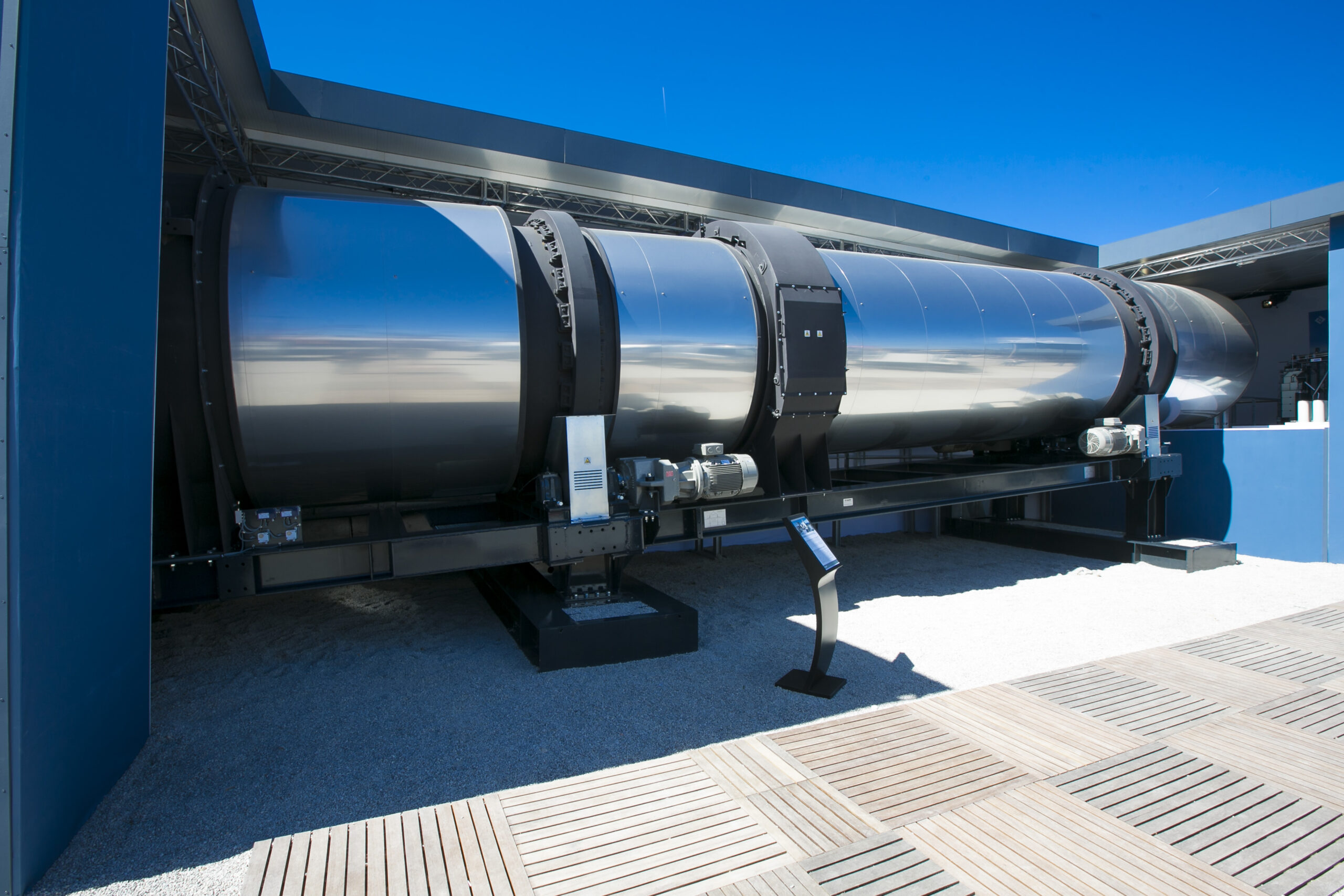
For the batch plant market, a key introduction from Marini has been its new Evodryer Plus. It is a sophisticated plant capable of handling up to 70% RAP in the feed, without compromising quality. Of note is that it is equipped with just one drum. This slots into the range between the more complex and costly parallel drum plants able to handle up to 80% RAP in the feed, and the simpler existing units featuring a single drum, which can handle up to 60% RAP in the feed. The firm says that the Evodryer Plus can use a high percentage of RAP in the feed but without the cost of maintenance or energy consumption of a twin drum plant. The key to the Evodryer Plus is the way the hot gas generator is integrated into the single drum. The firm moved the dryer from the ground to the top of the plant as this eliminates the risk of sticky RAP causing blockages in an elevator and also reduces thermal dispersion.
Meanwhile, the drum has been extended by 3m and two small burners have been added, firing the hot gas generator. This patented design heats the materials in the drum but without overheating. In addition, the discharge system features insulated hoppers to prevent sticking when there is a high percentage of RAP in the mix.
The Evodryer Plus suits medium-large production volumes with high RAP content but with just one drum, the plant is less costly to buy, has lower fuel costs and is simpler to maintain than twin drum plants.
Another asphalt plant innovation from the firm is its sophisticated control system called Marini Smart Plant, which has been developed in partnership with Bologna University. The system can be used to manage a complete operation and analyse data. Sensors are installed across the plant and the system uses these to determine optimal operation. The sensors also detect when components require maintenance, while provides operators with information on problem solving. Of note is that this control system can be installed on any make of plant.
For the binder market, the SAE eTank is said to be an eco-friendly, high-performance storage container designed to meet stringent environmental standards. This is pre-assembled for easy for ease of installation. Its containerised format allows for easy and cost-effective transportation and installation, reducing carbon footprint. The SAE Emulpack meanwhile is a versatile solution for the continuous production of high-quality road binder emulsions. It is electrically-heated and can produce up to 40tonnes/hour in continuous mode or 15tonnes/hour in batch mode.