The FAYAT Group has been a leader in the road machinery sector for many years and one area where the firm ranks amongst the pioneers is for the development of autonomous construction machinery. Both the BOMAG and Dynapac road machinery brands have been working on autonomous compactors for some time, with technological assistance for the positioning systems from Trimble.
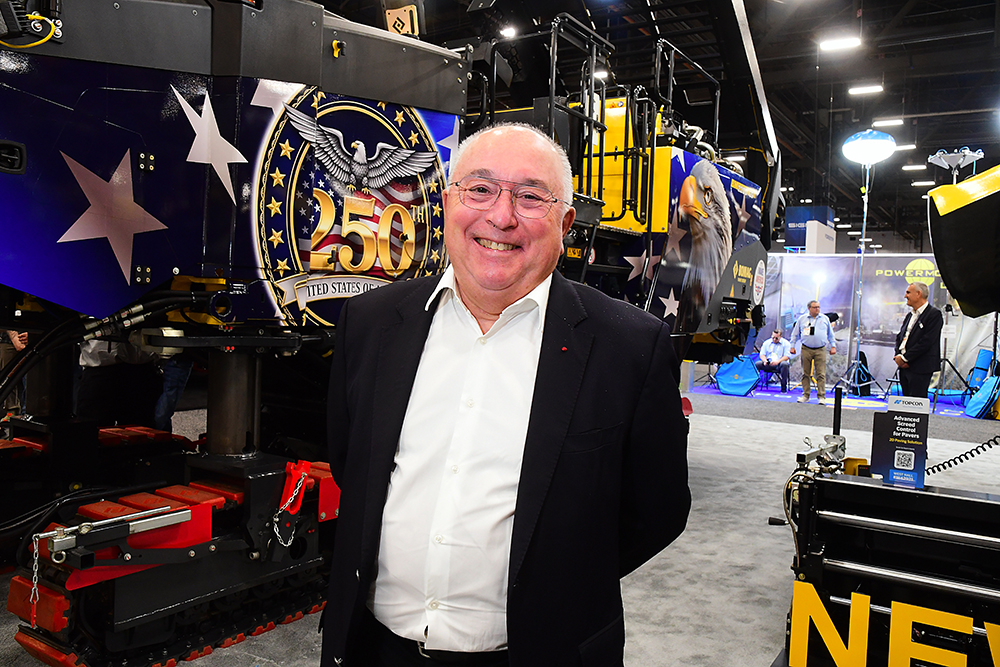
Autonomy and AI are buzzwords in the construction machinery sector at present. Jean-Claude Fayat is president of the family-owned FAYAT Group and said, “We are still at the beginning of this. I’m sure in the next years the development will go fast.”
He explained that labour shortages across the global construction are helping drive the need for greater levels of autonomy for off-highway machines. “It’s not easy to find people to drive machines.”
Fully autonomous construction machines remain far off for a number of reasons and perhaps would only suit use on specific jobsites with areas that would be closed to personnel access. But tools offering driver assistance capabilities and semi-autonomy are definitely attracting interest in the construction sector. Safety tools are particularly in demand and Fayat said, “A part of that is for detection of people.” He continued that a big French contractor Vinci has carried out analysis of incidents on construction sites involving injuries and identified that around 90% involve construction machines, often due to personnel not having been spotted by operators.
The FAYAT Group has a division that focuses on advanced technology and AI systems are helping to boost site safety. Fayat said, “AI is part of our detection system. We have a small team in the group that focuses on this.” He explained that this team works across BOMAG, Dynapac and Mecalac to provide AI and other advanced technologies for use in safety systems as well as other sophisticated tools.
Within the group, the firm has its own Fayat Innovation Challenge every two years. The most recent was in 2025, with the winners being announced at the bauma show in Munich. This time there are already 20 projects utilising AI and Fayat commented, “It’s a good motivation.”
Some of these advanced systems are already being used, such as the BOMAG AI tool that provides access to key data using a conventional smartphone.
Meanwhile, civils firm Razel-Bec, also part of the FAYAT Group, uses an AI tool to analyse tender processes. “It lets you know what information you need to comply and follow up with for the tender process.”
Electrification is another area where the FAYAT Group has been a pioneer, but market demand has so far not matched expectations. Fayat said, “We have worked a lot on that but if I see the number of machines we have sold it is low. Demand is higher for small electric machines but it is still low overall. The return on investment is not good.”
He added that while demand for electric equipment has been better in China, “Even there, electric machines are not dominant. Two years ago I was thinking take-up of electric machines would be faster but now I don’t know.”
Demand for electric machines in Europe remains still low and lower still in the US, with the exception of California where emissions requirements are stricter. Business levels are good across the group although tariffs have made importing machines to the US challenging and he said, “It’s the same for everybody.”
Although now that the ADM and LeeBoy brands are part of the FAYAT Group, the company has been able to cope with tariffs more easily than it would have otherwise. Fayat said that overall demand for construction machines is stable, “Today it’s a good market. The sales of equipment in the US are good.”