• About
  • Advertise
  • Contact
Thursday, July 16, 2026
Newsletter
Global Highways
  • News
  • Products
  • Features
  • Categories
    • Asphalt Milling, Paving & Compaction
    • Concrete Milling, Paving & Compaction
    • Connected Construction
    • Earthmoving & Soil Compaction
    • Engines, Components & Tyres
    • Finance & Funding
    • Highway & Network Management
    • Maintenance
    • Materials
    • Recycling
    • Road Markings, Barriers & Workzone Protection
    • Road Structures
  • Events
    • Events Calendar
    • CONEXPO-CON/AGG 2026
    • Intertraffic Amsterdam 2026
    • bauma 2025
  • Latest Magazine
  • Videos
No Results
View All Results
  • News
  • Products
  • Features
  • Categories
    • Asphalt Milling, Paving & Compaction
    • Concrete Milling, Paving & Compaction
    • Connected Construction
    • Earthmoving & Soil Compaction
    • Engines, Components & Tyres
    • Finance & Funding
    • Highway & Network Management
    • Maintenance
    • Materials
    • Recycling
    • Road Markings, Barriers & Workzone Protection
    • Road Structures
  • Events
    • Events Calendar
    • CONEXPO-CON/AGG 2026
    • Intertraffic Amsterdam 2026
    • bauma 2025
  • Latest Magazine
  • Videos
No Results
View All Results
Home Features Beyond warm mix

Beyond warm mix

A move to warm mix should be just one part of a much broader strategy to reduce the impact of road paving activities on climate change, says Nynas.

by Sarah Biswell
November 23, 2019
in Features
Reading Time: 3 mins read
A A
Capture.JPG

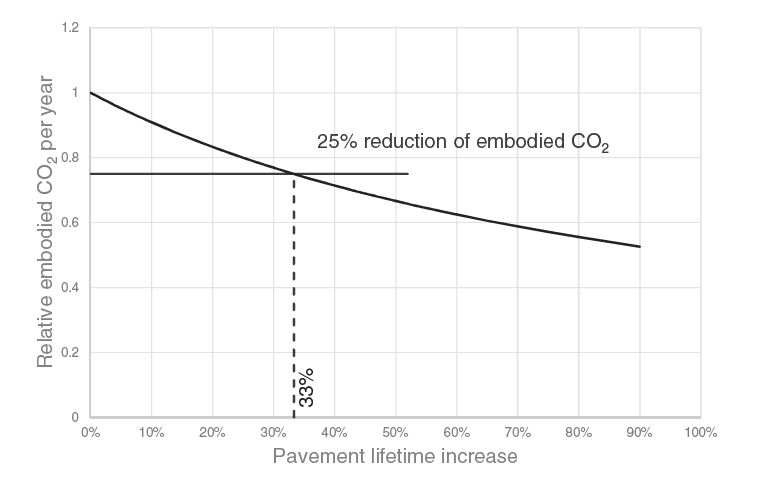
Even when using a more carbon-intensive PMB, a pavement that lasts 50% longer saves 25% in embodied Carbon. Source: Nynas]

Though reducing production temperatures is an important way to lower the industry’s carbon dioxide emissions, there is a far more obvious – and impactful – way of reducing a highway’s carbon footprint: building roads that last longer.

“The easiest environmental gain is for the contractor to use the right materials and do the right job,” said Nynas’ technical director bitumen, Carl Robertus.

Increasing a pavement’s life by one-third reduces its embodied carbon dioxide by 25%. Doubling its life leads to a halving in embodied carbon, according to Nynas. Even using polymer modified bitumen, which requires more carbon to produce than a standard one, delivers similar carbon savings (see graph).

However, ensuring that the bitumen in a mix is right for the job is not as easy as it used to be.  The rheology of bitumen has changed over the last decade, so that although a bitumen may meet the parameters defined and measured by traditional, empirical tests, its long-term behaviour may not be as good as expected.

To try and better predict long-term performance, US researchers have developed new parameters ΔTc – or Delta Tc – and the Glover-Rowe parameter to help express long-term durability and cracking behaviour.  Though more widely used in the US, where ΔTc was first referenced in 2011, there is little wider awareness of these parameters in Europe, other than among researchers.

“Some of the major asphalt contractors are now picking up on it,” said Dennis Day, technical support manager for Nynas Bitumen in the UK. “On the client side, I suspect they are not aware of it. We need to raise awareness of the new rheological characterisation of bitumen which is the only way to ensure you have good quality bitumens.”

The composition of bitumen has changed as refining processes have been updated. Advanced refining technology means that more high-value products can be extracted from a barrel of crude oil, leaving different products at the bottom of the barrel which are often blended with other products to create a bitumen that meets the standard property tests.

“Most refineries focus on producing fuel, with bitumen being only being a fraction of the total throughput,” adds Robertus. “These refineries generally maximise their economy by being flexible on the crude oil used as refinery feed. Consequently, the bitumen produced comes from a range of different oils which contributes to variations in product quality.”

According to Robertus, Nynas as a specialist bitumen producer has a different approach: “Most of Nynas’ bitumen is produced by straight run vacuum distillation from a limited number of crude oils. This brings consistency in the quality of the product.”

Nynas would like to further the industry’s understanding of parameters such as ΔTc, by analysing existing pavements. “We would like to look at certain sites that have done particularly well, or particularly poorly to analyse what has happened. We would take a sample and extract the bitumen to see how it looks in terms of the Delta Tc and the rheology,” said Robertus.

This would help increase our understanding of how the qualities of bitumen contribute to pavement lives – and carbon reduction.

Categories: Materials
Promoted Content Header
Nynas VIEW COMPANY
Bovo is chief executive of Italy-based bitumen producer Alma Petroli (image courtesy Eurobitume)
News

Eurobitume elects Sergio Bovo as president

April 24, 2026
Every tonne of bitumen delivered involves energy-intensive shipping and trucking (image courtesy Nynas)
Features

Saving when paving: a Nynas report

November 11, 2025
Swedavia was willing to deploy the lower carbon solution at Arlanda Airport because it has set itself the goal of next-zero greenhouse gas emissions by 2040 (image courtesy Kenneth Olsson)
Products

Nynas biogenic binder for Arlanda Airport

November 12, 2024
(image © Kenneth Olsson/Skanska)
Features

Bitumen trade bodies lead the carbon charge

October 18, 2024

Related Posts

One of the tasks involved flipping bottles up from the ground (Image: Hitachi Construction Machinery Europe/HCME)

Europe’s best operators get ready for the LANDCROS Operator Challenge Final

by Sarah Biswell
July 10, 2026

More than 90 of Europe's most skilled excavator operators have showcased their skills in recent months by taking part in...

Road repairs work

The importance of road maintenance

by Staff Writer
July 10, 2026

Gülay Malkoc discusses the importance of investing in road maintenance.

The new 24litre engine from DEUTZ is designed for high-load genset applications - (image: Deutz)

High power generation from Deutz

by Mike Woof
July 8, 2026

Deutz is offering a rugged new engine to suit challenging power generation installations

Join our newsletter

The mission of Global Highways is to cover the latest technologies and best practices in all areas of road, bridge and tunnel construction and maintenance, as well as their safe operation and management.

Subscribe to our newsletter

About Us

  • About Us
  • Advertise
  • Contact
  • Terms & Conditions
  • Privacy Collection Notice
  • Privacy Policy

Popular Topics

  • News
  • Features
  • Products
  • Videos
  • Events
  • CONEXPO-CON/AGG 2026
  • Intertraffic Amsterdam 2026
  • bauma 2025

© 2026 All Rights Reserved. All content published on this site is the property of Prime Creative Media. Unauthorised reproduction is prohibited

No Results
View All Results
NEWSLETTER
  • News
  • Products
  • Features
  • Categories
    • Asphalt Milling, Paving & Compaction
    • Concrete Milling, Paving & Compaction
    • Connected Construction
    • Earthmoving & Soil Compaction
    • Engines, Components & Tyres
    • Finance & Funding
    • Highway & Network Management
    • Maintenance
    • Materials
    • Recycling
    • Road Markings, Barriers & Workzone Protection
    • Road Structures
  • Events
    • Events Calendar
    • CONEXPO-CON/AGG
    • Intertraffic Amsterdam 2026
    • bauma 2022
  • Latest Magazine
  • Videos
  • About
  • Advertise
  • Contact

© 2026 All Rights Reserved. All content published on this site is the property of Prime Creative Media. Unauthorised reproduction is prohibited