Whether you are in the global Volvo Ocean Race or working on-site locally, sustainability is about attitude as much as technology. David Arminas reports.
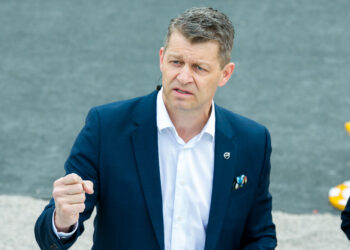
Technology, sustainability and safety. We ignore these often related themes at our peril. This was the key point made by Volvo Group chief executive Martin Lundstedt during his brief opening presentation at the start of the Building Tomorrow Conference in Spain last October.
The conference took place within the harbour of Alicante that was bustling with preparations for the start the 2017-18 edition of the Volvo Ocean Race. The public flocked into the harbour to view the line-up of seven hi-tech racing yachts.
The 83,000km round-the-world race was about to start with the yachts speeding out of Alicante Bay to start an exciting but perilous eight-month, 11-leg journey. It concludes in The Hague, Netherlands, next month.
Technological advances, from the carbon mono-hulls and onboard equipment to satellite communications, would improve each team’s chances of winning. It will also improve safety to ensure their physical survival in natural elements that few people outside sailing can fully comprehend. As in all the other editions of the race, teamwork is going to make the real difference between winning and losing the competition.
“What is the future? We are standing at a crossroads thanks to more technological change not just in the transport sector but also the infrastructure sector in general,” said Lundstedt in his presentation to invited Volvo group guests. “Challenges are immense, with increased population, increased welfare but decreased national GDP.
“We will need more infrastructure projects, more transport, more cities. But at the same time all this must be considerably more sustainable in the long run. We cannot continually use up the world’s resources, but must take more responsibility, for the future of our children and their children.”
Sustainability is not just about the environment. It also concerns social, ethical, safety and financial issues. “When all these factors are marching hand in hand, then we are succeeding,” concluded Lundstedt.
There can be no doubt about the marketing value for Volvo to sponsor the world’s premier yacht race. The world is very different now than when the event first took place as the Whitbread Round the World Race in 1973.
The natural elements remain just as brutal – even deadly. However, technologically the boats are lighter and faster and are adorned with more numerous and robust communication systems. In fact, each team has a reporter on board who is not part of the racing crew. He or she sends daily reports, often live, on the boat’s progress, including videos, photos and text messages.
But the race is also now as much about sustainability as well as winning. People are more aware of humanity’s continuing damage to the environment. Promoting sustainability is something to which Volvo has been committed for many years, explained Thomas Bitter, senior vice president for marketing and product portfolio at Volvo CE.
Volvo CE’s Swedish plant in Braas that manufactures articulated haulers has recently been independently audited as a carbon-neutral facility. It is also powered entirely by renewable energy. “It takes a lot of effort and planning but once you have done it, it’s very rewarding and brings savings,” he told World Highways. “For Volvo, as a company that carries environmental care in their brand value, we have to do this.”
Volvo has also joined the United Nations environmental campaign Clean Seas, a battle against ocean litter, and the race is promoting this with the slogan Turn the Tide on Plastic – also the name of one of the sailing teams.
Sustainability, safety and technology have featured high up in the Volvo company image for decades. The company’s car division was the first passenger vehicle manufacturer that decided safety can sell cars. While other car makers were extolling the aesthetics of their vehicles in the 1960s, Volvo was crash-testing its models as part of television commercials to show that a purchaser’s family was safe inside their product.
“It is the same for us in Volvo CE and our on-site environment. We put first the health and well-being of operators, bystanders and others on the jobsite,” said Bitter. “I think we are still in a lead position from a branding perspective. It is all part of the bigger picture of environmental care. If our sector is consuming 40% of the world’s energy then that makes environmental care a huge business for us.”
More than a driving school
Part of the Eco Operator training programme is the Volvo Advanced Training Simulator with its advanced 3-D graphics coupled with a hydraulically-controlled platform.
The operator feels precisely how the machine will react in various situations, This allows training in even the toughest environments and most stressful situations. The simulators can be used in up to 80% of completion of the basic operator training.
But Eco Operator is not a typical driving school. Rather, it is an advanced course for experienced operators. The purpose is to refine skills, knowledge and awareness of how to operate machinery more ecologically and economically while improving productivity and reducing fuel consumption. However, the programme is about more than correct machine operation and manoeuvring. It examines how to plan work in the most efficient way.
The result, according to Volvo CE, is an experienced operator who knows even more about saving fuel, increasing their – or their team’s – productivity and lowering maintenance costs.
Bitter switched from Volvo trucks to the construction equipment side in 2003 and, like many people back then, never thought the challenges facing the sector in the cause of sustainability would be so intense – big data collection, driverless vehicles, ever-increasing low emissions standards. The frustrating element for many in the sector, he believes, is that they can’t work fast enough to improve sustainability, knowing that their children’s future is at stake – he has two children: aged 17 and 20.
Improving sustainability will, like within the Volvo Ocean Race, be a team effort. Efficient use of equipment and effective use of data are only part of this sustainability equation. Equipment manufacturers, dealers, owners, machine operators and government authorities must work in cohort.
Individual manufacturers are increasingly investing in their own proprietary internet-based connectivity for machine coordination. Impressive gains are being made by the likes of Volvo CE. But this leaves contractors which operate several brands of equipment struggling to get their complete stable of machines operating together to achieve the highest efficiency gains.
Developments are hindered, he says, by a lack of accepted standards for protocols to allow branded programmes to exchange data. It could well be that some company from outside the construction industry can persuade manufacturers that a shared platform will still protect corporate competitiveness in some way.
“But I think it will come,” he says. “We have seen it before in other areas. Maybe equipment makers are not [technologically] mature enough yet or we are waiting for customers to push us in that direction. We have seen in other areas that you can standardise without giving up on competitiveness.”
Bitter is also keenly interested in operator efficiency as another element of boosting sustainability. Volvo is working with many dealers and directly with contractors to better understand how their machines are used.
SWECON, a key Swedish Volvo CE dealer, is promoting operator training. The customer pays for the training but the customer also sees immediate payback. “Working with SWECON has proven that fuel consumption goes down and the impact on the environment is less,” he says.
“Every manufacturer’s machinery has different characteristics. So if a contractor changes over to Volvo CE machinery, operators must relearn how to run the equipment efficiently. This is not just to drive Volvo’s business. We have to motivate customers which is in everybody’s best interest – financially, environmentally and socially.”
All at sea over sustainability
Barring any accidents and tragedies, the seven teams in the Volvo Ocean Race will cross the finish line in The Hague around the end of June. The 2017-18 route is, at 45,000 nautical miles – 83,000km – the longest in the race’s history.
Among the seven teams is Turn the Tide on Plastic skippered by Britain’s veteran female racer Dee Caffari and flying the United Nations flag. The campaign, backed by the Mirpuri Foundation as well as Ocean Family Foundation, is dedicated to the issue of ocean health. Caffari has a multinational, male-female squad, with the majority of her crew under 30 years of age. The Volvo Ocean Race was formerly the Whitbread Round the World Race and held every four years. In 1997-98 Volvo Group took over race sponsorship and since 2008-09 the race has been held every three years.
Teams used to design and build their own boats. But the 2014-15 race ushered in the one-design era, a 20m-long Volvo Ocean 65 mono-hull designed in the US. The Volvo Ocean 65 was the brainchild of Farr Yacht Design in the US and built by a consortium of four boatyards in the UK, Switzerland, France and Italy.
No fresh food is taken on board, so the crew lives off freeze-dried fare; they will experience temperature variations from −5 to +40 degrees Celsius and will only take one change of clothes. Safety is uppermost in the race organisers’ minds as well as the sailors’. Over the years, seven people have lost their lives directly during the race as a result of being swept overboard. In March, Britain’s John Fisher, a member of Team Sun Hung Kai/Scallywag was swept overboard in 35-knot winds and fierce seas during the Auckland, New Zealand to Itajai, Brazil leg. He was on watch and wearing appropriate survival gear when the incident occurred more than 2,200km west of Cape Horn, the southern tip of South America.
Apart from the 70cm-high aluminium and silver plate trophy weighing around 9kg, the winner receives no prize, just the prestige of overcoming what many perceive to be one of the greatest challenges in professional sport.
• Updates can be found daily on: www.volvooceanrace.com
Every machine needs the best-trained operators. “Our industry needs to ensure that operators are mastering their equipment. We all know that you can’t run a paver or grader without experience. But why so for excavators and wheeled loaders? To that end, we have developed together with our dealers the Eco Operator training programme for experienced operators,” says Bitter (see box).
The construction sector is as much about building people as it is infrastructure. “We can build the most technologically advanced machine, but if the operator doesn’t see the full potential of the machine, efficiencies will not happen. In this respect, maybe one of the biggest challenges in our industry is for our customers to attract the right personnel.”
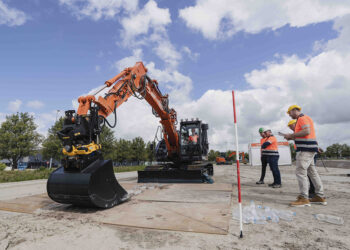
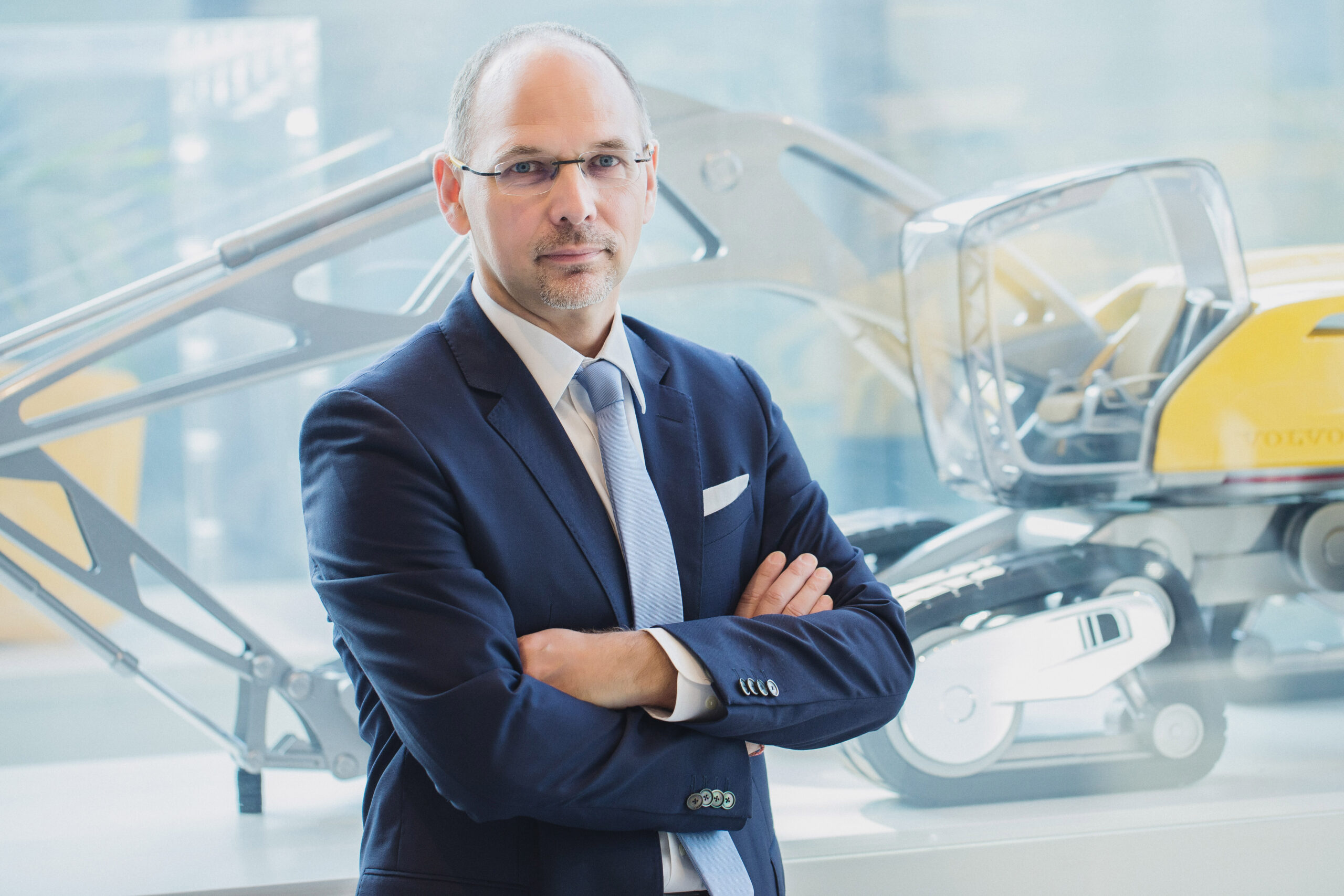
Take a look at what today’s children are doing on their mobile phones, he says. This is similar to what an operator standing outside Volvo CE’s experimental EX2 electric compact excavator is doing on his smartphone. “There is a link here. There will be a new generation of operator working in a totally different machinery environment that will help us attract the right people.”
Volvo CE is working in Sweden with Skanska to build an entirely electrified site. The target is to reduce exhaust emissions by 95% and increase productivity by 25%. The challenge for Volvo CE was to electrify crawlers, loaders and excavators. Volvo CE is on track for starting work on the site this year.
Assist functions including DigAssist is the first step and the end game is for the machines to be working alone, no operator on board. Some operator-less tests have been done with a crawler and wheeled loader. Without a driver, the productivity is up 75% compared to having a driver. But rather than lose the driver as an employee, the operator is now free to supervise two or three wheeled loaders to boost efficiencies.
The discussion about sustainability and infrastructure, however, can’t be solely among machine manufacturers, contractors and operators. They will have only some of the answers. Even with electrically driven equipment, the energy has to come from somewhere, be it a country’s national grid or from wind power on site.
With all this talk about sustainability, does Bitter consider himself an environmentalist, however that might be defined?
A pause. “No. I consider myself as somebody who has responsibility towards the next generation, my children and those of my colleagues,” he says.
“My daughter sees the planet as it is today and what it might be in 20 or 30 years,” he says. “I saw the planet what it was 30 years ago. We want to build a world that is better than the one we have. This is not just a marketing slogan.”
But given the state of the environment, it’s a tough challenge and it won’t be plain sailing.