More and more construction machinery manufacturers are now offering electric machines in their product ranges. At the recent bauma 2025 construction and quarry machine exhibition in Munich, Germany, there were many new pieces of equipment on show featuring electric rather than diesel power.
As with the automotive sector, the construction machinery firms are seeing the need to meet net-zero targets and address climate change, with electrification of machines being a key tool. A wide array of manufacturers including Ammann, Bobcat, Case, Caterpillar, Cifa, Develon, the Fayat Group, Hyundai, Komatsu, Liebherr, LiuGong, SANY, Volvo CE and the Wirtgen Group unveiled new electric machines, either in production or prototype format.
There will be demand for electric construction machines. Projects such as the UK’s Lower Thames Crossing will provide a massive opportunity for electric earthmoving equipment as the contracts from client National Highways have stipulated that no diesel machines will be allowed onsite. It remains to be seen how many other major construction infrastructure projects in Europe or elsewhere will have similar requirements.
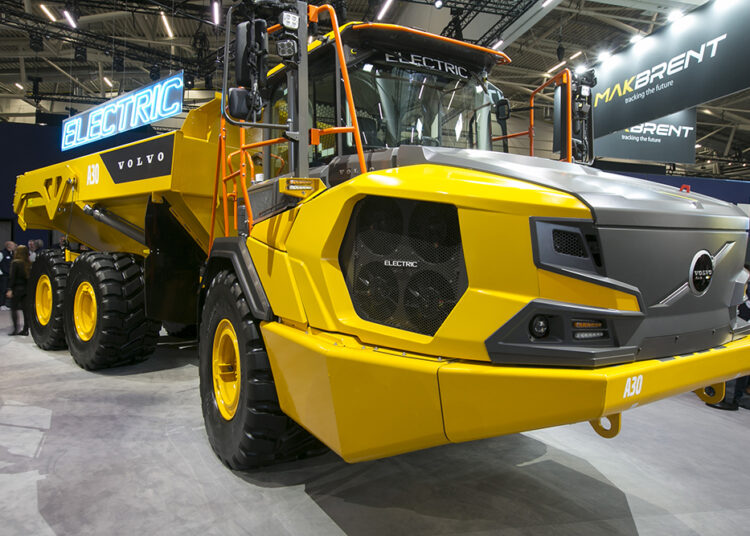
And the availability of electric wheeled loaders and excavators has become common in the compact and midi-size classes. But one of the most notable launches for the electric machine segment at bauma 2025 was for Volvo CE’s new ADT models.
These have come fresh on the heels of Volvo CE launching its new articulated hauler range. The firm says that deliveries for the new A30 and A40 battery-electric machines will commence in 2026 in selected markets, with a full roll-out of these models globally in 2027 and 2028.
The electric ADTs have a large battery that is fixed on the machine and according to Volvo Construction Equipment president, Melker Jernberg: “In a normal application, it’ll run for five hours.”
Apart from the electric motor and battery system in place of the diesel engine and fuel tank, the electric A30 and A40 retain the conventional hydraulics, driveline and axles of the diesel variants, which will allow production on the same assembly line.
According to Jernberg: “It’s possible to make a machine with electric actuators but, so far, it’s not even close for working life, efficiency or weight. I think it will come but hydraulic systems have developed enormously over the years and are fantastic.”
However, Jernberg says that take-up for these innovative electric solutions is not as quick as the Volvo Group would like. He commented “The transformation is underway slower than needed.”
He continued: “Our industry can do better and demand in the industry can do better.” And he asked, “Why don’t we demand sustainable solutions in procurement processes?”
Charging infrastructure will take time to be ready to meet the demand from consumers and Jernberg concedes that it will also take time for the market for electric construction machines to develop, “My best guess is the end of the decade maybe?”
But the Volvo Group is not being deterred. Anna Müller is president of Volvo Penta and said, “We have integrated electric solutions into different machines.” Apart from the battery-electric equipment from sister company Volvo CE, the machines include an asphalt paver, a mobile crusher and a drilling rig made by different manufacturers. She said that the firm is offering a range of modular site power solutions that can be used for recharging equipment or running site power.
Volvo CE and its sister firms Volvo Penta and Volvo Trucks are by no means the only companies looking ahead to an electric future.
The Ammann Group is investing heavily in new technologies that will help reduce the environmental impact of construction and to achieve net zero. Hans-Christian Schneider is CEO of the Ammann Group and says that electrification will assist the construction industry in delivering sustainability although he recognises that this will come at a cost to customers, with sales of electric machines remaining low at present. He said: “The break-even points are not as attractive as expected.”
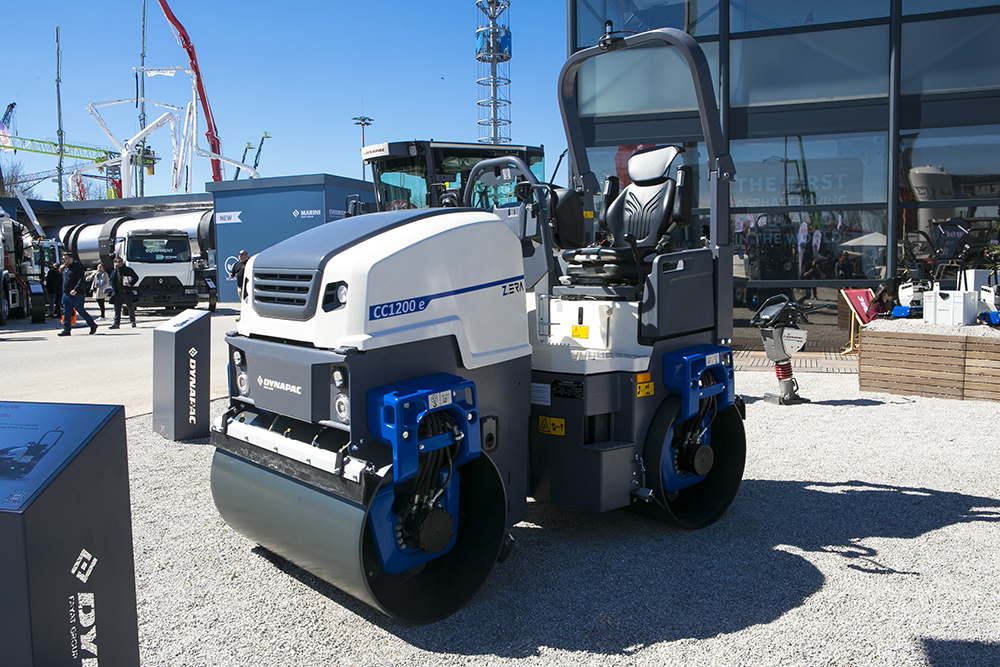
He does think that the total cost of ownership on electric machines is something customers should recognise. Customers typically keep machines in their fleets for 8-10 years. Analysing the running costs of an electric machine in comparison with a diesel unit over time reveals a benefit for the total cost of ownership with an electric unit. Schneider commented: “We’ve done the research and after 3½ years or so, the electric ones become cheaper. We did this on the small electric roller which we’ve had in the range for 1½ years now.”
Schneider said that the lower cost of electricity for recharging versus fuel costs is a key factor. He also said that with an electric machine, maintenance is considerably cheaper as there is no need to change filters or engine oil.
However, Schneider acknowledged that in Europe, for example, there is a dependency on energy and that energy is expensive. He also recognises that there are issues with the electricity grid in much of the developed West, with under-investment over many years that will hamper the more widespread use of electric machines.
Bobcat has also recognised the need to invest in low-carbon technologies and the firm has developed electric machines for its range. Product manager Robert Husar said that the firm has been working on electric drives for its telehandler models, which replace the hydrostatic drives with electric motors, increasing overall efficiency. Overall, Bobcat is developing various technologies, depending on the product type and customer usage.
He continued: “In terms of market acceptance, we know the electric machines do provide some value to customers.”
However, Bobcat’s sales of fully electric machines remain low at present, and he said, “If you look at the sales, it’s been a challenge to justify the investments.” Bobcat has recognised though that there will be an uptick in the market for battery-electric machines at some point and he added: “You have to be ready for it.”
He explained that electric equipment does have benefits in terms of safety as well as reduced working noise. However, he continued that customers do have reservations with the residual value of electric machines and due to one factor in particular: “We’re seeing a lot of changes in battery technology.”
Fuel usage of compact equipment such as mini excavators does not figure largely in the trend towards electric models for this segment, with regulations or subsidies having more of an effect on customer decisions. Husar commented that across Europe, there are now around 300 low-emission zones, most of which are in cities. But he added that there are no unified regulations on low-emissions requirements, meaning that supplying equipment to meet local demand can be a challenge.
Jean-Claude Fayat is president of the FAYAT Group and says that the firm has been investing in new technologies and that the group is now offering a number of electric machines in its portfolio. But Fayat said that these advanced electric machines are still a niche product, with a low take-up. “For me, it’s still slow. The sales are still low.”
The firm has developed electric machines to be ready for the demand when it comes but Fayat said that the high cost of the units still puts off many customers who still stick to conventional diesel equipment for the most part. This will change in time and he said, “When it comes down to 1.5x the cost of a diesel machine, electric models will sell strongly.”
Fayat said that the company can benefit from the knowledge and experience gained from China’s automotive sector, which has been encouraged to develop electric vehicles by the Chinese Government. China’s automotive sector has benefitted from some subsidies for electric vehicle R&D projects. Mass manufacturing of batteries and electric drives, as well as the crossover of this technology into the construction machinery sector, will help reduce costs and make electric construction machines more attractive to customers in the future.
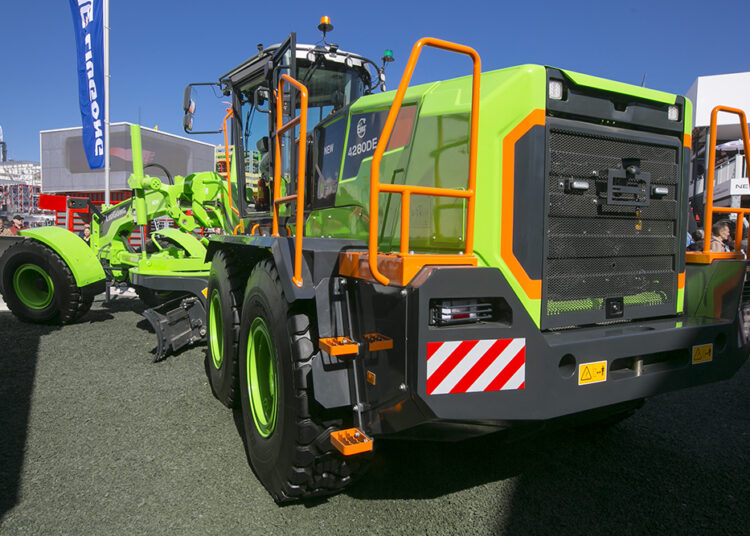
LiuGong’s chairman, Zeng Guang’an, said that the company’s commitment towards the future of battery-electric vehicles in the construction sector is exemplified by its new 4280DE motor grader, as well as the firm’s DR50CE rigid dump truck aimed at the 50tonne class. The battery-electric grader’s battery pack provides fast charging within 1.6 hours and allows normal working conditions from 6-10 hours. Meanwhile, the large-capacity lithium-iron phosphate battery is safe and durable. Its development also demonstrates how new technologies and imagination go hand in hand in today’s R&D.
For example, when the Chinese government took concrete steps to support electric-vehicle development back in 2014, he understood that this could also be done for LiuGong’s machinery.
“You need imagination, dedication, but also you need to invest in your ideas. This is most important for the long-term success of new technologies,” he said.
Apart from LiuGong’s electric grader and Volvo CE’s electric ADT, other stand-out electric machine innovations at bauma 2025 included the modular power system from ZQUIP, part of Moog Construction, and LiuGong’s electric dump truck.
ZQUIP and CASE collaborated to demonstrate how traditional diesel-hydraulic machinery can become zero-emissions machines with swappable energy modules that eliminate concerns about battery range. A CASE CX210ZQ and a CASE WX155ZQ concept excavators were on show, featuring electric-power systems from ZQUIP.
Moog engineers convert a machine by removing its diesel engine and installing a modular conversion kit containing one, two, three or more energy modules.
ZQUIP also has a newly developed hybrid module that operates as zero-emissions or hybrid, depending on the job and grid availability. The operator controls this option from the cab, significantly improving the use of a ZQUIP machine, explained Rob Bauer, engineering manager for ZQUIP.
“Our work with ZQUIP and Moog is about innovating the way job sites and construction vehicles operate for the betterment of everyone,” said Franco Invernizzi, vice president and global head of strategy at CNH CE, maker of CASE machinery. “The CX210ZQ and WX155ZQ models complement the electric offering we have available today, focused on the compact segment. The ZQUIP solution allows us to quickly expand our reach to those customers that have a need for larger, zero-emission heavy equipment.”
“We can convert virtually any make or model of diesel-hydraulic construction vehicle in the world,” said Holger Pietzsch, director of business development for ZQUIP. “Whether you’re an OEM, dealer, or construction company owner, these concept vehicles prove off-highway machines can run on swappable energy modules not unlike the way consumers power a variety of rechargeable hand tools.”
Meanwhile, a mobile charging solution, the Mobile Megawatt Charging System (MWCS) is now available from DIMAAG-EV. This can deliver extra versatility for electric construction machines. The California-based firm has developed a novel rough-terrain vehicle that can drive itself to charge electric machines when required.
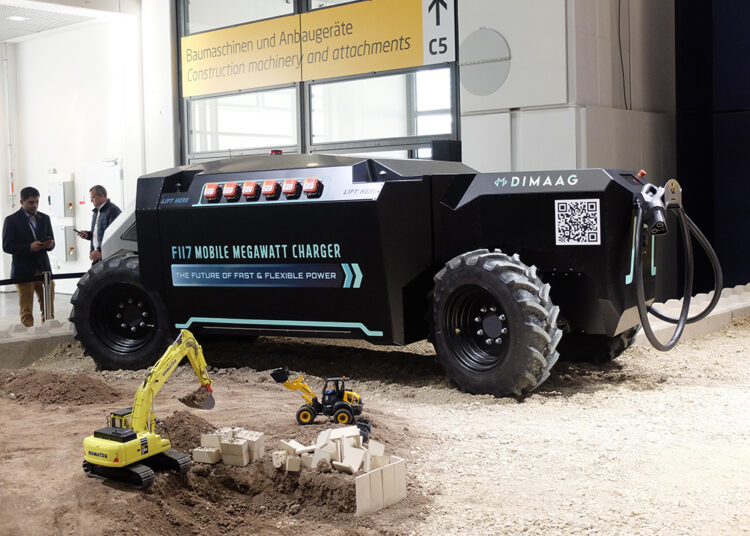
The firm says that the MWCS provides a fast, and practical way to charge off-road electric work vehicles. This brings innovative technology in high-power fast charging on a mobile vehicle, offering versatility for customers. Targeted for use with heavy machinery such as construction or quarry equipment, DIMAAG’s MWCS offers the potential to address power-supply challenges in the field.
The 4WD unit is effectively a giant booster battery on wheels according to the company. With 1MW capability, this can recharge an electric construction machine in just 15 minutes, while an operator takes a periodic break. The unit can then be recharged overnight for use again the following day.
The firm says that the unit benefits from advanced thermal-management technology that boosts safety and lifecycle to deliver improved total cost of ownership. The company also claims that its remote-controllable vehicle offers manoeuvrability and can charge multiple machines, with autonomous control available as an option.