
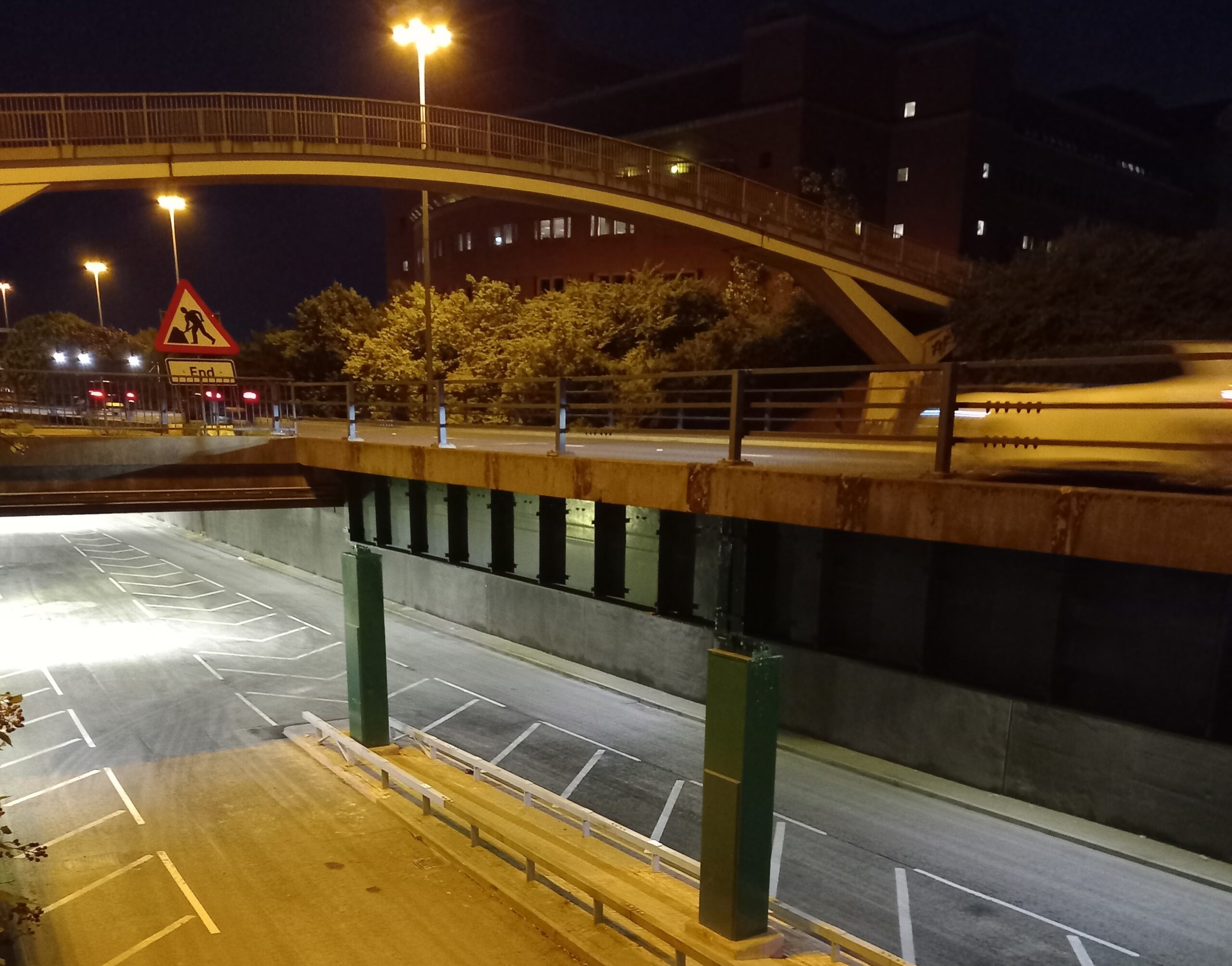
The Marsh Lane Bearing Replacement Scheme was commissioned by Leeds City Council and involved replacing 27 bridge bearings on the aging 1970s structure. This important arterial route for the city carries heavy traffic and the project followed on from similar works to the adjacent Regent Street Flyover.
Balfour Beatty was appointed by Leeds City Council to deliver the works. Speaking about the project, Daniel Barnes, project manager at Balfour Beatty said: “Due to the age of the bridge, we didn’t have any data or insight into its structural behaviour or regular levels of movement, whether caused by traffic loads, wind forces or thermal expansion. As such, a structural monitoring solution was imperative as a means of gathering this intelligence, data which was then fed into the new bearing designs– completed by Ekspan.”
Barnes continued, “It was here that we worked with Mabey Hire, whose in-house team supplied and installed a range of structural monitoring sensors to monitor the loads and longitudinal movement, with the sensors left in situ for two months to gather the valuable information needed to inform the bearing design.”
The project required the bridge deck to be lifted up by a maximum of 2mm, in order to provide access to the bearings. With 27 bearings in total, the works were carried out in eight phases, with a section of the bridge deck being jacked up and supported temporarily, while the bearings were replaced.
Working with Balfour Beatty, Mabey Hire designed, supplied and installed a temporary propping and jacking scheme, featuring its Mat 125, Mass 25 and Mass 50 props. The supplier’s hymat jacks were also supplied, installed in clusters of four.
Project teams faced challenges, including increased bearing loads beyond those considered in the original design, concentrated loads during jacking operations, and high lateral forces. As well as taking 300tonnes vertically, the propping scheme also had to satisfy transverse loads of 35tonnes. To satisfy this, Mabey Hire fabricated a cradle arrangement around the bridge columns.
With a major junction under the flyover and heavy traffic on the city ring road, teams had to consider access for the construction machinery. Keeping traffic running was a priority. As such, Mabey Hire had to design the propping scheme to take up minimal space and suit the line of the road, ensuring that it was able to be kept open to traffic.
Additional structural monitoring sensors were also fitted to monitor the movement of the bridge throughout the jacking.