The new SP 33 slipform paver from Wirtgen has demonstrated its versatility by paving a two-track farm road and kerb-gutter profiles on two Austrian projects. The work meant the SP 33 was transported from the plains of Lower Austria to the Styrian Mountains, all in the space of just one week.
The first project specified the paving of a two-track road for agricultural use in Sieghartskirchen. After this, the machine was moved to the Semmering Tunnel to pave a kerb-gutter profile.
In Sieghartskirchen, the brief specified the paving of two tracks with a width of 1m and a gap of 1m between them. The verges on both sides and the gap between them were later filled with crushed stone or gravel. To produce the two tracks of the farm road, the machine was fitted with two slipform moulds – one on the left side of the paver and one on the right.
The material was fed to the paver via the belt conveyor and a split chute that evenly filled each of the two moulds, explained Michael Stefaner, a group manager for civil engineering and road construction with construction company Habau and who worked with the contractor Bickhardt Bau on the project.
As with all slipform paving projects, precise regulation of the height, cross slope and steering also played a decisive role in the construction of the two-track farm road. This ensured production of the profiles in strict compliance with the project specifications.
On site, the machine was controlled by means of a stringline. A potential alternative would have been the use of stringless control with AutoPilot 2.0. The satellite-based control system automatically controls the height, steering and cross slope of the machine and replaces the conventional stringline with a virtual 3D model. The SP 33 also offers an option for height regulation and steering with the aid of a 3D system.
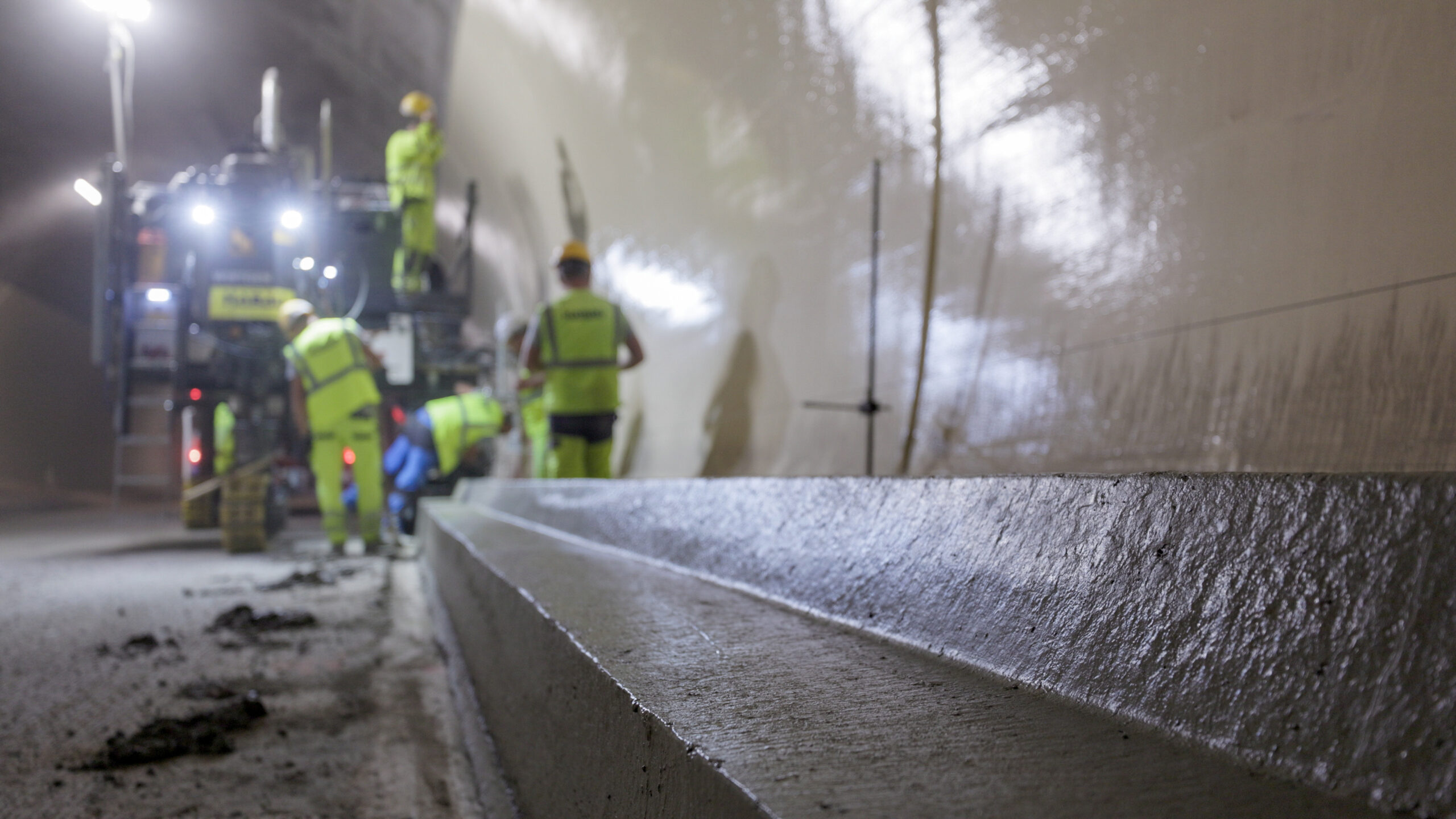
The task that faced the team in the Semmering Tunnel in Styria was the paving of kerb-gutter profiles on both sides of the tunnel. The particular challenge was that the new kerb-gutter profile had to be paved on top of the existing kerb profile in the tunnel. This meant that the work had to be carried out with extreme precision in order to ensure the structural stability and durability of the profiles. Following the completion of this work, a two-layer concrete track was paved between the two profiles with a slipform paver SP 1500.
As the tunnel is an important north-south traffic route, the construction project had to be completed as quickly as possible. Since only eight bolts need to be loosened when exchanging moulds on the SP 33, the team was able to save a lot of time. “Reconfiguring the machine, which would usually take us two or three days, was over and done with in just one day,” said Bernd Haberl, foreman at Habau Hoch-und Tiefbaugesellschaft.