
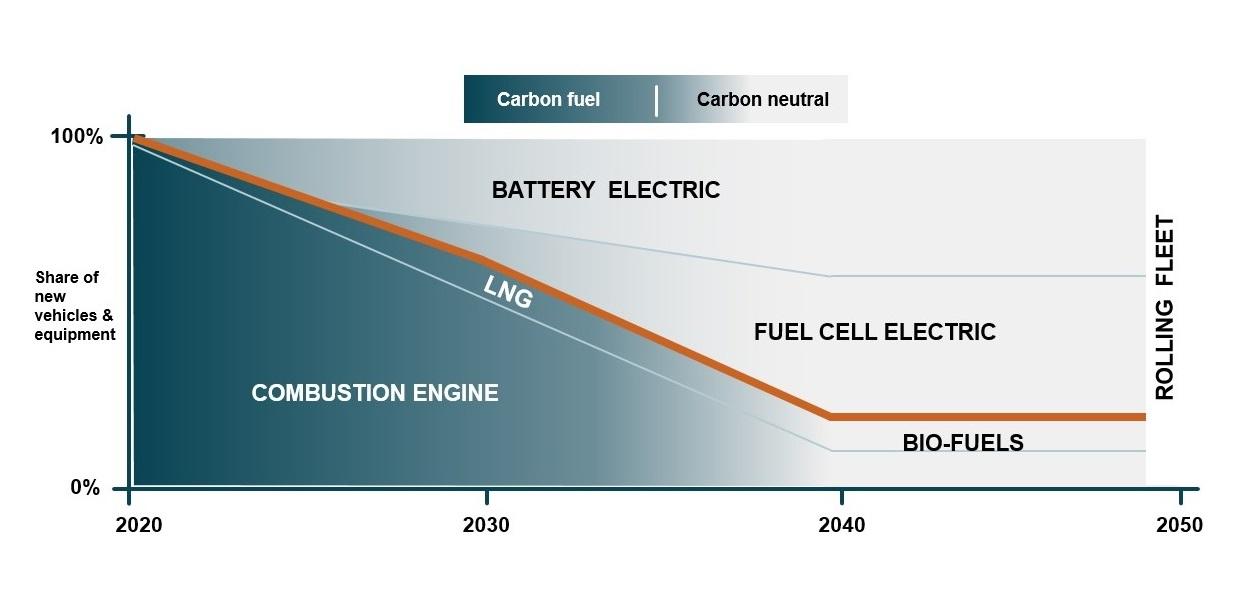
Volvo CE has been one of the most forthright of the major construction machinery manufacturers with regard to cutting carbon emissions. The firm has plans to be 100% fossil-free by 2040, so that the Volvo Group is announcing its development of ahydrogen fuel cell power programme should come as no surprise.
The Volvo Group is setting up a facility to test and develop hydrogen fuel cell technology solutions. The new research and development facility is located at the Volvo Construction Equipment (Volvo CE) Technical Center in Eskilstuna, Sweden. The firm says that this represents a big step forward in the company’s commitment to hydrogen. The lab is also the first facility in Volvo Group to be testing complete fuel cell units, and will as such be a strong contributor to the company’s dedication to fuel cell technology.
This development is of note given the recent announcement by engine firm Cummins that it is building its portfolio of hydrogen fuel cell power options. Meanwhile,Hyundai has also announced a research and development programme for the use of fuel cells in construction machines. And JCB has demonstrated its fuel cell excavator prototype, as well as unveiling a backhoe loader that retains its internal combustion engine, but uses hydrogen as fuel instead of carbon-based fuels, resulting in clean tailpipe emissions. Meanwhile, various items of equipment such as lighting towers are already being made available for construction purposes, featuring power from fuel cells.
Toni Hagelberg, Head of Sustainable Power at Volvo CE, said: “Fuel cell technology is a key enabler of sustainable solutions for heavier construction machines, and this investment provides us with another vital tool in our work to reach Science-Based Targets. The lab will also serve Volvo Group globally, as it’s the first to offer this kind of advanced testing. It’s a really exciting step to accelerate the development of fuel cell solutions towards our united vision for a carbon neutral society.”
The firm says hydrogen fuel cell technology will play a key role within its overall electromobility ambitions, together with battery electric solutions. The company has already developed its electric compact machines, and more sustainable internal combustion engine offerings. All three streams are intended to deliver a carbon neutral future. While battery electric solutions are ideal for urban construction and other use cases, the size of the batteries is too impractical for larger machines and heavy construction equipment, which is where hydrogen comes in as a promising alternative.
“Hydrogen can be produced in many different ways and it’s important to have a life-cycle approach across the entire value chain”, said Hagelberg. “Not only will the research and development carried out at the test lab be dedicated to producing fossil-free construction solutions, we will also look at how the hydrogen itself has been produced, and strive for so called “green” hydrogen produced from renewable energy.”
Fuel cells work by combining hydrogen with oxygen, with the resulting chemical reaction producing electricity. The process is completely emission-free, with the only by-product being water vapour. In principle, a fuel cell works much like a battery, except that it generates its own electricity from the hydrogen on-board rather than being charged from an external source. This means it can deliver longer driving ranges, and is more suited for use in long-haul transportation and heavier equipment.
An added benefit of hydrogen fuel cell solutions, is that they will also be free from the traditional machinery noise pollution. Without a combustion engine, hydrogen powered machines will be comparable to the low noise levels of the electric compact machines.
The Fuel Cell Test Lab is a demonstration of the same dedication to hydrogen fuel cell technology, as the recent launch of cell centric, a joint venture by Volvo Group and Daimler Truck to accelerate the development, production and commercialisation of fuel cell solutions within long-haul trucking and beyond. Both form a key part of the Group’s overall ambition to be 100% fossil free by 2040.