• About
  • Advertise
  • Contact
Thursday, July 16, 2026
Newsletter
Global Highways
  • News
  • Products
  • Features
  • Categories
    • Asphalt Milling, Paving & Compaction
    • Concrete Milling, Paving & Compaction
    • Connected Construction
    • Earthmoving & Soil Compaction
    • Engines, Components & Tyres
    • Finance & Funding
    • Highway & Network Management
    • Maintenance
    • Materials
    • Recycling
    • Road Markings, Barriers & Workzone Protection
    • Road Structures
  • Events
    • Events Calendar
    • CONEXPO-CON/AGG 2026
    • Intertraffic Amsterdam 2026
    • bauma 2025
  • Latest Magazine
  • Videos
No Results
View All Results
  • News
  • Products
  • Features
  • Categories
    • Asphalt Milling, Paving & Compaction
    • Concrete Milling, Paving & Compaction
    • Connected Construction
    • Earthmoving & Soil Compaction
    • Engines, Components & Tyres
    • Finance & Funding
    • Highway & Network Management
    • Maintenance
    • Materials
    • Recycling
    • Road Markings, Barriers & Workzone Protection
    • Road Structures
  • Events
    • Events Calendar
    • CONEXPO-CON/AGG 2026
    • Intertraffic Amsterdam 2026
    • bauma 2025
  • Latest Magazine
  • Videos
No Results
View All Results
Home Features The UK is ready for rubber – Tarmac’s new asphalt solution

The UK is ready for rubber – Tarmac’s new asphalt solution

A huge surplus of waste tyres and a strengthening commitment towards sustainability from local authorities has prompted asphalt supplier Tarmac to invest in technology to add crumb rubber to its mixes "Local authorities want to be green, sustainable and environmentally friendly,” said Tarmac’s technical director Brian Kent. “I get the sense that these issues are more important to them now. I do think we are going to get some traction.” Around 40 million tyres are worn out every year in the UK. Though

by Sarah Biswell
September 6, 2019
in Features
Reading Time: 3 mins read
A A
Tarmac's new asphalt uses waste tyres.jpg

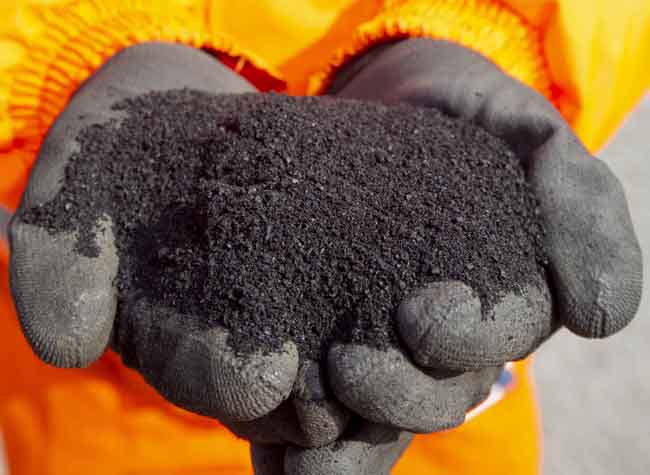
Tarmac is now using crumb rubber in asphalt

A huge surplus of waste tyres and a strengthening commitment towards sustainability from local authorities has prompted asphalt supplier Tarmac to invest in technology to add crumb rubber to its mixes

“Local authorities want to be green, sustainable and environmentally friendly,” said Tarmac’s technical director Brian Kent. “I get the sense that these issues are more important to them now. I do think we are going to get some traction.”

Around 40 million tyres are worn out every year in the UK. Though some are burnt for fuel at cement kilns, others turned to crumb rubber and used for sports pitches and to create items like car mats, there is still a surplus of 120,000tonnes of rubber waste. Currently these are shipped abroad.

Tarmac has modified seven of its 72 asphalt plants so that 1% of crumb rubber by weight can be added to mixes. This is combined with a warm-mix additive, Evotherm, so that the harmful emissions are not produced during the manufacturing process. Tarmac reckons this equates to 750 waste tyres/km of road resurfaced.

The company started investigating the use of end-of-life tyres (ELT) in asphalt back in 2011. They chose a method has been used successfully in the US for over a decade, said Kent.

This process is somewhere between the wet and dry processes for adding rubber to asphalt mixes. The rubber become part of the asphalt matrix, melting at first and then resolidifying to act “like a glue”, said Kent.

The result is a mix that is better than one created with standard bitumen, but not as enhanced as one made with a polymer-modified bitumen. Kent did not provide any test results to demonstrate its performance, saying that there were no tests that adequately mimicked ageing.

“Talking to colleagues in America, they have come to the conclusion that because rubber is in the material, it is helping to delay crack propagation and that means the roads are lasting longer,” said Kent. He added that where rubber is used in SMA (stone mastic asphalt) mixes, the crumbs sit in some of the air voids, improving waterproofing and hence enhancing durability.

The first UK authority to trial the mix was Coventry, with national authority Highways England also carrying out a trial on the M1 motorway near the East Midlands Airport. Authorities in London, Nottingham and Leicester are also planning trials with several others expressing interest.

Modifications to the asphalt plants involve adding an automated system to the plant which includes a silo, a screw to mix and making modifications to the software. The cost for modifications varies, depending on the plant but costs tens of thousands of pounds. Other plants will be upgraded, depending on market demand, says Kent.


Categories: Materials
Promoted Content Header
Tarmac VIEW COMPANY
Videos

Building roads for a net-zero future with Tarmac: The A64 Bramham

December 16, 2025
A novel concrete grade is being used on a trial for a stretch of road in the UK - image courtesy of Tarmac
News

Sssshhhhhh! – quiet concrete on UK trial

January 14, 2025
Road building, maintenance and repair works can now be carried out with a view to reducing climate change
News

Beyond cost: forging a solutions-led partnership for highways carbon-saving

December 30, 2024
A warm mix asphalt was used together with a pioneering CarbonSink bio-component binder from Shell, which locks carbon into the road to prevent it being released into the atmosphere
News

Tarmac goes low-carbon on UK’s A64

December 20, 2024

Related Posts

One of the tasks involved flipping bottles up from the ground (Image: Hitachi Construction Machinery Europe/HCME)

Europe’s best operators get ready for the LANDCROS Operator Challenge Final

by Sarah Biswell
July 10, 2026

More than 90 of Europe's most skilled excavator operators have showcased their skills in recent months by taking part in...

Road repairs work

The importance of road maintenance

by Staff Writer
July 10, 2026

Gülay Malkoc discusses the importance of investing in road maintenance.

The new 24litre engine from DEUTZ is designed for high-load genset applications - (image: Deutz)

High power generation from Deutz

by Mike Woof
July 8, 2026

Deutz is offering a rugged new engine to suit challenging power generation installations

Join our newsletter

The mission of Global Highways is to cover the latest technologies and best practices in all areas of road, bridge and tunnel construction and maintenance, as well as their safe operation and management.

Subscribe to our newsletter

About Us

  • About Us
  • Advertise
  • Contact
  • Terms & Conditions
  • Privacy Collection Notice
  • Privacy Policy

Popular Topics

  • News
  • Features
  • Products
  • Videos
  • Events
  • CONEXPO-CON/AGG 2026
  • Intertraffic Amsterdam 2026
  • bauma 2025

© 2026 All Rights Reserved. All content published on this site is the property of Prime Creative Media. Unauthorised reproduction is prohibited

No Results
View All Results
NEWSLETTER
  • News
  • Products
  • Features
  • Categories
    • Asphalt Milling, Paving & Compaction
    • Concrete Milling, Paving & Compaction
    • Connected Construction
    • Earthmoving & Soil Compaction
    • Engines, Components & Tyres
    • Finance & Funding
    • Highway & Network Management
    • Maintenance
    • Materials
    • Recycling
    • Road Markings, Barriers & Workzone Protection
    • Road Structures
  • Events
    • Events Calendar
    • CONEXPO-CON/AGG
    • Intertraffic Amsterdam 2026
    • bauma 2022
  • Latest Magazine
  • Videos
  • About
  • Advertise
  • Contact

© 2026 All Rights Reserved. All content published on this site is the property of Prime Creative Media. Unauthorised reproduction is prohibited