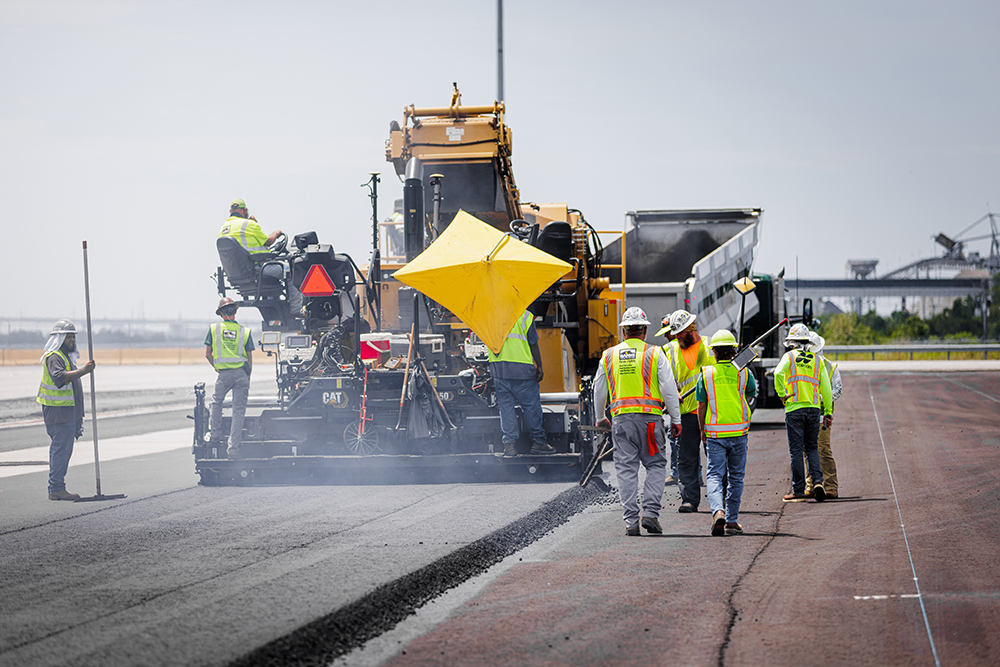
The award-winning I-526 work by Banks Construction in South Carolina showcases how SmoothRide technology is a gamechanger for road-maintenance projects. For both contractor and client, the benefits are time-savings on site which translate directly into financial savings, as well as material savings, which also translate into financial savings. Apart from these concrete, measurable benefits, there is another overriding benefit, again for both client and contractor. SmoothRide lays the foundation for a lasting and trusted partnership; a win-win situation, says Matt Kohler, vice president of strategic initiatives for North America, Latin America and Oceania. But how did SmoothRide, the idea, come about?
“When paving, you’ve got cross-slope correction, matt or material thickness and then you have rideability,” he says. “Traditional paving is 2D, whether contractors use a string line or a sonic tracker, they can give you one or two of those. They can’t give you all three with any real solid results. How can we correct this? By using a downward-facing LiDAR scanner and implementing a software called Resurfacing – that’s really the secret sauce to this whole thing. Then we put our 3D machine control to use, using our GNSS control, along with incorporating our sonic trackers into a product.
“So, we are actually reading the ground in real time for vertical elevation while the GPS is giving you positioning and then it is comparing it to whatever design you have done for the resurfacing model. That’s how you’re getting your true corrective action and we’re able to achieve very real variable depth paving or milling.”
Many road contractors’ bread and butter is in maintenance, and not in the construction of a road, notes Justin Thompson, an intelligent-paving specialist at Topcon Positioning Systems. SmoothRide is targeted for maintenance projects, which account for 95% of what a DoT typically contracts out every year. Mill-and-fill overlay projects make up the bulk of this. It’s not geared towards elevation, it’s geared towards cross-slope, ride specifications and road thickness.
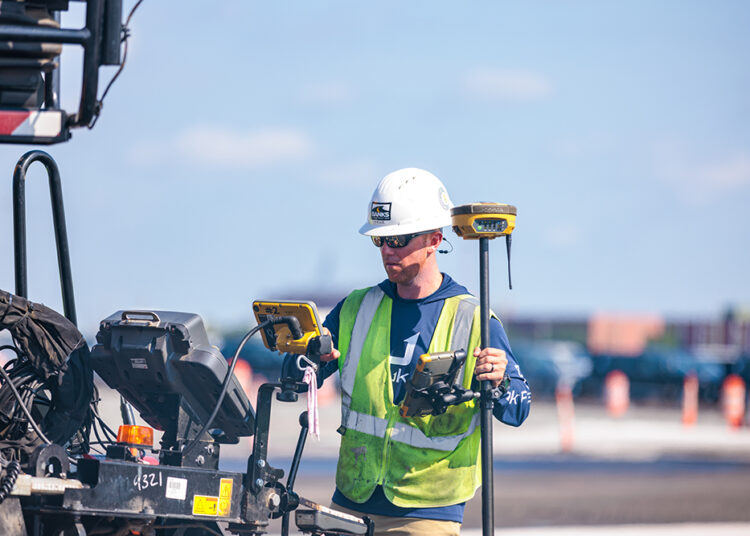
“It doesn’t really change the operator’s day-to-day value,” says Thompson. “So, we still use the same sensors that they use every day for paving and milling that we use on 2D systems. We use it on our 3D systems. So, their operational values of what they do stay the same, but we just use the GNSS for location and those same sensors for the grades.”
Some competitors are coming along right now, but Topcon remains in the forefront of this technology. It’s one thing to build a perfect road but it’s another thing to make that road perfect again. The contractor may not be working with a perfect base anymore. There are a lot of variables, explains Thompson.
For the I-526 work, Banks scanned the existing road and realised that the details and plan given to them by the DoT were not accurate. The road was supposed to be at a 2% crown but their RD-M1 scanner showed it was actually super-elevated, one side to the other. This completely changed the design of the project work. Thompson said Banks, to be certain, came to him to double-check the results. “We were right on the money,” says Thompson. “So they went back to the state DoT with the scanner’s results and said there was no way to correct this job per your plan specification.”
To avoid completely pulling the project and having to undertake a whole resurvey and redesign of the road, which would probably have taken another year, they allowed Banks to redesign the project themselves, using their data capture. Another time and money saver, notes Thompson. Banks was, of course, paid for time and material but the savings to the DoT were, he believes, in the order of a million dollars or more. “I heard this directly from the owners at Banks. They couldn’t be more happy with it, as was the state of South Carolina.”
The important point here is that both contractor and DoT were seen to be working in extremely close partnership. Both organisations owned the project. “Instead of arguing and fighting it out, they both came to an understanding that this is the best solution. We’ve seen this time and again with SmoothRide, where the contractor wants to deliver the most high-value, high-quality product that they can to their DoT. And the DoT needs the problem solved but must work within financial constraints,” says Thompson. “It’s a consultative relationship.”
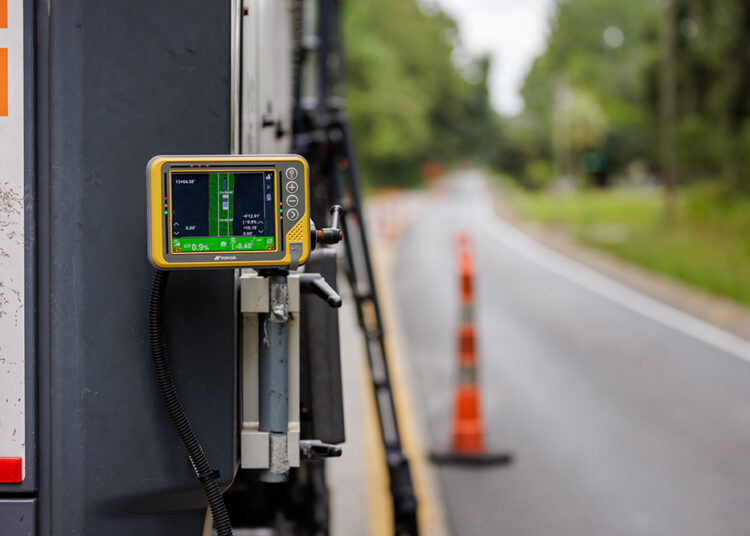
It leads to what might be called a virtuous circle, where the DoT sees the results of working with SmoothRide. “Once we get that first project accomplished, typically what happens is the DoT acknowledges that SmoothRide is a very, very viable solution and they actually encourage their contractors within their area to start using it more on different projects.”
Also, from a DoT perspective, says Thompson, there can be a “wow factor” when they see Topcon Positioning System’s Resurfacing software. “This is because DoTs are so software-design heavy, they typically use Bentley products for that, which are very, very good solutions. But then they see the Topcon Resurfacing module and how easy it is to use. We’re simply entering the specification data into a database inside of our software and it spits out exactly what that road’s going to look like per the DoT’s specification, on top of that scan data. It’s a quick process of entering cross-slope values, IRI values, the debt values that you want. It really does blow their mind.”
Even so, Thompson acknowledges that the real benefits from SmoothRide are to be found on larger resurfacing work. “We’re really all about correcting long longitudinal wavelengths. So, you’re probably looking at a minimum half-mile contract. Of course, you can use it on 500 feet if you want. But you’re not going to get the value for which you bought the system.”
The benefits will come tumbling in on projects that cover, say, several miles or major airport-runway revamps. This is because SmoothRide is a “volume cruncher”, says Kohler. “The more miles you can correct using it, the more money you can save. It really is a force multiplier where savings rise exponentially.”
Overall, SmoothRide offers both contractor and client – and road user – the certainty and comfort of as near a perfect road surface as you can get, says Thompson. There is no guesswork anymore. “With SmoothRide, we capture the existing data and we apply those corrective actions on top of that virtually, in a model, so we know.”
Certainty and comfort, thanks to no guesswork, is what cements that long-lasting partnership between contractor and DoT. “Absolutely,” says Kohler.
Matt Kohler is a graduate of Fort Lewis College, a public liberal arts college in Durango, Colorado. He has been in the positioning industry since 1993 and joined Topcon in 2011 where he has held several management positions. These include managing distribution as a regional sales manager, serving as a senior strategic-partner manager working with regional, national and global accounts, and overseeing Topcon’s Construction Business Unit for Western North America. Kohler is currently vice president of strategic initiatives for the Americas and Oceania regions within Topcon Positioning Systems, based in Livermore in the US state of California. He leads several business-development teams, focusing on growth strategies across key areas, including intelligent paving, compact-machine control, strategic-partner development and governmental engagements.
Justin Thompson has 15 years of extensive construction experience, having worked as a land surveyor, field engineer, survey manager, foreman and superintendent. His projects have included concrete bridges, water-treatment plants, and mainline road construction where he developed skills in building digital terrain models and using machine control. Prior to joining Topcon Positioning Systems, he was an inspection engineer for the North Carolina Department of Transportation. He is now an intelligent-paving specialist serving as a regional sales manager for Topcon asphalt-paving technologies. He oversees the southeastern region of the US and all of Canada, assisting Topcon dealers with the education, training and sales of asphalt-paving technology.