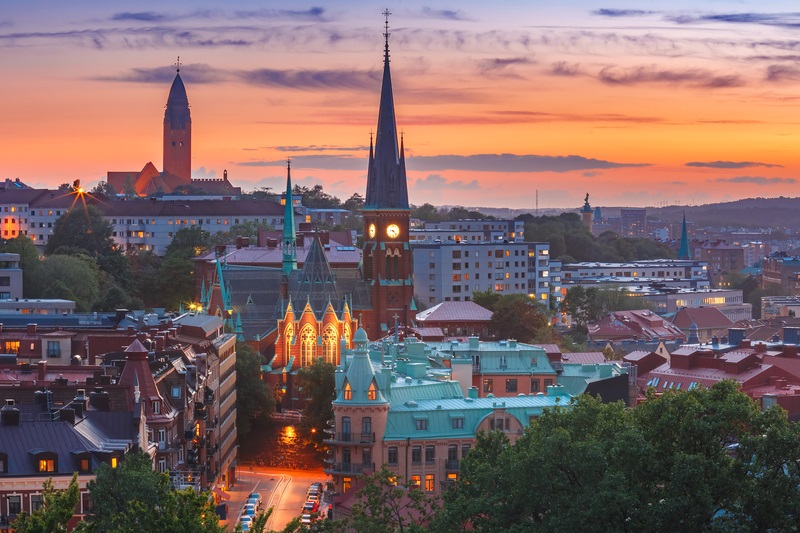
Upgrade work is due to commence for the Lundby tunnel in the Swedish city of Gothenburg. This 2 km tunnel was built in 1998 using drilling and blasting and was lined with shotcrete, a well-proven technology used frequently in Nordic countries.
However, the Swedish Road Administration, Trafikverket, says that the tunnel now needs to be renovated and requires measures to repair some damage from previous leaks and provide a more effective sealing solution. At the same time, large parts of the tunnel’s technical systems will be updated to meet the latest standards. The renovation will be carried out to increase traffic safety and reduce maintenance costs.
The project is expected to be completed in 2028. Damage from previous leaks in the roof have caused high maintenance costs and long-term risks for road users. To address this, Trafikverket is remedying damage by reducing water leakage and increasing traffic safety with the help of new safety-enhancing measures. The measures include a new firefighting system, new concrete railings inside the tunnel and updating the tunnel’s technical system. The project will affect traffic. Traffic planning is underway so that the work can be carried out without having too great consequences on the traffic system.
Meanwhile, Skanska is handling a $91.1 million agreement with Trafikverket to undertake the second phase of the Lundbyleden project in Gothenburg. This phase encompasses groundwork and civil works for roads, railways, and bridges.
This E2 Lundbyleden contract entails the revamp of the stretch between Brantingsmotet and Ringömotet, along with land work near Kville bangård. The project’s scope includes road reconstruction and expansion, the erection of five new bridges with retaining walls, and civil engineering for the Bohusbanan railway’s upgrade to a double track.
The works will involve roughly 80,000m of piling, the excavation and removal of around 200,000m³ of mass, and the use of approximately 11,000m³ of concrete.
Lundbyleden is a critical artery in Gothenburg, linking major highways such as the E6, E20, and E45 with Road 155 leading to the Port of Gothenburg and other key areas. The route currently faces heavy traffic and navigation challenges. The project is expected to be complete by the end of 2029 or early 2030.
In addition, contractor Veidekke is upgrading two stretches of the E20 highway close to Mariestad for Trafikverket, which is worth a total of $162.7 million. Using novel green construction technologies, the works will feature considerably lower levels of CO2 emissions than previous projects of a similar size. Work to the Hasslerör Bridge will have a climate-saving of 4 million kg of CO2.
The firm is undertaking the two stretches, between Hindsberg and Muggebo as well as Muggebo and Tjos, separately. The project includes building 15 bridges, interchanges and connections to local roads.