
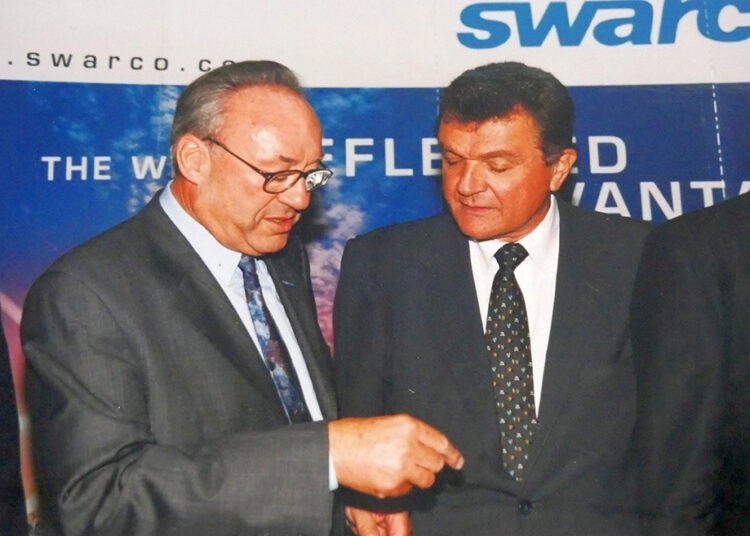
In the spring of 1999, Swarco Futurit managing directors Friedrich Peter Hofstadler and Franz Silhengst had every reason to celebrate, but also faced new challenges.
The development and production of signal heads from Signalbau Huber – then a Bosch Group company – had already been transferred to Swarco Futurit.
At the same time, a contractual agreement had just been signed with German competitor Siemens to outsource its traffic light production to Swarco, making Swarco the largest traffic light manufacturer in the world.
However, the existing production site in Amstetten, Lower Austria – the birthplace of Swarco and home to a glass bead factory – was too small. The order volume increased so significantly that it made sense to consider in-house injection moulding capacities for the plastic components of traffic lights. In short: more space, not to mention bigger thinking, was needed.
“The challenge was planning a new plant from scratch: What are its performance criteria? What capacities are needed?”
Since spatial expansion in Amstetten was limited, Swarco founder Manfred Swarovski proposed building a completely new plant on a greenfield site to meet the growing demands and prepare the company for the future. He suggested calling it the “Competence Centre for Visual Information” of the Swarco Group. He already had a location in mind: the small village of Neutal in Middle Burgenland, about 90 km south of Vienna, with a population of around 1,000.
His friend, Burgenland’s governor Karl Stix, had long tried to attract him to the region, which was then a structurally weak EU Target 1 region with special funding. After careful consideration, the decision was made to take the step and move to Austria’s eastern-most state, near the Hungarian border. It wasn’t easy – many challenges had to be addressed and overcome, although Neutal’s connection via the newly built S31 expressway proved to be a logistical advantage.
Special challenges
One can imagine the reaction of employees in Amstetten when they learned that their workplace would be moving over 200km southeast to Burgenland. It transpired that only two were willing to relocate and pioneer the new site.
The inevitable result: building and training an entirely new workforce in Burgenland. Meanwhile, staff at Swarco Futurit’s management and sales headquarters in Vienna’s 14th district quickly adapted to commuting to Burgenland.
The next challenge was planning a new plant from scratch. What are its performance criteria? What capacities are needed? What workflows have to be considered? How do we build up larger injection moulding capacities? What do we have to consider for the move from Amstetten to Neutal?
Franz Silhengst, who – along with Friedrich Peter Hofstadler – masterminded the construction project, recalls: “When we moved from Vienna-Liesing to the production site in Amstetten in 1994, two trucks sufficed. Moving from Amstetten to Neutal required 30 trucks, and just as many [were needed] for relocating Siemens’ traffic light production.”
“The company has primarily implemented investments with a focus on sustainability”
The company Unger Stahlbau in Oberwart was found to be the appropriate partner to build the facilities, including the shop floor for traffic light and VMS production, injection moulding machines and warehouse capacities. A logistics zone for the docking of forwarding agents, a reception desk, offices, social and conference rooms, a small product showcase, car parking spaces, photometric and wet exposure quality control facilities and even a fire water pond had to be planned.
Another demanding milestone: updating the SAP ERP system in parallel to the construction works to ensure seamless order processing during the transition.
In 1999, another special facet was added: the Y2K problem, also known as the ‘millennium bug’. At the time, there were great fears that computers would no longer function when the date changed to 2000. The Y2K problem was a potential computer error in which programs stored years as two digits (e.g. ‘99′ for 1999) instead of four digits (e.g. ‘1999′) to save memory space. During the transition from 31 December 1999 to 1 January 2000, it was widely believed that some computers would incorrectly interpret the year ‘00′ as 1900 instead of 2000, which could lead to malfunctions. However, thanks to massive global efforts to fix the software and hardware, there were only a few minor disruptions when the year 2000 dawned.
Construction phase
As early as August 1999, construction vehicles arrived in Neutal to level a 40,000m² plot of land that was quickly available and prepare it for the construction of the plant. On 11 August, just as the first excavator drove onto the field, it suddenly became quite dark for a short time: a rare phenomenon known as a total solar eclipse.
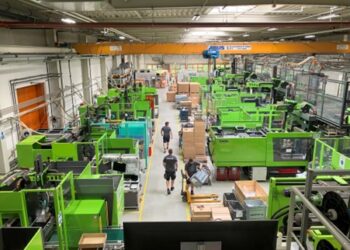
Construction work then progressed very quickly and, just five months later, the buildings were ready to be moved into and the interior work could push ahead. Work began on setting up the office infrastructure and IT landscape in January 2000. Gradually, Engel injection moulding machines with clamping forces between 75 and 700 tonnes and injection weights of 10 to 3,500 grams were installed. The production of traffic lights and variable traffic signs picked up speed. In 2000, the shop floor covered an area of 5,600 m². This has increased to 11,700 m² today, through expansions in 2004, 2008 and 2011.
In 2000, the headcount at Swarco in Neutal was 108 employees. Gradually, we became the largest employer in the region, boosting the local economy. Today, around 200 employees work in three shifts.
The big day: inauguration
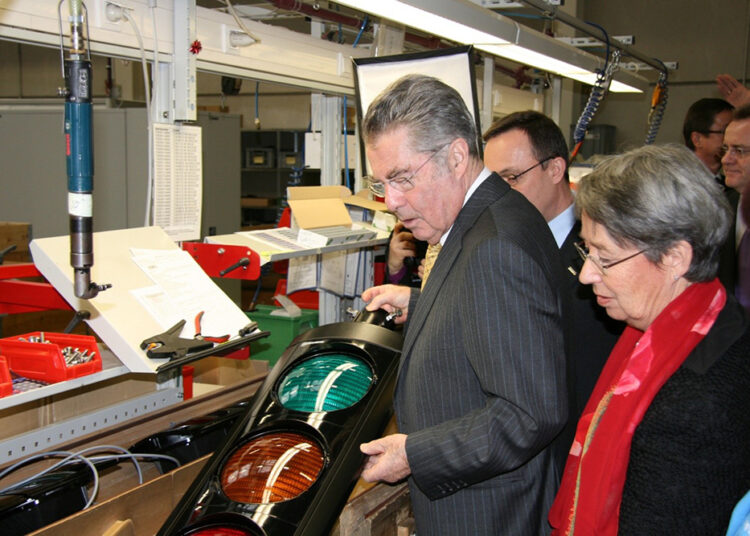
On 29 September 2000, the big day finally arrived: the workforce and numerous business partners from Austria and abroad gathered for the grand opening of the Neutal plant, which included a blessing of the building, speeches from politicians and business leaders and, of course, culinary delights and musical entertainment. The opening of the site was a milestone for the region and a sign of the partnership between Swarco and the local community, as emphasised to the media by the then governor Karl Stix, Neutal’s Mayor Josef Thiess, Manfred Swarovski and Swarco Futurit managing directors Friedrich Peter Hofstadler and Franz Silhengst.
Technological evolution
The past 25 years have also seen rapid technological progress. Further increases in order volumes required the gradual expansion of production areas. “Previously manually-supported production steps – such as equipping the variable message sign matrix plates with optical lenses – have been automated,” explains plant manager Artur Schubert. “Today, robots ensure that the lenses are positioned precisely and that the correct insertion pressure is applied.”
The unique VMS optics developed by Swarco are now internationally patented and help to significantly extend the service life of the LED displays, giving VMS customers the confidence of a very favourable total cost of ownership.
Automating the process
Initially, a traffic light with all its components was fully assembled by one person. Today, assembly lines significantly shorten the production time for a signal head.
At the turn of the millennium, there was a ground-breaking technological advance. At that time, LEDs became bright enough to be used as a light source in signal heads and variable message signs. This meant that the incandescent or halogen bulbs previously used in traffic lights were replaced. In the case of variable message signs, the previous fibre optic technology, in which the central light from a halogen bulb was transported via hundreds of fibre optic strands to the lenses on the matrix panel, was abandoned in favour of energy-efficient LED technology.
“Whereas traffic lights initially required clusters of 180 LEDs for a red, amber or green light to ensure the standard-compliant light intensity, the Swarco factory now produces traffic lights whose light is generated by just one or two LEDs,” says Swarco Futurit MD Artur Pesendorfer.
“Over the years, LED manufacturers have succeeded in achieving more and more lumens per watt with a single LED. Modern LED traffic lights, which consume more than 95% less energy than conventional light sources, are now making a significant contribution to reducing the operating costs of urban transport infrastructure.”
“The company will soon launch Combia Circular, the first plastic traffic light made from recycled polycarbonate”
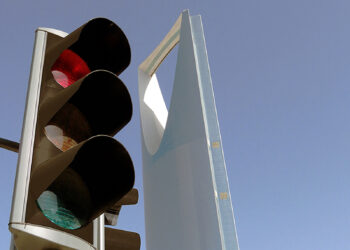
With the exception of the AluStar model, Swarco exclusively manufactures traffic lights made of plastic, which means that service technicians only have to lift around 4kg when installing a three-aspect traffic light. At the Neutal plant, over 800 tonnes of robust polycarbonate are moulded into traffic light and VMS components, such as lenses, housing parts and brackets, in the 15 injection moulding machines every year.
“The slim Futura, developed in 2008, was the first eco-designed traffic light with a life cycle assessment from cradle to grave,” recalls Pesendorfer. “It was a big hit, because to date we have exported more than half a million units worldwide.”
The world – our market
Swarco Futurit has always been a very export-oriented company. Its business-to-business partners are primarily system integrators and road operators who install traffic lights and variable traffic signs at urban intersections or in motorway, tunnel or parking guidance systems. The products manufactured in Neutal are reliable and valued contributors to road safety and environmentally-friendly traffic management in more than 80 countries, from Iceland to South Africa and from the UK to New Zealand.
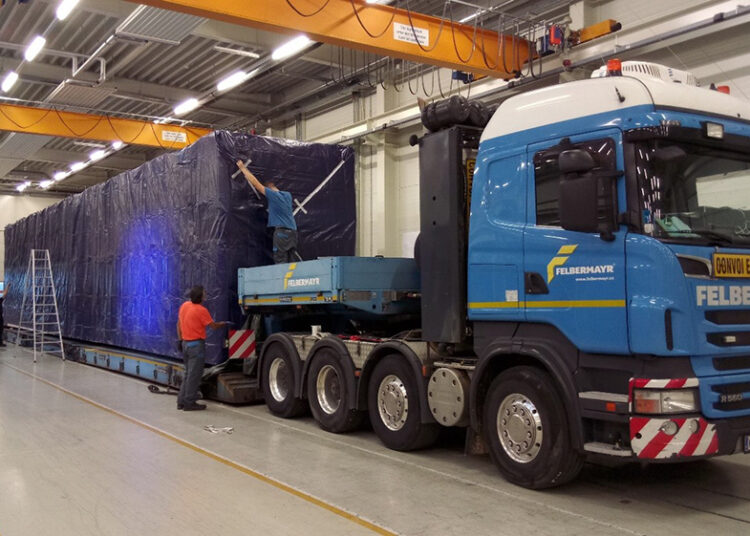
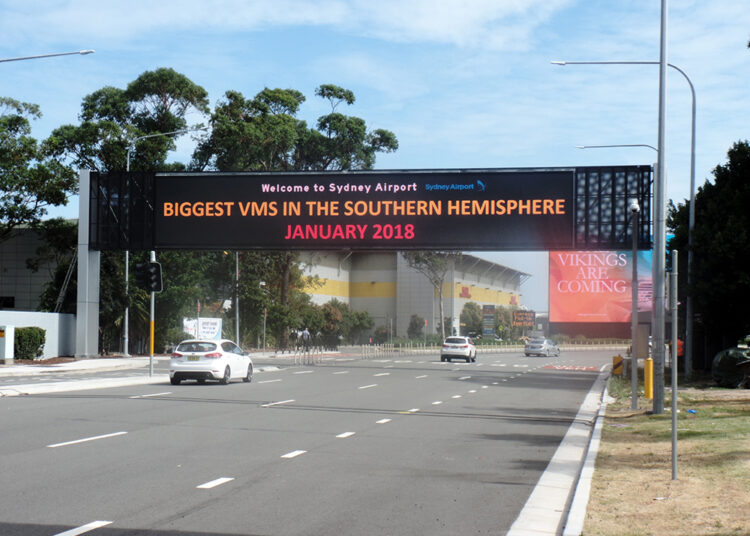
“One of the most spectacular moments occurred in 2018, when low-loaders drove into the factory hall to pick up the huge, 22m wide and 3m high variable message signs, each with 750,000 LEDs, for Sydney Airport in Australia, the largest variable traffic signs in the southern hemisphere,’ says Artur Schubert, proudly.
Modernisation, sustainability & environmental awareness
After a quarter of a century of successful business in Burgenland, it is time to modernise the factory site in order to be well equipped for the future. The ground-breaking ceremony on 26 August 2024 marked the start of a fundamental renovation and upgrade of the Neutal site, with operations continuing unaffected.
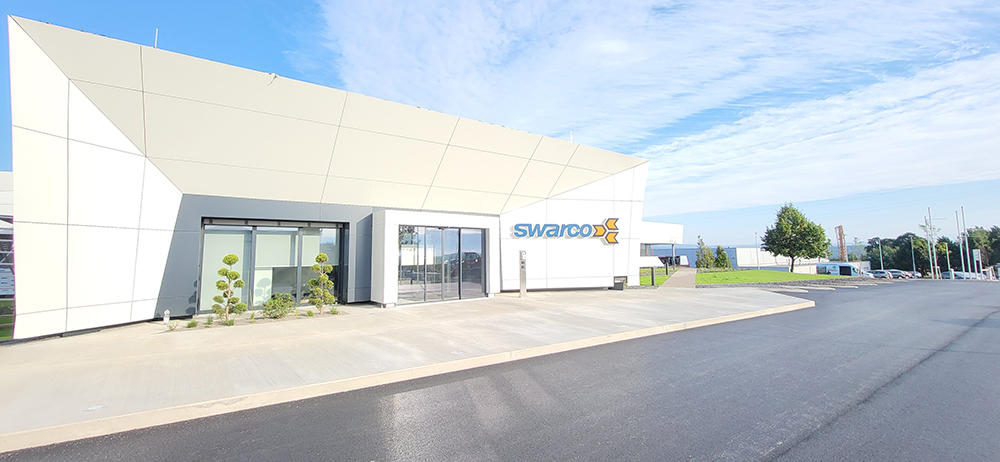
Attractive office space featuring state-of-the-art (energy) technology and newly-designed social and recreation rooms in the production, office and outdoor areas have been created over the last 12 months. In terms of construction, there is now a clear separation between the employee area and the guest area. Last but not least, sufficient parking spaces for employees and guests have been created, including charging infrastructure for electric vehicles.
Recently, the company has primarily implemented investments with a focus on sustainability. A 1 MWp photovoltaic system in Neutal produces enough electricity to operate the company’s own facilities almost entirely self-sufficiently. The waste heat from the injection moulding machines is used to heat the buildings at Manfred-Swarovski-Straße 1 in Neutal. In the production area and offices, intelligently-controlled LED lighting ensures further energy efficiency and contributes significantly to reducing the site’s carbon footprint.
“Swarco is continuing to write a story that is helping to shape the traffic and transport of tomorrow”
The company will soon launch Combia Circular, the first plastic traffic light made from recycled polycarbonate. This is an important step towards CO2 reduction, waste avoidance and life cycle optimisation, without compromising the well-known reliability and durability of Combia traffic lights. At the end of its service life, all components can be separated by material type and are designed for recycling.
On 24 September 2025, almost exactly 25 years after the opening ceremony, Swarco will celebrate the reopening of the modernised site, which is increasingly becoming the production hub for the company’s ITS business, in the presence of the Supervisory Board, Executive Board, local politicians, architects, construction companies and numerous national and international business partners. Two days later, there will be a big family event for the workforce.
25 years of Swarco in Neutal stand for progress, community and entrepreneurial courage. The success story shows how technology and commitment can enrich the life of a region. Looking to the future, Swarco remains convinced that sustainable development, innovative strength and social responsibility form the basis for further decades of success.
In Neutal, Swarco is growing, developing and networking – and continuing to write a story that is helping to shape the traffic and transport of tomorrow.
Content produced in association with Swarco