Thank you for taking the time to discuss sustainability. First of all, how does the Wirtgen Group define sustainability?
For the Wirtgen Group, sustainability is an integral component of its corporate principles. This is from development and design phases of products through to all stages of the value chain, up to and including the use of the machines on projects around the globe. Our customers very much appreciate the expertise we contribute.
The efficient use of resources within the context of a closed-loop economy is becoming increasingly important in road construction. There is also a need for further action in view of the growing demands for climate protection. Asphalt recycling makes a significant contribution to cost-efficiency in road construction, the conservation of natural resources and the reduction of CO2 emissions.
Is it increasingly difficult or easier to measure progress towards achieving sustainability?
Both the Wirtgen Group and its customers have defined specific and measurable parameters. This enables the identification and management developments. The parameters can be found everywhere: from the proportion of renewable energy in the manufacturing process, fuel consumption or water use of the machines, noise levels or the proportion of recycled materials used. All this has a significant impact on the potential for saving valuable resources.
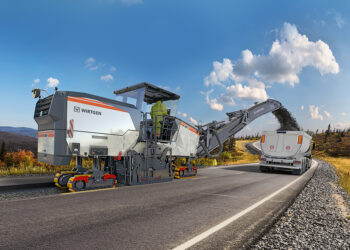
The Wirtgen Group offers a wide range of solutions for this: Kleemann plant setups offer a variety of options for recycling construction materials. The asphalt-recycling technologies from Benninghoven increase the recycling rate of reclaimed asphalt pavement (RAP) in mixing plants. A particular focus here is set on asphalt recycling management. At the Wirtgen Group, this is the interaction of Wirtgen cold milling machines, Kleemann crushers and screening plants and Benninghoven asphalt-mixing plants.
Layer-by-layer milling produces homogeneous milled material and enables clean separation of material from surface courses, binder courses and base layers. This is the basis for high recycling rates with simultaneously consistent product quality. In addition, precise water management ensures a reduced moisture content of the reclaimed asphalt pavement material. This influences the RAP addition rate and reduces the energy required for subsequent heating of the asphalt granulate in the mixing plant.
During processing, gentle handling in the screening and crushing phase largely preserves the original grain-size distribution. The material flow in processing leads to an improvement of homogeneity and thus enables consistent quality. The subsequent mixing technology in modern Benninghoven asphalt-mixing plants with a recycling drum and a hot-gas generator allows RAP addition rates of up to 100% and a reduction of the emissions of volatile organic compounds [VOC] to below 50mg/m³.
Bitumen heating takes place exclusively via hot gases without flame contact. This influences the bitumen properties in the reclaimed asphalt and further improves environmental compatibility, as its long-term durability leads to the generation of less waste over time.
The Wirtgen Group offers digital solutions that collect key data. For example, the fuel consumption of individual machines in the customer’s fleet, and then visualises the data on a single platform, the John Deere Operations Center. This already enables a holistic overview of numerous aspects within a complex process.
Is there too much emphasis on specific climate goals and too little about reduction in material use?
Many discussions focus heavily on CO2 reduction goals, while concrete material and resource efficiency often receive too little attention. But that is exactly where we have big and immediately realisable savings potentials.
In conventional road rehabilitation, raw material makes up almost three-quarters of the costs. Furthermore, close to 80% of CO2 emissions are attributable to raw material and material processing. Optimised recycling management enables a reduction of both costs and emissions.
The majority of customers have clearly defined goals. The achievement of climate goals and the conservation of valuable resources go hand in hand. The production of raw material for road construction – in particular bitumen and mineral aggregates – has a significant impact on emissions. The consideration of the entire ‘rock-to-road’ process chain plays a decisive role in the achievement of a sustainable solution.