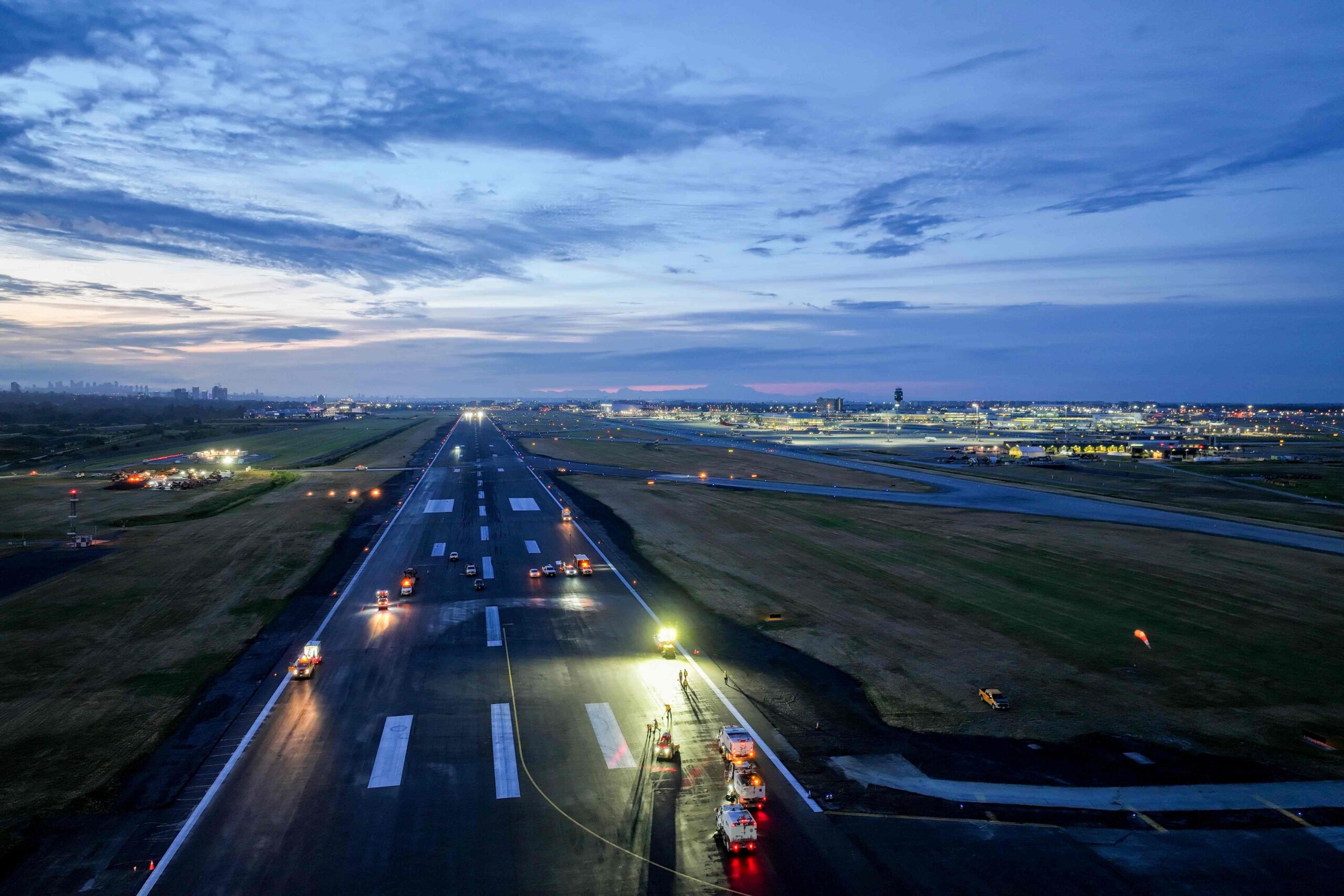
It is one thing to keep a road open during a paving project. It’s a totally different thing to keep an airport runway open and available during paving. But that is exactly what Amrize and its partners did for a recent major runway renovation near the western Canadian city of Vancouver. The entire work had to run literally to clockwork precision with no room for error.
Constructed in the 1990s, Vancouver International Airport’s north runway has been a critical part of YVR’s airfield network, handling hundreds of aircraft movements each day. According to the airport administration, the 3,030m-long runway handles around 370 aircraft movements daily during peak times.
But after 35 years of hard landings, the strip was in need of a hard upgrade, at a cost of around CAN$133 million.
In October 1994, YVR announced that it had selected Kiewit, along with Lafarge Canada, to deliver paving and construction services and Tristar Electric to deliver lighting and electrical works. DeltaTec was selected as a subcontractor to Tristar. The upgrade programme was to generate an additional 100,000 person-hours of work during construction, resulting in new jobs and economic value for the region.
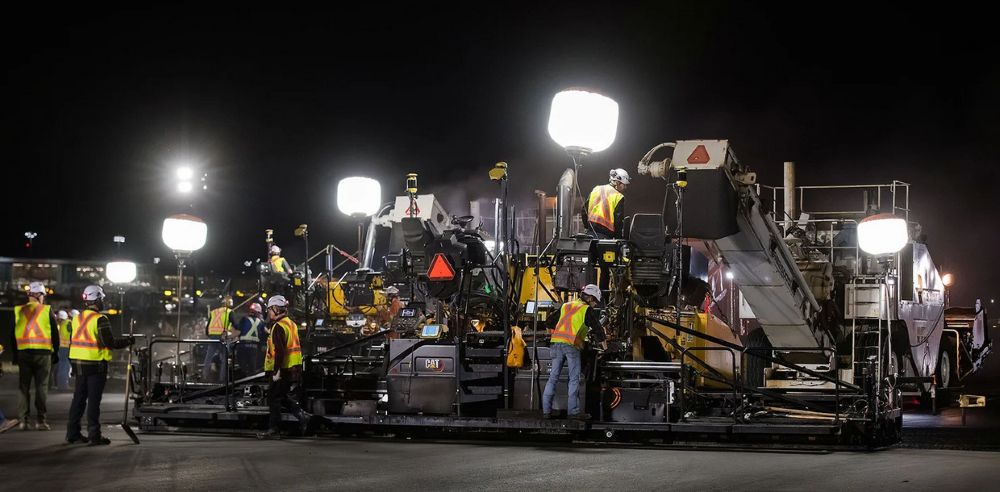
YVR operates a dual-runway system, with aircraft typically using the south runway for departures and north runway for arrivals. But this has been altered depending on construction activity and requirements. In preparation for the start of paving, crews set up the airside laydown site, created access roads and conducted environmental testing around the construction site. This required the programme team to work together seamlessly as planned and complete the early works. Prior to all this, in March, crews undertook a trial exercise which provided teams with the opportunity to refine strategies and plans to safely maximise productivity within the limited construction window each night.
The runway and connecting taxiways had around 230mm of asphalt overlay. The upgrade work was to include a complete asphalt overlay of the runway and connecting taxiways, drainage improvements and electrical improvements. Around 1,600 LED lights had to be modified to match the new runway height. Of these around 102 halogen bulbs were replaced with high-efficiency lights in order to ensure that all north runway lights were LED.
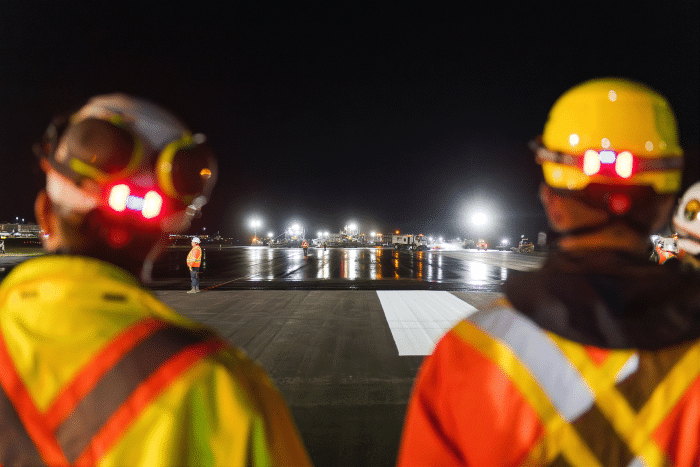
However, key to the contract was that the runway was to remain open during airport operational times, basically during the day. All paving was to be done at night which required exceptional efficiencies to complete essential work on time. To this end, the work, which started in the spring of last year, was carefully planned to take place during six months of overnight shifts starting at 10pm. By sunrise every day, crews returned the runway to service with its surface, line painting and lights ready to safely accommodate the day’s flights schedule. This overnight window would shape every aspect of the project.
Each evening before the shift began, teams reviewed minute-by-minute schedules, examined weather conditions and coordinated assets for the night shift. Since all work had to be completed, inspected, cleaned up and handed back to airport operations before the first morning arrival, planning and communication were just as crucial as the paving itself.
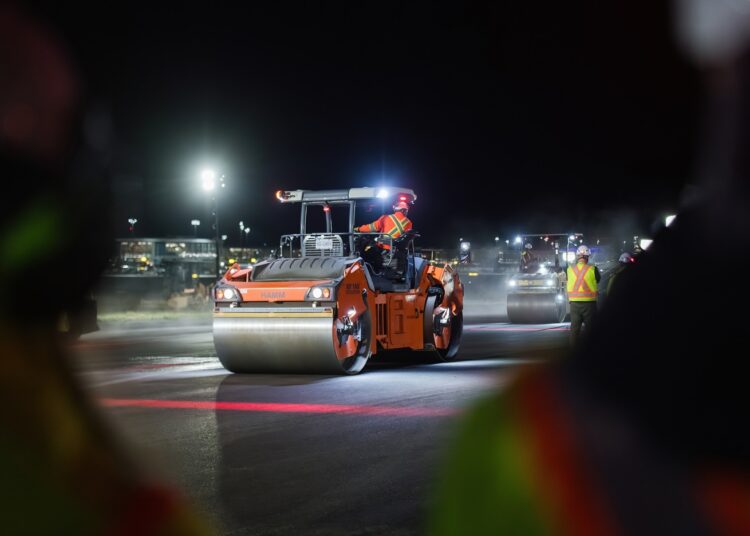
Working in partnership with YVR’s general contractor Kiewit – which built the runway back in 1996 – Amrize supplied and placed around 154,000 tonnes of advanced asphalt solutions across the entire north runway and its connecting taxiways. The largest night-time paving shift involved laying around 2,300 tonnes of asphalt over a 230m-long strip of runway.
Amrize deployed dedicated, highly trained crews to deliver a complex paving programme under a tight scheduling window with the company’s Mitchell Island plant playing a key role, explains Brice Babuik, Amrize’s pave manager for the greater Vancouver area. The Mitchell Island team ensured the 400-tonne-per-hour plant maximised uptime and produced consistent, high-quality asphalt mix. Asphalt paving machines included a Caterpillar AP-1055 and a Vögele 2000-3i. The pave teams mastered the use of dual 10m screeds that were paving in echelon with Topcon Positioning Systems’ Millimeter GPS paving control. Hamm rollers were also used.
The asphalt mix incorporated additives and fibres to make it stronger and longer lasting. It was also produced with Environmental Product Declarations (EPDs) which provide transparent information about the environmental impact of the materials used.
With 100 crew members operating 100 pieces of equipment across the full project night after night, consistency was critical. For Amrize’s portion, that meant managing up to 60 milling and paving units, supported by 30 trucks and transfers to keep material moving efficiently. Technology lent a hand to ensure repeatable results over the programme, while maximising efficiency, quality and speed.
For example, the mmGPS Paver Control automated screed adjustments for consistent surfaces. Thermal imaging allowed for real-time monitoring of the asphalt temperature for optimal compaction. The use of wide screeds meant fewer joints, greater paving efficiency and higher nightly volumes of asphalt being laid down.
Together, these tools helped Amrize lay 220mm-depth overlays in generally 120m-long increments. This ultimately provided a smooth, uniform surface across the 65m-wide, 3km-long runway and its 11 taxiways.
The project also included 120,000m² of topsoil placed around the perimeter of the runway that was seeded with vegetation indigenous to the area.
Amrize believes that the north-runway programme exemplified the power of a close partnership between itself, YVR and Kiewit, as well as the broader construction and operations teams. Through extensive pre-planning, high-performance materials, and specialised equipment, the project stayed on schedule throughout the six months of construction, which concluded in October last year.
Its approach – nightly work, innovative materials, precise execution and seamless handovers – has been drawing interest from airports across North America, says Gord Bird, Amrize’s general manager for the greater Vancouver area. These airports are looking to modernise major airfield infrastructure while keeping flights on schedule, passengers on the go and airlines doing business.
For a video of the project, click here.
Product of Canada
Cement producer Amrize, which until mid-2025 was called Lafarge Canada, was part of the Holcim Group. Holcim announced it would spin-off its North American holdings into a new, independent public company and Amrize came into existence last June.
Amrize recently launched a “Product of Canada” cement label, offering builders the assurance of Canadian-made manufacturing and quality. The label signifies that all aspects of the cement are made in Canada from raw materials and processing to manufacturing, meeting applicable national requirements. This label is being rolled out at key Amrize cement operations in the country, beginning at its flagship cement plant in Exshaw in the province of Alberta – the largest cement plant in Canada – as well as at the company’s plant in Bath, Ontario.
Apart from its work at Vancouver International Airport, Amrize has helped shape many of Canada’s most recognisable landmarks, such as the iconic Confederation Bridge linking the Atlantic island province of Prince Edward Island to New Brunswick province, the Champlain Bridge in Montreal and essential infrastructure work at Calgary International Airport.