• About
  • Advertise
  • Contact
Friday, July 17, 2026
Newsletter
Global Highways
  • News
  • Products
  • Features
  • Categories
    • Asphalt Milling, Paving & Compaction
    • Concrete Milling, Paving & Compaction
    • Connected Construction
    • Earthmoving & Soil Compaction
    • Engines, Components & Tyres
    • Finance & Funding
    • Highway & Network Management
    • Maintenance
    • Materials
    • Recycling
    • Road Markings, Barriers & Workzone Protection
    • Road Structures
  • Events
    • Events Calendar
    • CONEXPO-CON/AGG 2026
    • Intertraffic Amsterdam 2026
    • bauma 2025
  • Latest Magazine
  • Videos
No Results
View All Results
  • News
  • Products
  • Features
  • Categories
    • Asphalt Milling, Paving & Compaction
    • Concrete Milling, Paving & Compaction
    • Connected Construction
    • Earthmoving & Soil Compaction
    • Engines, Components & Tyres
    • Finance & Funding
    • Highway & Network Management
    • Maintenance
    • Materials
    • Recycling
    • Road Markings, Barriers & Workzone Protection
    • Road Structures
  • Events
    • Events Calendar
    • CONEXPO-CON/AGG 2026
    • Intertraffic Amsterdam 2026
    • bauma 2025
  • Latest Magazine
  • Videos
No Results
View All Results
Home Features On the road to energy efficiency and emissions reduction with IRF

On the road to energy efficiency and emissions reduction with IRF

Global commitments to reduce carbon emissions and simultaneously increase the resilience of critical infrastructure to extreme weather events have placed greater societal expectations on road builders to design and deliver sustainable pavements that are both affordable and scalable.

by Sarah Biswell
November 15, 2019
in Features
Reading Time: 3 mins read
A A

A particular manifestation of the problem is known as the urban heat island (UHI) effect. UHIs manifest as the temperature rise in built-up urban areas relative to the surrounding rural countryside, largely because of the relatively greater proportion of incident solar energy that is absorbed and stored by man-made materials. The direct impact of UHI can be significant on both daytime and night-time temperatures, and the indirect impacts include increased air conditioning loads, deteriorated air and water quality, and reduced pavement lifetimes. As temperature extremes become more frequent, future pavement properties will fall outside the current design envelope. Mitigation strategies can be roughly lumped into two categories: increased vegetation (trees, landscaping, and green spaces) and changes to building practices including, alternative pavements and paved surfaces design with modified thermal properties and a longer life span.

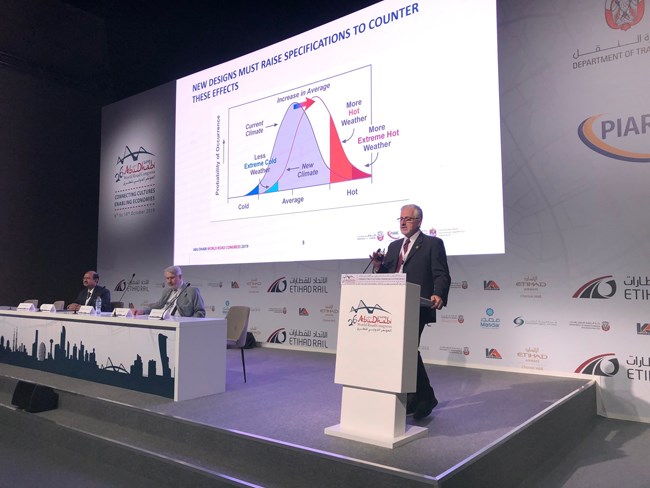
Against this backdrop, the International Road Federation sponsored a foresight session on sustainable pavements during the recent PIARC World Road Congress in Abu Dhabi. The aim of the session was to present a comparative benchmark of the state of readiness of the most promising pavement technologies, and endeavour to achieve a high-level consensus on the political and financing framework required to operate the transition from pilots today, to large-scale deployment tomorrow.

Top-level panellists with a diverse background in pavement research, design guidelines and industry applications confirmed that technological responses – and the associated decision support tools – are available to deploy tested and proven solutions with demonstrable benefits in a relatively short time frame.

There is no doubt that knowledge, scientific data and technical guides on improved road materials and construction processes exist in the region and around the world. Decision-makers need to make a bold move on accepting change, promoting innovation, and providing a platform for implementation.

These innovations include high-quality pavement materials with life-extending additives and green pavement technologies such as recycled asphalt materials which combine to offer road agencies a powerful toolkit of energy and environmental performance enhancement mechanisms. As a case in point, modern asphalt rubber mixtures have been tested to deliver improved permanent deformation and fatigue cracking whilst providing a much-needed recycling outlet for end of life tyres.

Panellists also noted that progress is already visible on the ground, but needs to be dramatically scaled up given the magnitude of the problem. In the United Arab Emirates, which hosted the discussions, sustainable pavements and construction practices are well defined and laboratory testing capabilities and modelling techniques are well established. Pavement test sections of modified materials have been installed, and some are being planned for near future installations.

International cooperation and exchange of best practices remain a must, and these questions will continue driving the work of the Washington-based IRF Global Committee on Sustainable Pavements in the years to come.


Promoted Content Header
Washington-based IRF Global VIEW COMPANY
Climate resiliency: beyond design and construction
Features

Climate resiliency: beyond design and construction

July 18, 2023
IRF Washington
Features

GRAA Winner Profile: Samuel De Champlain Bridge Corridor project

June 7, 2023
IRF Washington
Features

IRF Announces winners of 2022 Global Road Achievement Awards

February 9, 2023
IRF Washington
Features

Safety has no alternative

January 30, 2023

Related Posts

One of the tasks involved flipping bottles up from the ground (Image: Hitachi Construction Machinery Europe/HCME)

Europe’s best operators get ready for the LANDCROS Operator Challenge Final

by Sarah Biswell
July 10, 2026

More than 90 of Europe's most skilled excavator operators have showcased their skills in recent months by taking part in...

Road repairs work

The importance of road maintenance

by Staff Writer
July 10, 2026

Gülay Malkoc discusses the importance of investing in road maintenance.

The new 24litre engine from DEUTZ is designed for high-load genset applications - (image: Deutz)

High power generation from Deutz

by Mike Woof
July 8, 2026

Deutz is offering a rugged new engine to suit challenging power generation installations

Join our newsletter

The mission of Global Highways is to cover the latest technologies and best practices in all areas of road, bridge and tunnel construction and maintenance, as well as their safe operation and management.

Subscribe to our newsletter

About Us

  • About Us
  • Advertise
  • Contact
  • Terms & Conditions
  • Privacy Collection Notice
  • Privacy Policy

Popular Topics

  • News
  • Features
  • Products
  • Videos
  • Events
  • CONEXPO-CON/AGG 2026
  • Intertraffic Amsterdam 2026
  • bauma 2025

© 2026 All Rights Reserved. All content published on this site is the property of Prime Creative Media. Unauthorised reproduction is prohibited

No Results
View All Results
NEWSLETTER
  • News
  • Products
  • Features
  • Categories
    • Asphalt Milling, Paving & Compaction
    • Concrete Milling, Paving & Compaction
    • Connected Construction
    • Earthmoving & Soil Compaction
    • Engines, Components & Tyres
    • Finance & Funding
    • Highway & Network Management
    • Maintenance
    • Materials
    • Recycling
    • Road Markings, Barriers & Workzone Protection
    • Road Structures
  • Events
    • Events Calendar
    • CONEXPO-CON/AGG
    • Intertraffic Amsterdam 2026
    • bauma 2022
  • Latest Magazine
  • Videos
  • About
  • Advertise
  • Contact

© 2026 All Rights Reserved. All content published on this site is the property of Prime Creative Media. Unauthorised reproduction is prohibited