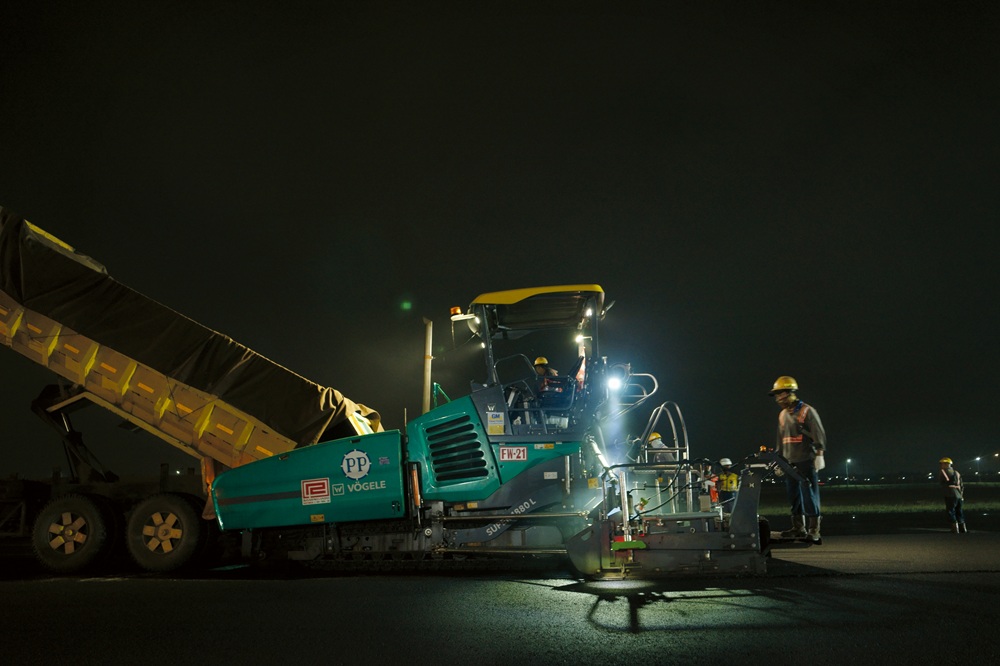
Jakarta’s Soekarno Hatta International Airport is now benefiting from a new runway surface, following the completion of repaving work. The 3.6km-long by 60m-wide runway had to be repaved at night so as to minimise disturbance for the flights using the busy airport.
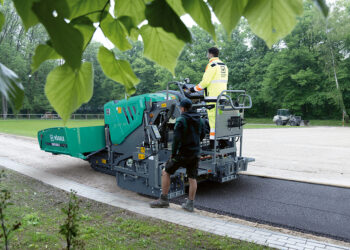
The lead contractor for the runway project, PT Roadmixindo Raya, opted to utilise two SUPER 1880 L pavers from Vögele for the work, with the machines working in echelon. Using the two pavers so close to each other allowed the surface to be laid ‘hot-to-hot’, ensuring an effective bond at the joint and ensuring a longer life for the surface.
The work was needed to redevelop the facility as the number of passengers and aircraft movements at the airport in Jakarta has been increasing significantly over several years. This has resulted in the airport, Indonesia’s largest, undergoing an almost continuous process of modernisation and expansion. One of the airport’s three runways was due for resurfacing work. However, the job presented challenges to the contractor as the work could only be carried out between llpm at night and 5am in the morning, so as not to disrupt the busy flight schedule.
Reliable and productive machines were required to deliver the paving work within the tight timeslot available for the contractor. Two Vögele SUPER 1880 L pavers were selected by the contractor for the job. These two pavers were able to deliver the high efficiency, productivity, and quality required for the work to rehabilitate the runway.
The two pavers were operated in echelon to pave four layers each. Because they operated in staggered format, one slightly ahead of the other, the asphalt could be laid ‘hot-to-hot. This is a key factor in ensuring a long life surface as the hot asphalt forms a strong bond at the joint. The primary cause of early failure of asphalt surfaces is from water penetration followed by joint failure and potholes. But with a hot-to-hot paving operation, this potential risk is eliminated, allowing a dense and stable bonding of the individual courses and providing long-term protection against the penetration of water.
The two pavers were set with screed widths of 8m each and paved four asphalt layers in total. The two base layers had thicknesses of 7-8cm, while a binder course of 8cm was laid and then a 2cm wearing course on top.
Because of the airport environment, the contractor had to meet very tough requirements on surface quality. At international airports, paving requirements are based on the strict regulations of two aviation authorities, the International Civil Aviation Organization (ICAO) and Federal Aviation Administration (FAA). These define a variety of parameters ranging from the mix quality and tensile strength to the surface quality and paving precision. Equally strict requirements apply to the formation of joints.
In addition to the strict quality requirements and the tight time window, care also had to be taken to ensure that sufficient mix of the required quality was supplied continuously to the pavers.
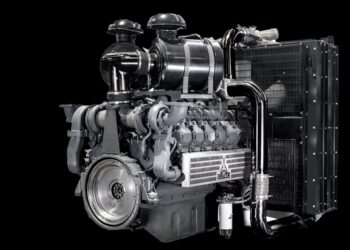
Important features of the two SUPER 1880 L pavers from Vögele included the large material hoppers and high paving rate. The SUPER 1880 L pavers are powered by efficient six cylinder diesels rated at 158kW. The paver operators were able to run the engine in ECO mode during paving situations that required less power. In this mode, nominal engine speed is reduced from 2,000-1,700rpm, lowering operating costs and noise emissions.
Maximum productivity was also a crucial factor on the airport construction site: “To make the best use of the working hours, the processes had to run smoothly. This was the only way we could keep to the schedule,” said Tadjus Tamsil, Director at PT Roadmixindo Raya. He said that one of the key features of the Vögele tracked pavers is the large material hopper with a capacity of 15tonnes. Its considerable length and low material feed height enabled each tipper truck to easily dock with the SUPER 1880 L and quickly offload the mix. “This meant that the trucks were able to quickly transfer their loads of mix, enabling us to maintain a high laydown rate and work continuously without interruption.” Andrew Davian, Project Manager at PT Roadmixindo Raya, added: “The fact that the SUPER 1880 L also made it easy to meet the required criteria for surface quality and paving precision was a huge relief for the paving crew during the demanding work through the night.”
The AB 500 TV extending screeds used on the project also played an important role in ensuring paving quality. The AB 500 has a basic width of 2.55m and can be hydraulically extended to a width of 5m. With bolt-on extensions, it enables pave widths of up to 8.5m. “Maximum quality and perfect grade and slope control are particularly critical on a project like this at the airport. The combination of the AB 500 and the tamper bar and vibration compaction systems enable us to achieve outstanding pre-compaction and, consequently, a very high-quality result,” said David Gouw Tama Priatna, Director at PT Roadmixindo Raya. In addition, the extending screed reached the specified temperature quickly and evenly due to the electric screed heating system. This system heats all components that come into contact with the asphalt mix and ensures a particularly homogeneous surface structure.
The intuitive ErgoBasic operating concept ensured precise paving results in Jakarta. It was developed on the basis of the proven ErgoPlus operating system from Vögele with the aim of being just as quick, precise, and intuitive – but slimmed down to the most important paving functions. Vögele has also developed a system for automated grade and slope control to complement the ErgoBasic operating system, namely Niveltronic Basic. This system is fully integrated into the machine control system and therefore tailored precisely to suit the SUPER 1880 L. ‘ErgoBasic is a major plus point of the Vögele paver. “The operating concept enables quick and simple control and makes it easier for the paving crew to achieve precise results,” said Faisol Fuad, likewise Director at PT Roadmixindo Raya.