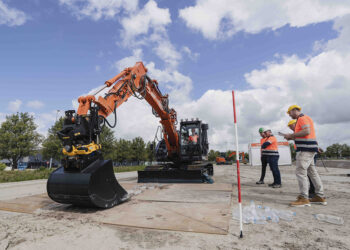
Offering a mobile charging solution, the Mobile Megawatt Charging System (MWCS) from DIMAAG-EV can deliver extra versatility for electric construction machines. The California-based firm has developed a novel rough-terrain vehicle that can drive itself to charge electric machines when required.
The firm says that the MWCS provides a fast and practical way to charge off-road electric work vehicles. This brings innovative technology in high-power fast charging on a mobile vehicle, offering versatility for customers. Targeted for use with heavy machinery such as construction or quarry equipment, DIMAAG’s MWCS offers the potential to address power-supply challenges in the field.
The 4WD unit is effectively a giant booster battery on wheels according to the company. With 1MW capability, this can recharge an electric construction machine in just 15 minutes, while an operator takes a periodic break. The unit can then be recharged overnight for use again the following day.
The firm says that the unit benefits from advanced thermal-management technology that boosts safety and lifecycle to deliver improved total cost of ownership. The company also claims that its remote-controllable vehicle offers manoeuvrability and can charge multiple machines, with autonomous control available as an option.
Having developed its first electric drives more than 10 years ago for industrial applications, Bonfiglioli is now adapting the technology to manufacture electric drives for road construction equipment.
The manufacturer has developed a range of electric motors for mobile equipment, including pavers and rollers, which it calls the BPM series. The permanent magnet synchronous motors it deploys are the most efficient on the market, says Massimo Palomba, e-mobility sales and business development manager, mobility and wind industries for Bonfigloli. They have an efficiency of up to 98%, compared to 40 to 60% for hydraulic motors.
“Electrification is not only about getting away from fossil fuel, it is about reaching for better efficiency,” says Palomba. “Because an electric powertrain is more efficient than a hydraulic one, it consumes less resources.”
In a bid to fight off competition from lower cost suppliers from China and Japan, Bonfiglioli is looking to become a solutions supplier – rather than a component one. To that end it acquired electronics manufacturer Selcom so that it can now provide elements such as PCB boards and power converters in-house.
Volvo Penta has highlighted its battery-electric platform for construction, emphasising its battery energy- storage (BESS) subsystem.
The engine manufacturer says it delivers dependable power through its core pillars: proven combustion engines, purpose-built electric drivelines, and integrated battery energy-storage subsystems.
Volvo Penta’s scalable and modular BESS subsystem enables OEMs and system integrators to seamlessly integrate and deploy electric power to meet energy needs in construction.
The same high-performance, energy-dense battery technology used in Volvo Penta’s electromobility drivelines now powers its BESS subsystem – designed for reliable performance, durability, and resistance to dust and corrosion in tough environments. Volvo Penta’s BESS subsystem enables system integrators and BESS manufacturers to create tailored solutions for everything from mobile, temporary power applications to permanent infrastructure at electric sites.
Deutz is offering a range of solutions to meet customer requirements, from engines powered by diesel, hydrogen, and biofuels such as HVO (hydrotreated vegetable oil) to hybrids and fully electric drives, battery components and gensets, and digital innovations in the service business.
He said: “We also firmly believe that the internal combustion engine is here to stay for some years yet, most notably in heavy-duty applications. When run on hydrogen, modern biofuels, or in hybrid systems, where Deutz combustion engines serve as range extenders for battery-electric drives, combustion technology is already able to contribute to decarbonisation.” All Deutz engines are approved to run on HVO.
The firm is offering an efficient internal combustion engine, the Deutz TCD 3.9/4.0, developed to deliver a powerful and reliable solution for the off-highway segment that can cope with the most challenging conditions.
The hydrogen-powered series production engine is part of the Deutz New Technology segment. The Deutz TCG 7.8 H2 is the first hydrogen combustion engine to be EU Stage V-certified.
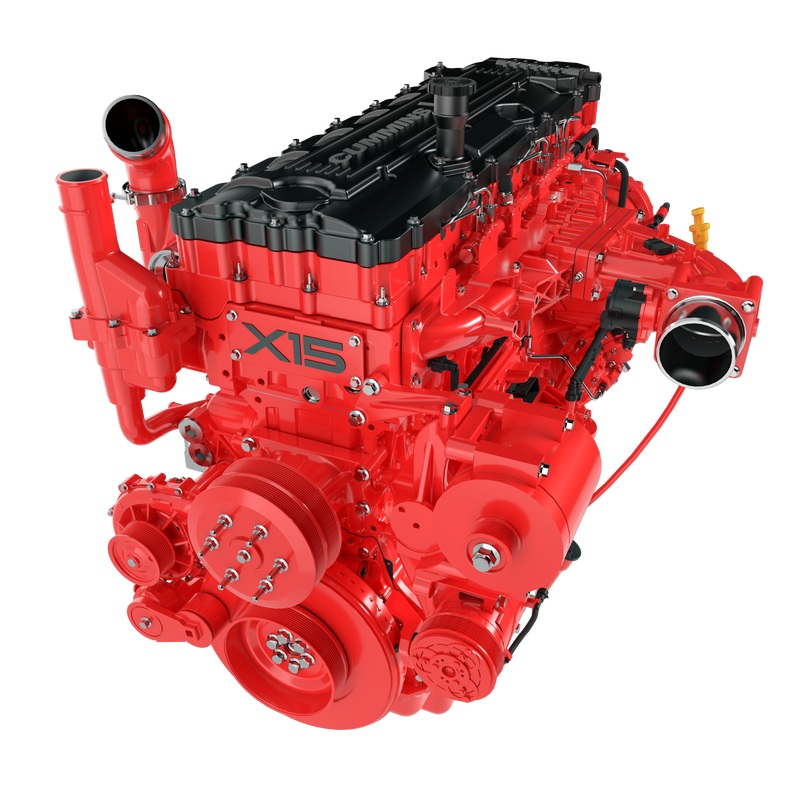
The Next Gen X15 for Off-Highway engine from Cummins delivers more than just power and drivability for off-road machines: it offers reliability and operating-cost reductions through a proprietary, prognostic-based, maintenance-monitoring system, says the manufacturer.
Millions of miles of testing data have been analysed by Cummins engineering experts to allow the new engine to deliver life-remaining forecasts on engine consumables including oil, oil filter, stage 2 fuel filter, DPF, and urea filter.
These first-fit devices offer immediate access to Cummins’ Connected Solutions …a full suite of digital capabilities.
There is also remote diagnostics with real-time monitoring of fault alerts and predictive insights for Cummins engines to reduce unplanned downtime.
The new 2606-E13TA engine from Perkins delivers a market-leading power density according to the firm. This 13litre unit delivers similar outputs to earlier generation 15litre and even 18litre single-turbo engines.
The engine features a narrow design with the gear train at the rear and the alternator mounted directly on the block.
Benefitting also from a variable geometry turbo, the engine can deliver from 340-515kW and is HVO ready, with the potential for alternative fuels such as methanol, ethanol and hydrogen.
Meanwhile, the improved 904 J-E36TA unit now offers a maximum power rating of 106kW, with a power-density increase of 6% and a torque increase of 3%.
The firm is also working on its six-cylinder 1206 engine, being developed as a multi-fuel project trialling ethanol, methanol, biomethane and hydrogen.
According to a Perkins spokesperson: “It’s in the test cell right now and is one year into a three-year programme.”
Rehlko’s new KDI 1903TCR engine packs a big punch in a compact package, delivering 50kW of power and 250Nm of torque with three cylinders.
“Our mantra is power density and torque density,” says Massimiliano Bonanni, general manager – product strategy at Rehlko.
The KDI range includes three-cylinder 1.9litre engines which deliver a power output of 42kW and 225Nm torque and four-cylinder 2.5litre engines which deliver 56kW and 315Nm torque. The KDI 1903TCR sits in between the two.
The new engine would be suited to a wide range of construction equipment such as small excavators, skid-steers, telehandlers or pumps.
John Deere Power Systems (JDPS) says it is ushering in ‘a new era in power’ with its comprehensive range of power solutions, emphasising innovation, sustainability, and customer-focused design.
JDPS says that its comprehensive engine line-up includes next-generation engines. This includes the JD4, JD14, and JD9 engine that provides more power than the existing John Deere PSS 9litre engine and offers streamlined integration, making it ideal for a wide range of construction applications. The optimised JD9 builds on the proven performance of the existing 9litre engine to offer lower complexity and installation costs while maintaining the renowned John Deere quality and reliability.