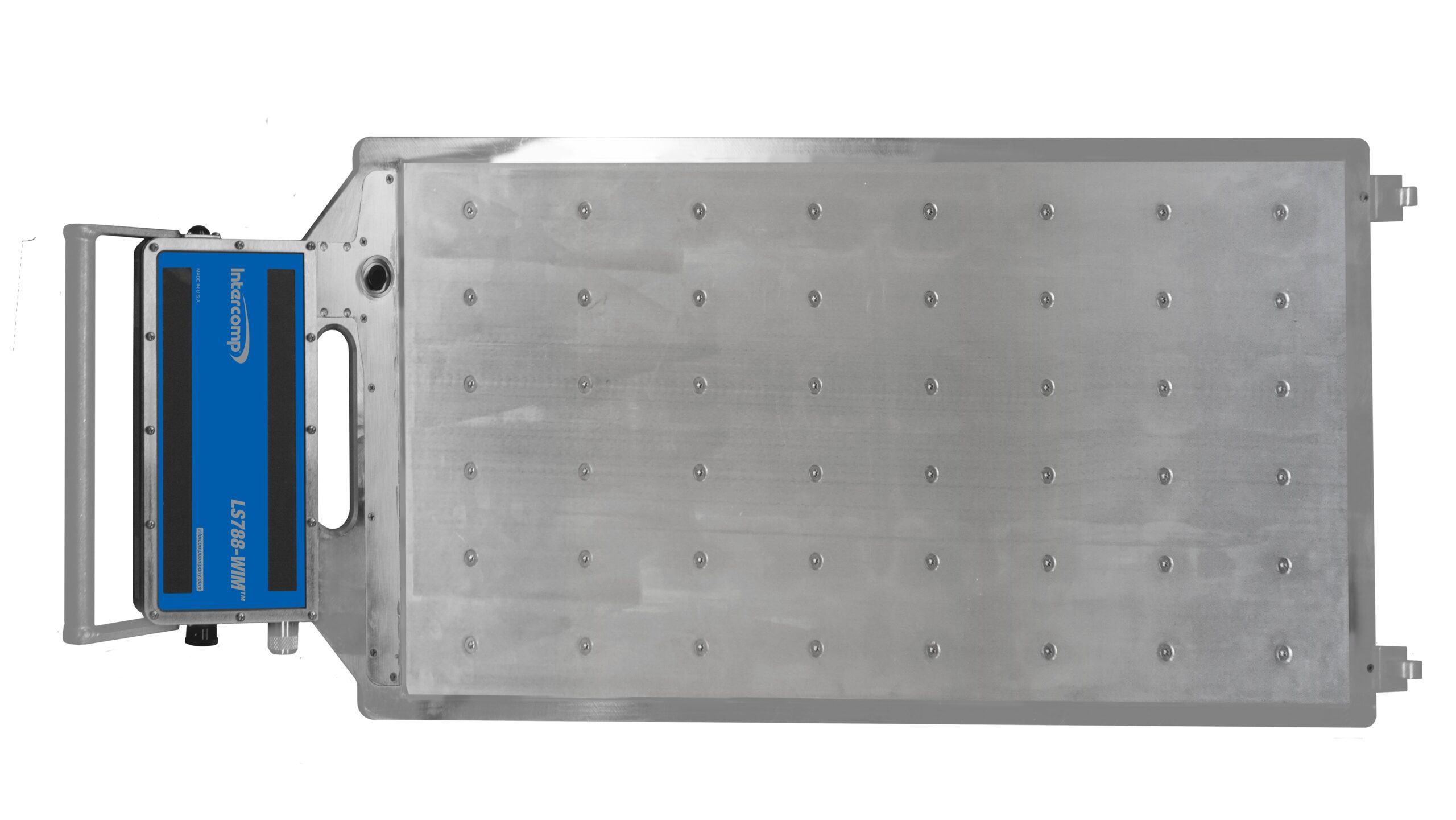
Intercomp reports that its LS788-WIM portable weigh-in-motion scale has received NTEP certification for commercial-vehicle weight enforcement.
All devices sold in the US as “legal for trade” purposes must pass evaluation to get a National Type Evaluation Program (NTEP) certification.
The LS788-WIM is the firm’s latest low-profile, high-performance strain gauge portable scale. Intercomp says it can be deployed by one person in under 15 minutes and fits easily in the back of a vehicle, making it ideal for rapid use at mobile enforcement sites.
Used with roll-up portable ramps, the system is only 22mm high but can also be used for static weight measurement.
The completely wireless LS788-WIM scales are powered by solar power and batteries.
Total system capacity is up to 9,979kg with an accuracy weight measurement of 2-3% when used dynamically at speeds of up to 16kph. For static measurement, weighing precision is ± 0.5%.
The LS788-WIM features Intercomp’s RFX wireless-ready, remote- communication capabilities as standard, allowing the scale system to communicate weight data wirelessly to RFX-enabled WIM indicators, displays, or PCs.
With line-of-sight connectivity up to 90m, the technology operates pairs of portable axle scales while protecting the safety of officials on the ground who need no longer approach scales around moving vehicles to get a weight reading. Multiple scales can be operated simultaneously, while workers are kept apart from traffic.
Intercomp adds that that 89cm-wide, low-profile scale platform allows the LS788-WIM to handle dual-tyred axles “with ease”.
Last year Intercomp launched the LTR788 Dual Platform Scale, also NTEP-certified for commercial-vehicle weight enforcement. Intercomp created the LTR788 scale for direct measurement of individual tyre-loading in a dual-tyre configuration.
Historically, tyre failures within dual-tyre setups have occurred more frequently on inner tyres than outer tyres. However, it was also assumed that individual tyres in a dual-wheel configuration carry near equivalent loads. This was because there was no scale which could directly measure individual tyre weights.