• About
  • Advertise
  • Contact
Saturday, July 18, 2026
Newsletter
Global Highways
  • News
  • Products
  • Features
  • Categories
    • Asphalt Milling, Paving & Compaction
    • Concrete Milling, Paving & Compaction
    • Connected Construction
    • Earthmoving & Soil Compaction
    • Engines, Components & Tyres
    • Finance & Funding
    • Highway & Network Management
    • Maintenance
    • Materials
    • Recycling
    • Road Markings, Barriers & Workzone Protection
    • Road Structures
  • Events
    • Events Calendar
    • CONEXPO-CON/AGG 2026
    • Intertraffic Amsterdam 2026
    • bauma 2025
  • Latest Magazine
  • Videos
No Results
View All Results
  • News
  • Products
  • Features
  • Categories
    • Asphalt Milling, Paving & Compaction
    • Concrete Milling, Paving & Compaction
    • Connected Construction
    • Earthmoving & Soil Compaction
    • Engines, Components & Tyres
    • Finance & Funding
    • Highway & Network Management
    • Maintenance
    • Materials
    • Recycling
    • Road Markings, Barriers & Workzone Protection
    • Road Structures
  • Events
    • Events Calendar
    • CONEXPO-CON/AGG 2026
    • Intertraffic Amsterdam 2026
    • bauma 2025
  • Latest Magazine
  • Videos
No Results
View All Results
Home Features New developments in bitumen technology

New developments in bitumen technology

From softwood in Sweden to rubber and rubble in Australia - Kristina Smith reports on new technologies which could shape tomorrow’s asphalt mixes

by Kristina Smith
November 30, 2020
in Features
Reading Time: 3 mins read
A A
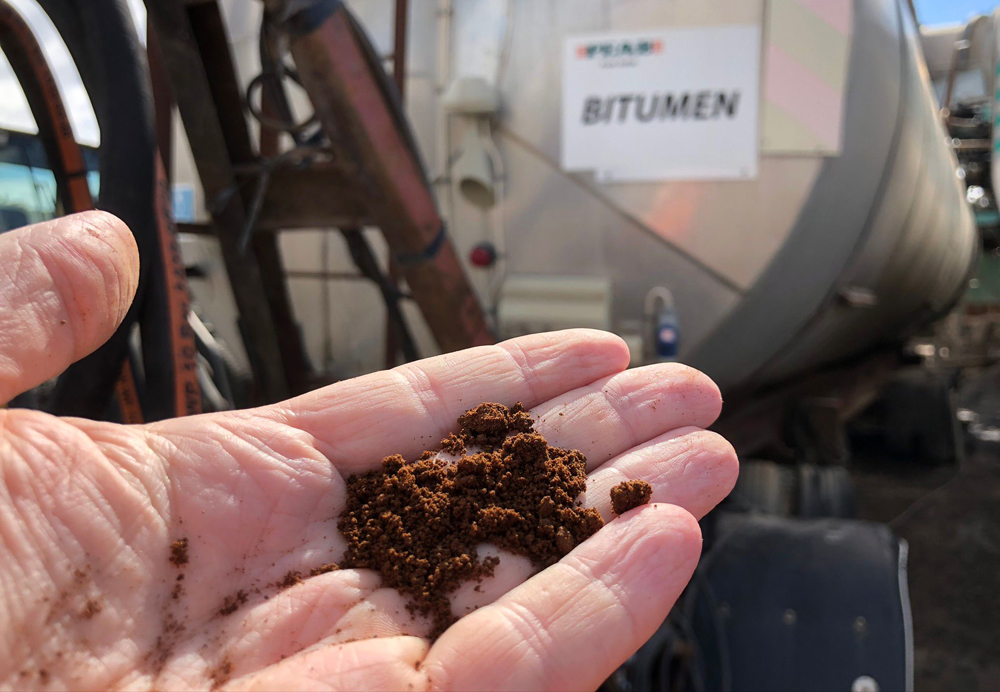
Lignin, a natural polymer from softwood has been used to replace some of the bitumen in a road in Sweden

Lignin, a natural polymer from softwood has been used to replace some of the bitumen in a road in Sweden

PEAB Asphalt has laid a short section of road in Northern Sweden with asphalt containing lignin, an organic polymer found in plants and some algae. The lignin used in this trial has been extracted from softwood. Replacing some of the bitumen in a mix with a renewable material such as lignin would reduce consumption of bitumen and lessen the environmental impacts of road construction.

The trial is part of a bigger European-funded research programme, Rewofuel, to investigate the use of biofuel in sectors such as aviation and automotive.  The €19.8 million programme kicked off in June 2018 and will run until the middle of 2021.

PEAB laid the 50m-long section of binding layer asphalt in early July on a municipal street in Sundsvall, which is around 400km north of Stockholm. Up to 10,000 vehicles/day use the road in an area which experiences severe weather conditions in winter, requiring studded tyres to deal with the snow and ice.

“This first field trial was important for us because it allowed us to see the effects of the lignin during normal production, whether it reacts to anything, how it smells,” explained Mats Wendel, innovation advisor for PEAB Asfalt, with is part of the PEAB construction and civil engineering group. Wendel reports that there was no difference in the production and workability of the asphalt, although it did smell slightly different, with some observers noticing the scent of wood.

Although PEAB has successfully replaced up to 25% of the bitumen with lignin in laboratory tests, the researchers decided to go for a more modest 10% replacement for the field trial. “That kept us within the national specification, which is based on the European one,” said Wendel. “We thought it was a good thing to stay safe for our first trial.”

Swedish chemical and cleantech company Sekab produced the lignin used in the asphalt trial. One of the biggest technical challenges for the researchers was how to mix the lignin, which is in powder form, into the bitumen.
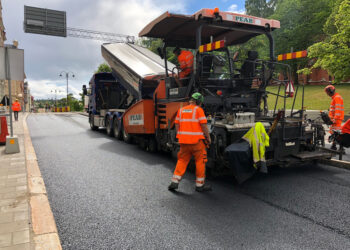
The road featuring lignin was laid in Northern Sweden by PEAB

The next step will be to carry out more trial paving sections, including laying surface courses which can be monitored for performance over time. Although studies suggest that asphalt containing lignin could perform better than asphalt with bitumen only, Wendel says that currently they can only say that the performance is just as good as a standard mix asphalt.

PEAB Asfalt has been aggressively pursuing carbon reduction goals across its business, working over the past five years to introduce biofuels at its asphalt plants in order to lower carbon emissions by almost 50%. “This year we will be using renewable fuels at all our stationary plants,” said Wendel. “If you can reduce carbon emissions by half using existing technology and still be competitive, then you can move on to start working on the other half.”

International and national carbon reduction commitments mean that highway authorities in Sweden are also keen to try new technologies and get involved in trials, said Wendel: “Road owners know that they have to be part of the change.”

Categories: Materials
Promoted Content Header
Peab Asfalt VIEW COMPANY
Swedish recycling group Ragn-Sells could bring more environmentally-friendly-produced road salt to Scandinavia’s highways (image courtesy Peab)
News

Circular salt for Sweden

May 23, 2022
Eurobitume President Christophe Jacquet - 2018650.jpg
Features

A new event is preparing the asphalt industry for tomorrow’s world

September 11, 2018
Features

Digital opportunities: Eurasphalt & Eurobitume (E&E) event, Berlin

July 3, 2018

Related Posts

One of the tasks involved flipping bottles up from the ground (Image: Hitachi Construction Machinery Europe/HCME)

Europe’s best operators get ready for the LANDCROS Operator Challenge Final

by Sarah Biswell
July 10, 2026

More than 90 of Europe's most skilled excavator operators have showcased their skills in recent months by taking part in...

Road repairs work

The importance of road maintenance

by Staff Writer
July 10, 2026

Gülay Malkoc discusses the importance of investing in road maintenance.

The new 24litre engine from DEUTZ is designed for high-load genset applications - (image: Deutz)

High power generation from Deutz

by Mike Woof
July 8, 2026

Deutz is offering a rugged new engine to suit challenging power generation installations

Join our newsletter

The mission of Global Highways is to cover the latest technologies and best practices in all areas of road, bridge and tunnel construction and maintenance, as well as their safe operation and management.

Subscribe to our newsletter

About Us

  • About Us
  • Advertise
  • Contact
  • Terms & Conditions
  • Privacy Collection Notice
  • Privacy Policy

Popular Topics

  • News
  • Features
  • Products
  • Videos
  • Events
  • CONEXPO-CON/AGG 2026
  • Intertraffic Amsterdam 2026
  • bauma 2025

© 2026 All Rights Reserved. All content published on this site is the property of Prime Creative Media. Unauthorised reproduction is prohibited

No Results
View All Results
NEWSLETTER
  • News
  • Products
  • Features
  • Categories
    • Asphalt Milling, Paving & Compaction
    • Concrete Milling, Paving & Compaction
    • Connected Construction
    • Earthmoving & Soil Compaction
    • Engines, Components & Tyres
    • Finance & Funding
    • Highway & Network Management
    • Maintenance
    • Materials
    • Recycling
    • Road Markings, Barriers & Workzone Protection
    • Road Structures
  • Events
    • Events Calendar
    • CONEXPO-CON/AGG
    • Intertraffic Amsterdam 2026
    • bauma 2022
  • Latest Magazine
  • Videos
  • About
  • Advertise
  • Contact

© 2026 All Rights Reserved. All content published on this site is the property of Prime Creative Media. Unauthorised reproduction is prohibited