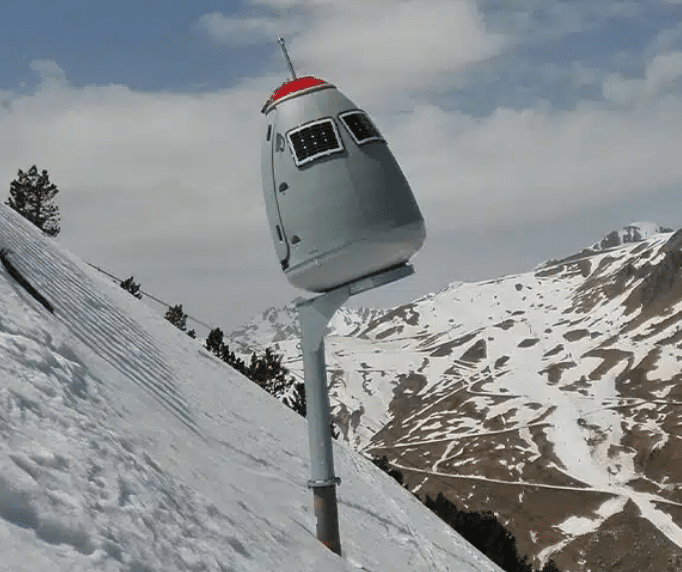
MND Safety reports that it recently deployed 24 removable O’BellX
avalanche-control systems to secure the main road on the Norwegian island of Arnøya.
The installation enables preventive avalanche release even in extreme climatic conditions and during the polar night, thanks to autonomous systems that can be remotely operated.
MND Safety has also secured a contract for roads leading to Norway’s North Cape for the installation of 19 additional O’BellX systems, representing several million euros, confirming the renewed confidence of Norwegian authorities in these technologies, noted MND.
The North Cape is on the northern coast of the island of Magerøya in northern Norway. The European route E69 motorway has its northern terminus at the North Cape which makes it the northernmost point in Europe that can be accessed by car and the E69 the northernmost public road in Europe.
MND is a French industrial group with more than 3,000 clients in 49 countries, operating through 12 international locations. Its Safety division has been specialising in developing explosive-free, preventive avalanche-control systems for more than 30 years in order to secure infrastructure exposed to avalanche hazards. The company’s solutions allow infrastructure managers, such as road agencies, to trigger avalanches at the most appropriate time. This limits the need for road closures and improves the safety of both highway operational teams and road users.
“Transport infrastructure in mountainous regions is increasingly exposed to natural hazards” said Jean-Guillaume Aldebert, director of the MND’s Safety division. “Our objective is to provide infrastructure operators with reliable, remotely operated solutions adapted to extreme environments, in order to sustainably secure transport corridors while ensuring the safety of operators.”
Its Gazex, O’BellX and DaisyBell solutions are now used to protect roads, as well as railways, industrial sites, ski resorts and energy infrastructure in more than 20 countries. Designed and manufactured in the French Alps, these technologies help ensure safe mobility and strengthen the resilience of infrastructure in mountainous regions.
Key features of the O’BellX include an MND-patented automatic drop/replacement hook that allows the active module to be installed and removed from its support base by helicopter without any human assistance and in a single rotation.
Meanwhile, the MND-patented MULTISYNC option allows for simultaneous explosions, as well as synchronised, successive explosions with a possible delay of up to five seconds for firings on anywhere from two to 10 O’BellX or O’BellX Option+ systems.
The Option+ system’s support base incorporates a skirt that allows the system to double the amount of gas mixture used at the time of firing, thus doubling the explosion’s effect compared to the standard O’BellX module. The overall height of the Option+ support base can be selected during installation, based on the terrain and historical snow conditions, to position the explosion point at the most effective elevation.
In the mountainous Canadian province of British Columbia, MND said that no fewer than 30 Gazex systems, five O’BellX units and one DaisyBell system protect people and goods along several dozen kilometres of major highway corridors.
Meanwhile, in the US, several state departments of transportation rely on the group’s technologies to secure avalanche-prone mountain roads, most notably in the states of Utah, Wyoming and California. In Colorado, along the Loveland Pass and Eisenhower Tunnel corridor, a system combining Gazex and O’BellX technologies is in effect.
In France, Gazex technologies have been securing mountain-access roads for decades, notably in Bonneval-sur-Arc in the Savoie region, Isola 2000 in the Alpes-Maritimes and Chamonix, near the Mont Blanc Tunnel – an area particularly exposed to avalanche hazards.
MND presented its technologies in Chambéry, France, at the recent 17th World Winter Service and Road Resilience Congress, an event put on by PIARC (World Road Association), based in Paris. MND said it highlighted the expertise of its MND Safety division, a pioneer in remote, explosive-free, avalanche-control systems.
To view information about the PIARC event,click here.
To view a video of how the technology works,click here.