• About
  • Advertise
  • Contact
Thursday, July 16, 2026
Newsletter
Global Highways
  • News
  • Products
  • Features
  • Categories
    • Asphalt Milling, Paving & Compaction
    • Concrete Milling, Paving & Compaction
    • Connected Construction
    • Earthmoving & Soil Compaction
    • Engines, Components & Tyres
    • Finance & Funding
    • Highway & Network Management
    • Maintenance
    • Materials
    • Recycling
    • Road Markings, Barriers & Workzone Protection
    • Road Structures
  • Events
    • Events Calendar
    • CONEXPO-CON/AGG 2026
    • Intertraffic Amsterdam 2026
    • bauma 2025
  • Latest Magazine
  • Videos
No Results
View All Results
  • News
  • Products
  • Features
  • Categories
    • Asphalt Milling, Paving & Compaction
    • Concrete Milling, Paving & Compaction
    • Connected Construction
    • Earthmoving & Soil Compaction
    • Engines, Components & Tyres
    • Finance & Funding
    • Highway & Network Management
    • Maintenance
    • Materials
    • Recycling
    • Road Markings, Barriers & Workzone Protection
    • Road Structures
  • Events
    • Events Calendar
    • CONEXPO-CON/AGG 2026
    • Intertraffic Amsterdam 2026
    • bauma 2025
  • Latest Magazine
  • Videos
No Results
View All Results
Home Features Meva’s Mammut 350 formwork makes the difference for Neckar viaduct

Meva’s Mammut 350 formwork makes the difference for Neckar viaduct

by Sarah Biswell
April 20, 2018
in Features
Reading Time: 3 mins read
A A
Neckar PIC 1.JPG

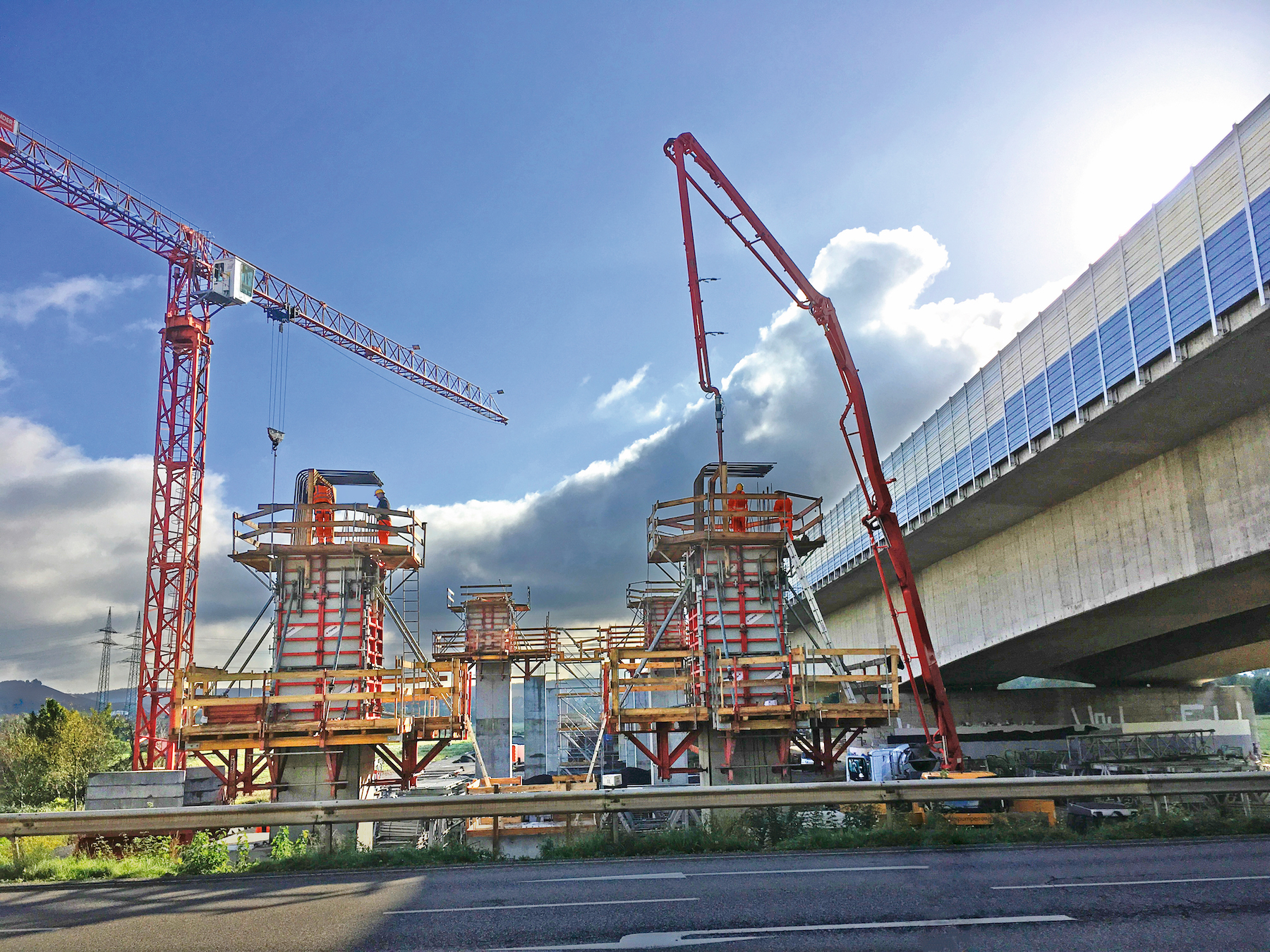
Piers parallel to the old bridge are being built using the KLK 230 climbing platform, the Space shoring tower and Mammut formwork

Formwork specialist Meva is helping replace the longest motorway bridge, the Neckar River viaduct in Germany’s south-west state Baden-Wuerttemberg

Work on the 1.3km Neckar viaduct, part of the A6 motorway at Heilbronn, should be finished by 2022. It is part of the A6 expansion project between the Weinberger junction and Wiesloch/Rauenberg.

The project is officially the new Neckar viaduct BAB 6 at Heilbronn. Federal Motorway 6, the A6, is also known as the BAB 6. The 477km motorway starts at the French border near Saarbrücken and ends at the Czech border near Waidhaus. It then continues through the Czech republic to the capital Prague. Internationally it is known as Via Carolina.

Around US$21 million was spent on renovating the structure only in 2003 but it has been struggling to handle 100,000 vehicles a day. The extension of the 25km section of motorway for an estimated €1.3 billion was announced at the start of 2017. It was immediately clear that the greatest challenge would be construction of the new six-lane bridge over the Neckar River.

ViA6West, the public-private partnership is working with partners Hochtief PPP Solutions, DIF and BUNTe. ViA6West is responsible for the planning and construction of the bridge as well as maintenance until 2046. In actual fact, two bridges will be created over the Neckar valley: a temporary parallel construction for the ongoing traffic and, after the old bridge has been dismantled, the new bridge.

ViA6West is now constructing the temporary bridge next to the old 1960s bridge in two steps. The first is building a foreland bridge with launching girder and the second is constructing the section over the Neckar using the incremental launching method.

The two sections will meet and be connected shortly before Neckar island. The entire superstructure with the travel lanes and the noise barriers is already complete. Subsequently, the old bridge will be demolished and the final foundations and piers erected.

The highlight of the project is then planned for 2022 – the lateral displacement of the two bridge sections by up to 20m onto the end piers and completion of the structure. For this, 40 hydraulic cylinders will be operated via a computer¬ and camera-controlled system to position the bridge sections to the nearest millimetre. The task will take only a few days and the bridge sections and connections will be completed. A completion deadline is set in concrete – the National Garden Show in Heilbronn, which opens its doors on April 17, 2019. Special formwork when made of wood are designed to be used only once. That the concrete bridge piers and foundations are only temporary structures which are dismantled when the actual main bridge is complete is the exception rather than the rule.

“Building a bridge of this size parallel to the old bridge and then moving it laterally into position is literally a mammoth task,” said Andreas Scherzl, a Munich-based project supervisor. “Foundations for the abutments and the bridge piers are being poured using Meva’s Mammut 350 formwork system, as are the bridge piers themselves.

“The KLK 230 climbing platform and the Space shoring tower ensure that formwork can be erected safely. The launching beams on the piers of the temporary bridge also play a key role to ensure that the entire construction can be manoeuvred laterally into its final position after completion of the superstructure complete with travel lanes and noise barriers,” explained Scherzl.

Meva’s special design department was required for work on round pier columns and the pier heads in the area of the steel reinforced concrete bridge directly above the Neckar River. Alexander Schmid, who is supervising the work, said a 3D programme was used to get the precise bending and twisting in the four formwork panels. At the customer’s request the formwork panel had to have a wooden surface.

Categories: Road Structures
Promoted Content Header
MEVA Hochtief

Related Posts

One of the tasks involved flipping bottles up from the ground (Image: Hitachi Construction Machinery Europe/HCME)

Europe’s best operators get ready for the LANDCROS Operator Challenge Final

by Sarah Biswell
July 10, 2026

More than 90 of Europe's most skilled excavator operators have showcased their skills in recent months by taking part in...

Road repairs work

The importance of road maintenance

by Staff Writer
July 10, 2026

Gülay Malkoc discusses the importance of investing in road maintenance.

The new 24litre engine from DEUTZ is designed for high-load genset applications - (image: Deutz)

High power generation from Deutz

by Mike Woof
July 8, 2026

Deutz is offering a rugged new engine to suit challenging power generation installations

Join our newsletter

The mission of Global Highways is to cover the latest technologies and best practices in all areas of road, bridge and tunnel construction and maintenance, as well as their safe operation and management.

Subscribe to our newsletter

About Us

  • About Us
  • Advertise
  • Contact
  • Terms & Conditions
  • Privacy Collection Notice
  • Privacy Policy

Popular Topics

  • News
  • Features
  • Products
  • Videos
  • Events
  • CONEXPO-CON/AGG 2026
  • Intertraffic Amsterdam 2026
  • bauma 2025

© 2026 All Rights Reserved. All content published on this site is the property of Prime Creative Media. Unauthorised reproduction is prohibited

No Results
View All Results
NEWSLETTER
  • News
  • Products
  • Features
  • Categories
    • Asphalt Milling, Paving & Compaction
    • Concrete Milling, Paving & Compaction
    • Connected Construction
    • Earthmoving & Soil Compaction
    • Engines, Components & Tyres
    • Finance & Funding
    • Highway & Network Management
    • Maintenance
    • Materials
    • Recycling
    • Road Markings, Barriers & Workzone Protection
    • Road Structures
  • Events
    • Events Calendar
    • CONEXPO-CON/AGG
    • Intertraffic Amsterdam 2026
    • bauma 2022
  • Latest Magazine
  • Videos
  • About
  • Advertise
  • Contact

© 2026 All Rights Reserved. All content published on this site is the property of Prime Creative Media. Unauthorised reproduction is prohibited