• About
  • Advertise
  • Contact
Thursday, July 16, 2026
Newsletter
Global Highways
  • News
  • Products
  • Features
  • Categories
    • Asphalt Milling, Paving & Compaction
    • Concrete Milling, Paving & Compaction
    • Connected Construction
    • Earthmoving & Soil Compaction
    • Engines, Components & Tyres
    • Finance & Funding
    • Highway & Network Management
    • Maintenance
    • Materials
    • Recycling
    • Road Markings, Barriers & Workzone Protection
    • Road Structures
  • Events
    • Events Calendar
    • CONEXPO-CON/AGG 2026
    • Intertraffic Amsterdam 2026
    • bauma 2025
  • Latest Magazine
  • Videos
No Results
View All Results
  • News
  • Products
  • Features
  • Categories
    • Asphalt Milling, Paving & Compaction
    • Concrete Milling, Paving & Compaction
    • Connected Construction
    • Earthmoving & Soil Compaction
    • Engines, Components & Tyres
    • Finance & Funding
    • Highway & Network Management
    • Maintenance
    • Materials
    • Recycling
    • Road Markings, Barriers & Workzone Protection
    • Road Structures
  • Events
    • Events Calendar
    • CONEXPO-CON/AGG 2026
    • Intertraffic Amsterdam 2026
    • bauma 2025
  • Latest Magazine
  • Videos
No Results
View All Results
Home Products MAD about Vitronic in Germany

MAD about Vitronic in Germany

Vitronic has supplied two of its latest sensor columns to the project MAD Urban (Managed Automated Driving for Urban Mobility and Logistics) being set up in Braunschweig (Brunswick).

by David Arminas
April 30, 2025
in Products
Reading Time: 4 mins read
A A
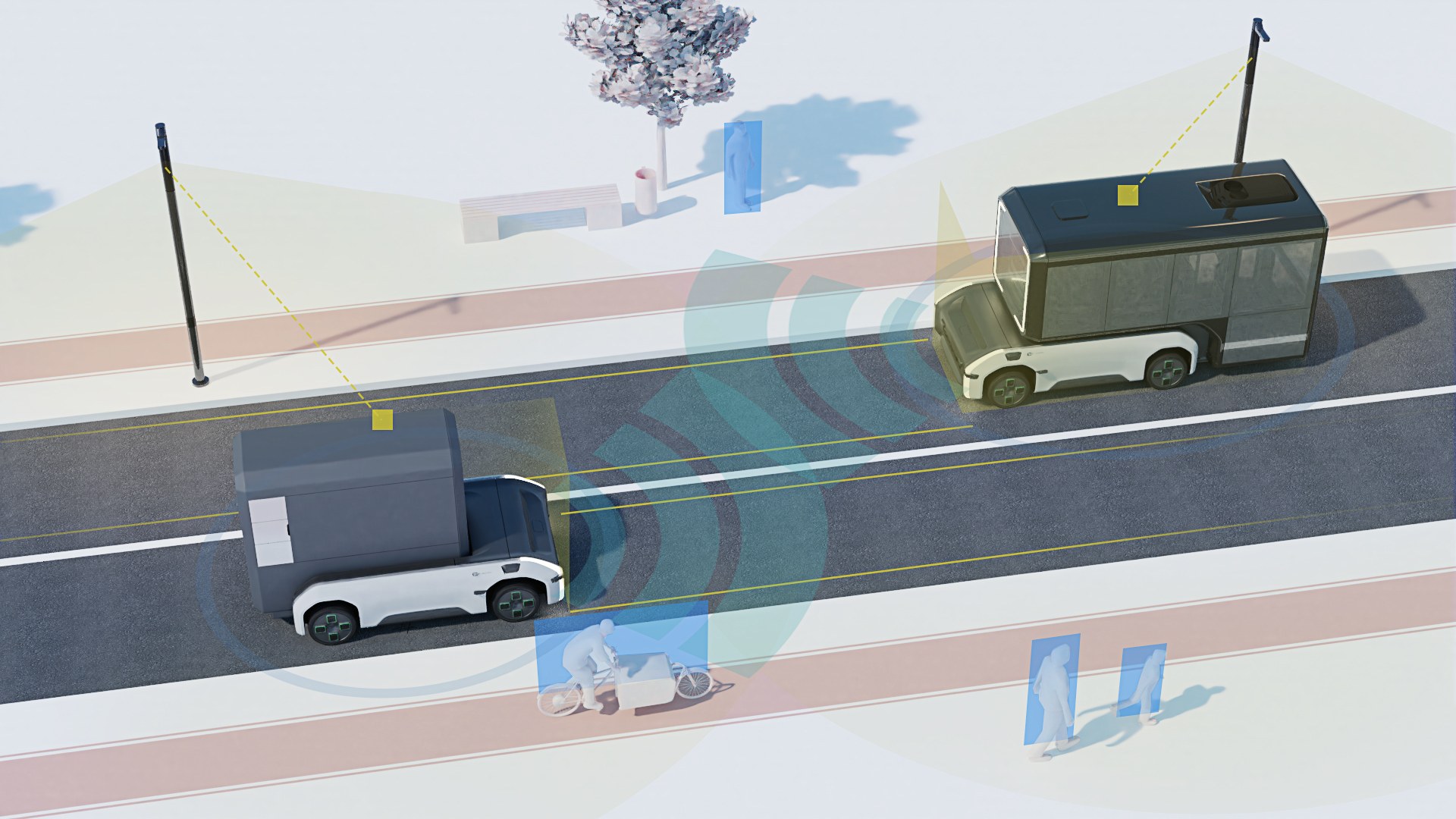
The MAD Urban (Managed Automated Driving for Urban Mobility and Logistics) is using sensors in the infrastructure (image courtesy of German Aerospace Center/ Deutsches Zentrum fuer Luft- und Raumfahrt  - DLR (CC BY-NC-ND 3.0)

The MAD Urban (Managed Automated Driving for Urban Mobility and Logistics) is using sensors in the infrastructure (image courtesy of German Aerospace Center/ Deutsches Zentrum fuer Luft- und Raumfahrt - DLR (CC BY-NC-ND 3.0)

Vitronic it is now a partner in Germany’s research project MAD Urban – Managed Automated Driving which is led by the German Aerospace Center (DLR).

MAD is being set up in the Tostmannplatz area of the city of Braunschweig (Brunswick) in the northwest state of Lower Saxony and will run until the end of September. It is branded as the world’s first research project for the “Holistic Remote Control of Vehicles Using Intelligent Infrastructure”. The project is the first of its kind where the complete control of vehicles by road technology is to be tested.

The aim of the project is to demonstrate the feasibility of infrastructure-supported automated driving in urban areas. But instead of integrating automation functions in the vehicle, these are outsourced to the infrastructure, to edge and cloud systems. By continuously detecting all objects – on the road or in intersections – using infrastructure-based sensors, automated vehicles can be remotely controlled by appropriately equipped operating areas. This not only increases the economic efficiency of autonomous driving, but above all the safety of all road users, as critical traffic situations can be detected at an early stage.

At the beginning of April, Vitronic and DLR jointly installed two sensor columns at Tostmannplatz to analyze traffic. The focus is on high-performance detection systems based on a stereo camera, radar and LiDAR technology. These systems use AI to detect and classify road users and obstacles in real time with high precision. This enables a comprehensive traffic image which is the basis for safe, connected driving. Personal data is not recorded or stored.

The recorded sensor data flows into a central data hub, where it is processed in real time. By continuously recording all objects in the intersection area, automated vehicles will be guided safely across the intersection during the test phase at Tostmannplatz.

“Stationary sensor technology significantly increases road safety: it detects areas over a large area and from multiple angles – even where vehicle-integrated systems reach their limit,” said Richard Werner, project manager for promotion and research projects at Vitronic’s Machine Vision Group. “For example, concealed road users are detected reliably and at an early stage, before they even enter the field of vision or sensor range of a vehicle. This makes it possible to anticipate and avoid potential hazards”.

Vitropnic also noted that the MAD Urban research project is first showing of the company’s new generation of columns with stereo optical sensor technology, which will be officially launched by the end of the year or early next year. The robust, weatherproof and urban space-friendly housing can be used flexibly thanks to its modular construction. The choice of materials, production and energy consumption have all been sustainably optimized – in line with the principles of green engineering.

Other partners include GFT, a digital technology transformation company, Matrix Vision, since 2017 part of Balluff Group, a German company based near Stuttgart and which focuses on camera-based sensing and machine vision along with images sensing, FZI Research Center for Information Technology, based in Karlsruhe, and Intel.

Last December, the government published its strategy for autonomous driving that is intended to pave the way for self-driving cars in everyday traffic. The goal is to make Germany one of the world’s leading hubs for innovation and production in the autonomous driving sector, Volker Wissing, Federal Minister for Digital and Transport, said at the time. “With this strategy, we are creating a suitable innovation-friendly framework – a framework that has to be fleshed out by business and industry. Together we will be able to make autonomous driving an everyday occurrence. We are convinced that the future of mobility lies in autonomous driving.”

The strategy, in English, can be downloaded by clicking here.

Meanwhile, Vitronic reports that it is also part of the funding and research project IMoGer – Innovative Modular Mobility Made in Germany.

The project, also led by the German Aerospace Center, aims to combine local public transport and courier and parcel logistics in a holistic mobility approach in order to serve the “last mile” – fully automated according to SAE level 4, without safety drivers.

With a total project volume of €39.2 million and a funding volume of €35.2 million, IMoGer is the largest funding project awarded by the federal Ministry for Digital and Transport to date.


Categories: Highway & Network Management
Promoted Content Header
Vitronic VIEW COMPANY
The Spanish capital Madrid will host the 52nd ASECAP Days event in May this year - save with the early bird registration offer
News

Early bird registration open for ASECAP Days

January 21, 2025
The theme for the congress will be “Connecting to Empower Mobility: Roads as Enablers of a Sustainable Future for All”
News

EU Green Deal at IRF World Congress 2024

July 2, 2024
Vitronic’s Scanning LIDAR will help safeguard the roads in Montgomery County of the US state of Maryland
Products

Vitronic’s 90 POLISCAN for Maryland

November 17, 2022
Vitronic’s Scanning LIDAR will help safeguard the roads in Montgomery County of the US state of Maryland
Products

Vitronic’s 90 POLISCAN FM1 LIDAR for Maryland

September 14, 2022

Related Posts

(Image: CIFA)

CIFA introduces the new K60H with 7-section boom: a new benchmark in the 60-metre class

by Sarah Biswell
July 10, 2026

CIFA expands its CARBOTECH range with the introduction of the new K60H with 7-section boom, a truck-mounted concrete pump designed...

Better visibility, more order, more convenience: The new SUPER 800-5 P min paver from Vögele offers numerous advantages.

Market launch for new mini road paver from Vögele

by Sarah Biswell
July 6, 2026

Market launch for new mini road paver from Vögele

The W 200 F combines high milling performance with innovative automation solutions and. in particular, addresses the needs of users looking for efficiency and flexibility in a compact machine concept.

The W 200 F with MILL ASSIST impresses on the Latin American market

by Sarah Biswell
July 6, 2026

The large milling machine combines smart machine control with automated documentation

Join our newsletter

The mission of Global Highways is to cover the latest technologies and best practices in all areas of road, bridge and tunnel construction and maintenance, as well as their safe operation and management.

Subscribe to our newsletter

About Us

  • About Us
  • Advertise
  • Contact
  • Terms & Conditions
  • Privacy Collection Notice
  • Privacy Policy

Popular Topics

  • News
  • Features
  • Products
  • Videos
  • Events
  • CONEXPO-CON/AGG 2026
  • Intertraffic Amsterdam 2026
  • bauma 2025

© 2026 All Rights Reserved. All content published on this site is the property of Prime Creative Media. Unauthorised reproduction is prohibited

No Results
View All Results
NEWSLETTER
  • News
  • Products
  • Features
  • Categories
    • Asphalt Milling, Paving & Compaction
    • Concrete Milling, Paving & Compaction
    • Connected Construction
    • Earthmoving & Soil Compaction
    • Engines, Components & Tyres
    • Finance & Funding
    • Highway & Network Management
    • Maintenance
    • Materials
    • Recycling
    • Road Markings, Barriers & Workzone Protection
    • Road Structures
  • Events
    • Events Calendar
    • CONEXPO-CON/AGG
    • Intertraffic Amsterdam 2026
    • bauma 2022
  • Latest Magazine
  • Videos
  • About
  • Advertise
  • Contact

© 2026 All Rights Reserved. All content published on this site is the property of Prime Creative Media. Unauthorised reproduction is prohibited