The Marsh Lane Bearing Replacement Scheme is a critical infrastructure project in the northern English city of Leeds. Commissioned by Leeds City Council, it involved replacing 27 bridge bearings on the ageing 1970s New York Road Flyover, a vital arterial route for the city used by thousands of people every day.
Following on from similar works to the adjacent Regent Street Flyover, the wider scheme is integral for the long-term management and maintenance of the city’s transport networks. Balfour Beatty was appointed by the city to deliver the works.
“Due to the age of the bridge, we didn’t have any data or insight into its structural behaviour or regular levels of movement, whether caused by traffic loads, wind forces or thermal expansion,” explained Daniel Barnes, project manager at Balfour Beatty. “As such, a structural monitoring solution was imperative as a means of gathering this intelligence, data which was then fed into the new bearing designs completed by Ekspan.
“It was here that we worked with Mabey Hire, whose in-house team supplied and installed a range of structural monitoring sensors to monitor the loads and longitudinal movement, with the sensors left in situ for two months to gather the valuable information needed to inform the bearing design.”
A 2mm lift
The scale of the project required the bridge deck to be lifted by a maximum of 2mm in order to facilitate access to the bearings beneath. With 27 bearings in total, the works were carried out in eight separate phases, subject to traffic management, whereby a section of the bridge deck was jacked up and temporarily supported, while the bearings were replaced.
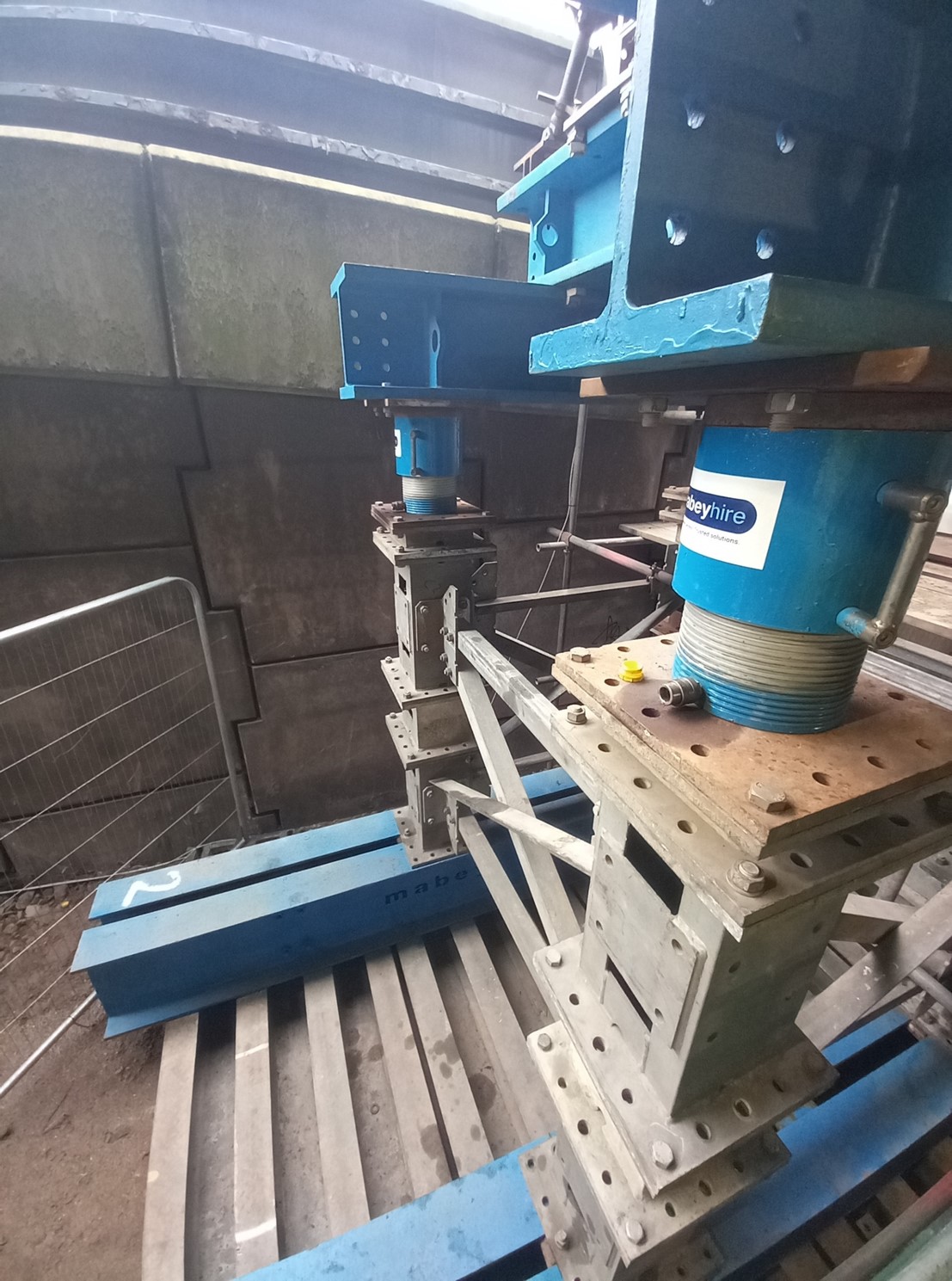
Working closely with Balfour Beatty, Mabey Hire designed, supplied and installed a bespoke temporary propping and jacking scheme to facilitate the works. The system featured Maybe’s Mat 125, Mass 25 and Mass 50 props. The supplier’s Hymat jacks were also supplied, installed in clusters of four to deliver the required load capacity.
Project teams faced numerous challenges, including increased bearing loads beyond those considered in the original design, concentrated loads during jacking operations, and high lateral forces. As well as taking 300 tonnes vertically, the propping scheme also had to satisfy transverse loads of 35 tonnes. To satisfy this, Mabey Hire fabricated a bespoke cradle arrangement around the bridge columns.
There were also logistical constraints and obstacles to overcome. With a major junction under the flyover and heavy flow of traffic on the city ring road, teams had to consider access for the heavy-plant equipment and machinery. Keeping traffic running was a high priority, with the need to minimise disruption to the public. As such, Mabey Hire had to carefully design the propping scheme to take up minimal space and suit the line of the road, ensuring that it was able to be kept open to traffic.
Additional structural monitoring sensors were also fitted to monitor the movement of the bridge throughout the jacking.
“To avoid damage to the deck expansion joints, it was imperative that we did not exceed the 2mm tolerances during the jacking operations,” said Barnes. “What’s more, to minimise disruption to the public, the bridge remained open during the entire work programme, with the exception of the delicate and highly precise jacking and de-jacking operations. As such, it was essential that we had constant insight into the bridge’s structural condition.
“To assist with this, Mabey Hire installed specialist monitoring equipment that could measure to within 1/100th of a millimetre, just about as precise as civil engineering can get,” said Barnes.
Mabey Hire also supplied wireless sensors and loggers which could monitor vertical movement during the works. Magnetised to the steel beams, close to the individual bearings, the sensors could be easily removed and relocated to the next group of bearings.
Wider contract
Barnes said that the Marsh Lane Scheme is part of a wider contract that they have been working on since 2020. With many of the highway bridges, tunnels and retaining walls in this area built in the 1960s and 1970’s, a lot of them are reaching the age where significant maintenance work is required.
“We’d worked with Mabey Hire on the similar Regent Street Flyover project, which was completed in 2020-22 and so we knew they would be up to the task. Perhaps the biggest value of working with Mabey Hire is its one-stop-shop service and comprehensive offering. You benefit from their engineering knowledge, hire of specialist equipment and their dedicated in-house installation team. Having this guidance and expertise available in-house is a big attraction. You can trust in their honesty and certainty of delivery.”
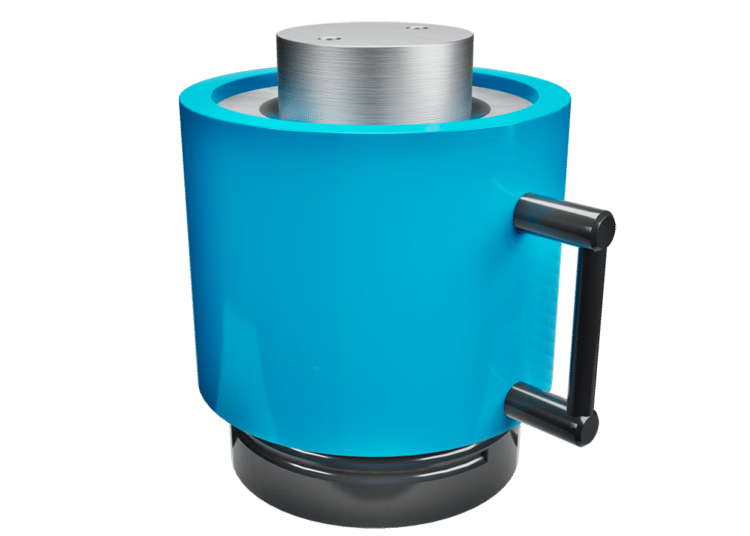
Hymat jacks
The aluminium lightweight, single-acting hydraulic Hymat jacks can be used on their own or with the Mat 125 and Mass 50 propping systems. They are easy to use and can be supplied with a bolt-on flat base and head plate with either a fixed or spherical head which allows a 5º rotation. Unlike conventional screw ram cylinders, the Hymat jack has an externally threaded cylinder barrel onto which a locking collar is attached. The outer collar engages with special head plates or spherical heads to provide a mechanical load path when the hydraulic pressure is released. In this way the ram is totally isolated, removing adverse effects of lateral loading.