Running across the north of England, the M62 motorway provides an important transport connection between west and east, reaching an altitude of 370m at its highest point.
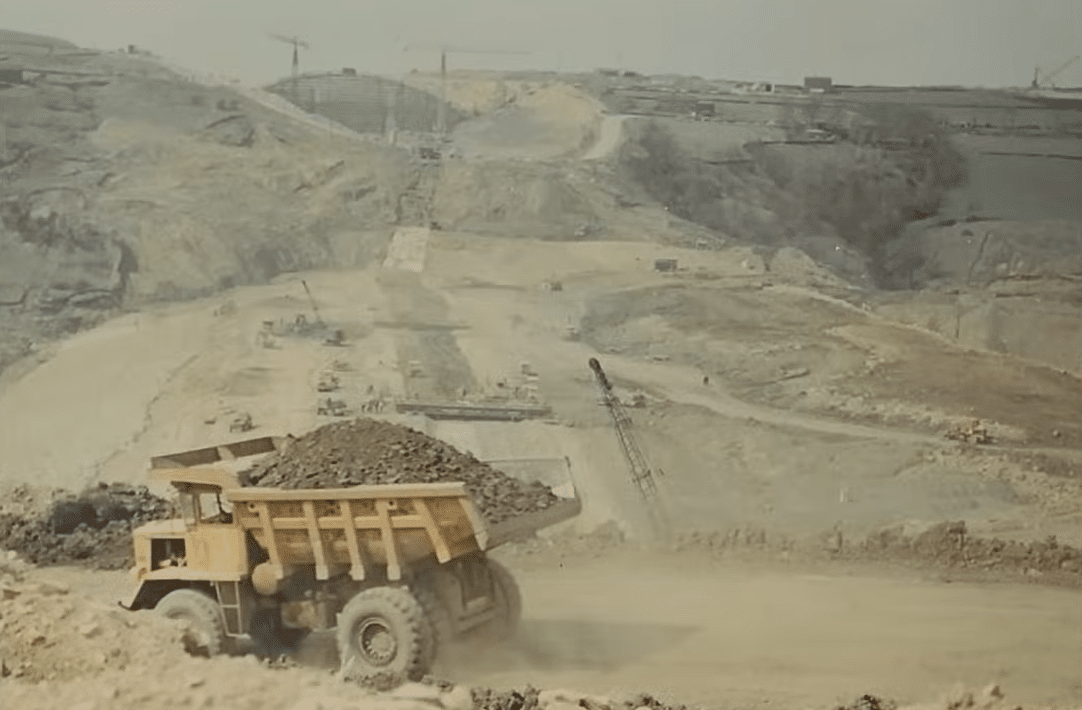
Notable from the footage are the machines in use. At the time of this project, scrapers were still the machines used commonly for mass earthmoving operations. This was before the switch to the more versatile partnering of hydraulic excavator and ADT as used widely nowadays. Although there were ADTs at the time, they were smaller and not used in many earthmoving works.
Life was tough in the late 1960s for machine operators and the scraper drivers had to endure working in all weather conditions, without the comfort of even the most basic cab and just a small windshield for protection. Driving a scraper can be uncomfortable enough given the shocks to the seat but for these older machines, this would have been very tough.
But even for those rigid truck drivers with cabs for their Euclid R45s, Aveling Barford SN-35s or Cat 769s, they would have been cramped, noisy and uncomfortable in comparison to modern machines. These trucks did not have power steering or automatic gearboxes, so would have been very physical to drive.
The Euclid R45s would have likely been built in the Scottish Motherwell factory that opened in 1950, became Terex after this footage was shot and is now still making ADTs, sold under the Rokbak brand. The R45s were powered by two stroke Detroit Diesel engines that were high-revving and particularly noisy, as well as being heavy on fuel and with a reputation for blowing turbochargers.
The Aveling Barfords would have been built in the factory in Grantham, some powered by Rolls Royce engines and some with the noisy Detroit Diesel two strokes. The Cat 769s meanwhile were the first of the firm’s rigid truck range, small and very basic compared to current models. None of these trucks would have had air conditioning and they would have had crude heating and ventilation instead, while seating would have been hard with minimal adjustment.
The RB cable shovels being used were a lot harder to operate than a modern hydraulic excavator, with heavy controls. The variety of rigid haul trucks meant a different number of passes was needed, not meeting the optimum efficiency expected nowadays.
Bear in mind that this muckshifting operation would have been carried out long before the development of GPS or machine control systems, using surveying methods that would now seem incredibly rudimentary.
The workforce meanwhile, largely from Ireland, would have coped with long periods working away from families and homes. Many of the workers would move from job to job, living a nomadic lifestyle. There were no hardhats, no safety boots and no PPE of any sort.
The M62 motorway was of note for the time, the alignment running along the top of a dam and also featuring Europe’s longest single-span concrete bridge at the time. A fact picked up by the newspapers of the time was that one farmer along the route refused to move. His farm was left, in between the two carriageways, with a tunnel providing access. It is still there today.
Construction remains a tough job but bear in mind that the workers of that time had it far harder than today.