
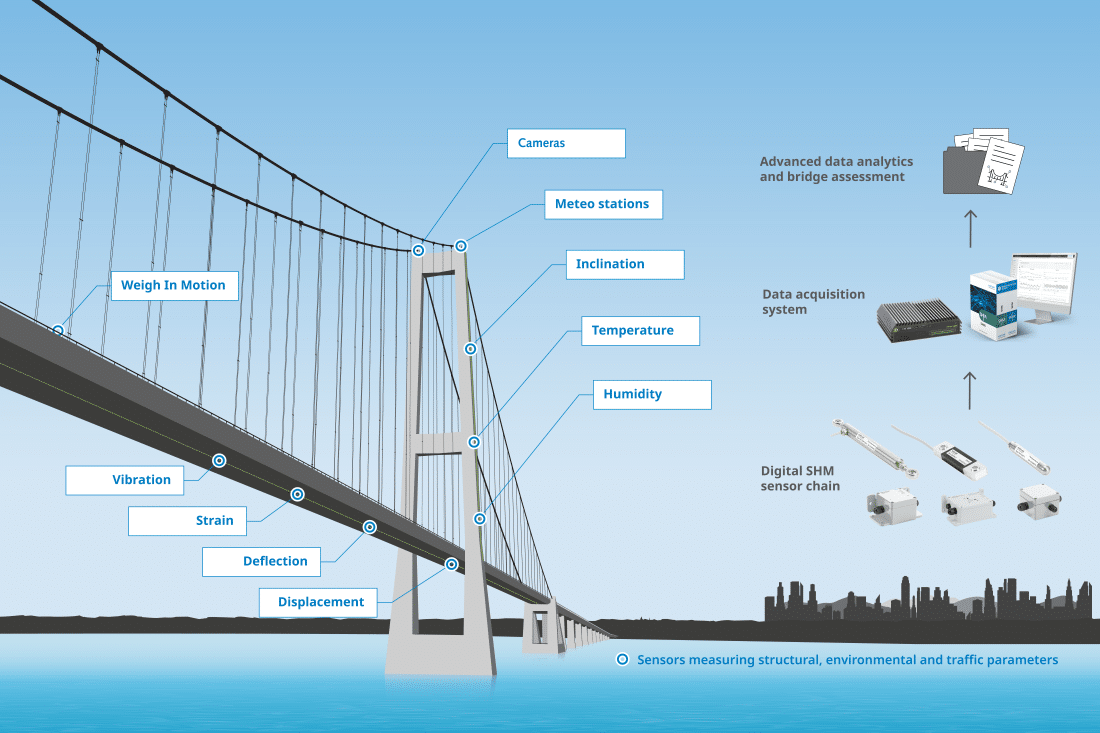
At Intertraffic Amsterdam, Kistler is presenting its first fully digital structural-health-monitoring (SHM) system for bridges. The company says that it marks a “significant leap forward” by delivering an objective view of how bridges behave under actual operating conditions.
Until now, structural-health-monitoring solutions have relied heavily on analogue technology. At the heart of the new SHM solution are digital sensors organised in flexible clusters that can be installed in daisy-chain or star topologies. This modular approach allows optimal adaptation to any type of bridge geometry while minimising cabling effort.
The system continuously measures key structural parameters, including strain, displacement, cracks, vibration, inclination and temperature. Open interfaces allow operators to integrate additional custom sensors as needed. To ensure perfect time alignment among all channels and maximum data reliability, all sensor clusters are synchronised within microseconds. The sensors come in a robust, weatherproof design with full immunity to electromagnetic interference. Thanks to their self-configuring digital technology, setup time is dramatically reduced and manual adjustments are minimised. The result is a faster and more cost-efficient installation.
For complete monitoring data and active bridge protection, the new digital SHM system can be combined with weigh-in-motion (WIM) technology from Kistler. WIM systems – installed upstream of the bridge – measure traffic loads and detect overloaded vehicles whose drivers can then be automatically fined or prevented from using the bridge.
Both SHM and WIM data streams are processed by a dedicated edge device (IPC). This ensures high-resolution data capture with precise time synchronisation. Operators can configure time- and event-based triggers as well as automatic alarms that notify them when sensor readings exceed predefined thresholds. It is also possible to directly correlate traffic loads with the resulting structural impact, giving infrastructure operators real-time visibility into how traffic affects structural health.
Washington Bridge
In the northeastern US state of Rhode Island, Kistler has implemented an integrated WIM and SHM solution for the Washington Bridge. The structure is outfitted with accelerometers, strain gauges, temperature sensors, inclinometers and a meteorology station as well as a WIM system to monitor specific load conditions. The combined solution supports operators during restoration work on the historic structure.
Increased traffic volumes required real-time insights into actual vehicle loads and their effect upon the Washington Bridge. By correlating traffic data with vibration, strain and movement measurements, engineers can derive site-specific load ratings based on real data rather than conservative assumptions. This is improving maintenance planning and safety interventions.
Meanwhile, in Southeast Asia, the Sultan Abdul Halim Muadzam Shah Bridge (Penang Second Bridge) is a 24km crossing between mainland Malaysia and Penang Island. As part of a high-speed WIM programme, the system is installed to continuously monitor vehicle loads and traffic patterns to gather highly accurate traffic and axle-load data.
For even larger structures, such as the 915 Çanakkale Bridge in Turkey, multiple Kistler WIM-sensing lanes offer continuous insights into live traffic loads and the number of overloaded vehicles. Integrated into the existing monitoring framework, the system allows operators to correlate real traffic conditions with structural response and environmental influences. The resulting data supports more accurate fatigue assessments, service-life predictions and site-specific load ratings – all critical factors for long-term bridge protection.
At Intertraffic, Kistler can be found in hall 1 on stand 410.