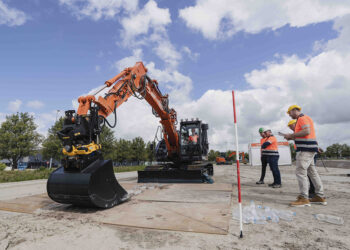
Liebherr is working on some radical technologies for off-highway machines that will be applicable to markets such as earthmoving, quarrying and mining.
The company has demonstrated some of these systems at bauma 2025 event, but continues to refine the systems, According to Dr Manuel Böst, in charge of R&D and emerging technologies at Liebherr’s Bischofshofen facility, these technologies have moved beyond being prototypes for demonstration and are now undergoing field trials in working sites.
The solutions have been developed to deliver safe and practical remote control of machines working in hazardous locations. Solutions have also been developed to offer autonomous operation of machines. And another radical development is for a totally autonomous, self-balancing electric hauler that features just two wheels.
Dr Böst explained that the firm is working on these new systems to meet key challenges for the construction, quarrying and mining sectors. There is a worldwide shortage of people wanting to enter these industries, which new technology could help address. Furthermore, these new systems could help address other challenges also such as safety, decarbonisation, increasingly tough regulations and even urbanisation.
Dr Böst said that the remote, semi-autonomous and autonomous technology will help address the shortage of operators by taking over some of the simple and repetitive tasks. However, he said that this will not replace the need for people to operate machines, “The human operator will still be needed for more complex tasks.”
The latest Liebherr remote control system, LirReCon, allows machines to be operated from a remote location and utilises available technlogy from the firm. However, the system can only be fitted to the firm’s newer generation machines and not to earlier models. Florian Falbesoner at Liebherr Telfs commented, “We want to use existing technology as much as possible. You don’t even need 5G.”
The system uses private IP-based communications, which offer the necessary cyber-security according to Falbesoner and he added, “Data security will be a big issue.”
The system is based on existing assistance systems and even allows long-distance tele-operation, for use on sites that are hard or dangerous to access. Remote diagnostics also allow firms to optimise operations through data collection.
The autonomous system takes technology one step further. When a machine is delivered to site, an operator can drive the piece of equipment around first. This allows the machine to ‘learn’ the work area. Falbesoner said, “You don’t need special expertise to do this.”
The firm has been evaluating its autonomous technology in working areas, with the system having notched up over 3,000 hours. The technology can learn from a worksite and make decisions on routes. Falbesoner said, “The machine never does the same job twice. You can monitor it from anywhere in the world.
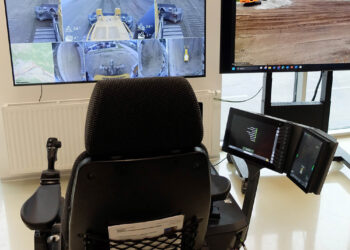
Human machine operators are still a focus for Liebherr however. To assist in training operators safely, Liebherr has developed a sophisticated simulator in partnership with specialist firm Tenstar. The units have controls similar to Liebherr machines and can be used to simulate a wide range of machines. These can be used for basic training of inexperienced operators or for training more experienced operators for more specific tasks. The units can be bought by customers with large equipment fleets but are also being supplied to Liebherr dealers. Customers can access these to ensure operators are kept updated with training requirements and in a safe environment, without risking either personnel or machines.
And Liebherr has also developed a simple and cost-effective 3D grading system for use with dozers. This is claimed to optimise working and offer consistently high-performance results, while reducing fuel consumption by up to 10% at the same time. This is available as an alternative to machine control technology, although Liebherr customers can also specify systems from Leica Geosystems, Topcon, Trimble and now Unicontrol also from the factory.
Perhaps the most radical system being worked on by Liebherr is its innovative hauler, the S1, a novel solution to haulage requirements. This compact machine is able to carry 500kg and is self-balancing, with direct electric drive to each of its two wheels. According to Altan Enginalev, the concept is entirely scalable. Larger versions could be built for heavy-duty earthmoving operations and using available truck tyre technology would allow maximum payloads of up to 130tonnes.
Enginalev said, “It has one axle and one axis for movement and balance. The machine is able to pivot and turn on the spot. This was designed as autonomous and self-balancing.”
Enginalev added that it features electric drive and is driverless, allowing it to be used in difficult operations with restricted space such as tunnelling. “We built it and it works. Now that we know it works, the next step is to scale it up. The future is one step ahead,” he added.
As it has no cab, there is no need to consider operator comfort so the S1 has no need for suspension. This keeps its design simple, reducing the number of components required. The simple body can tip to release its load.
Sensors and LIDAR systems ensure that the S1 can identify obstacles in front and behind. The unit can be guided by GPS although versions for underground use would be able to utilise localised systems to determine position. Inertial navigation technology (IMUs) will also likely help the units to geolocate.
Whether the unit requires a gyroscope for stability or how it balances has not been revealed and the firm is reluctant to reveal many technical details until the S1 has undergone more testing.