Working in partnership with National Highways, the firm has completed work on a demonstration scheme for the new E21 Stone Mastic Asphalt (SMA) specification. According to the firm, this sets a precedent for the next generation of low-carbon, high-performance road- surface materials.
The project, carried out on the busy M5 motorway between Junction 28 and Junction 30, marks a significant step ahead in the UK’s transition to more durable, lower-emission road infrastructure. Developed through National Highways’ Low Carbon Demonstration Fund, the scheme shows how collaboration between Holcim UK and its supply-chain partners can accelerate innovation from concept to carriageway.
The resurfacing demo uses Holcim’s ProLay Ultra asphalt, a product that is being developed continuously as a next-generation road-surface solution. ProLay Ultra already meets the new National Highways E21 SMA specification, which places greater emphasis on durability, whole-life carbon, and ride quality.
Designed with a carefully balanced aggregates matrix, increased bitumen content, and polymer modified bitumen (PMB), ProLay Ultra achieves a low in-situ void content for enhanced resilience and long-term performance. As part of this trial, a section of the E21 Stone Mastic Asphalt incorporated graphene, further enhancing the mechanical strength, fatigue resistance, and long-term durability of the surface.
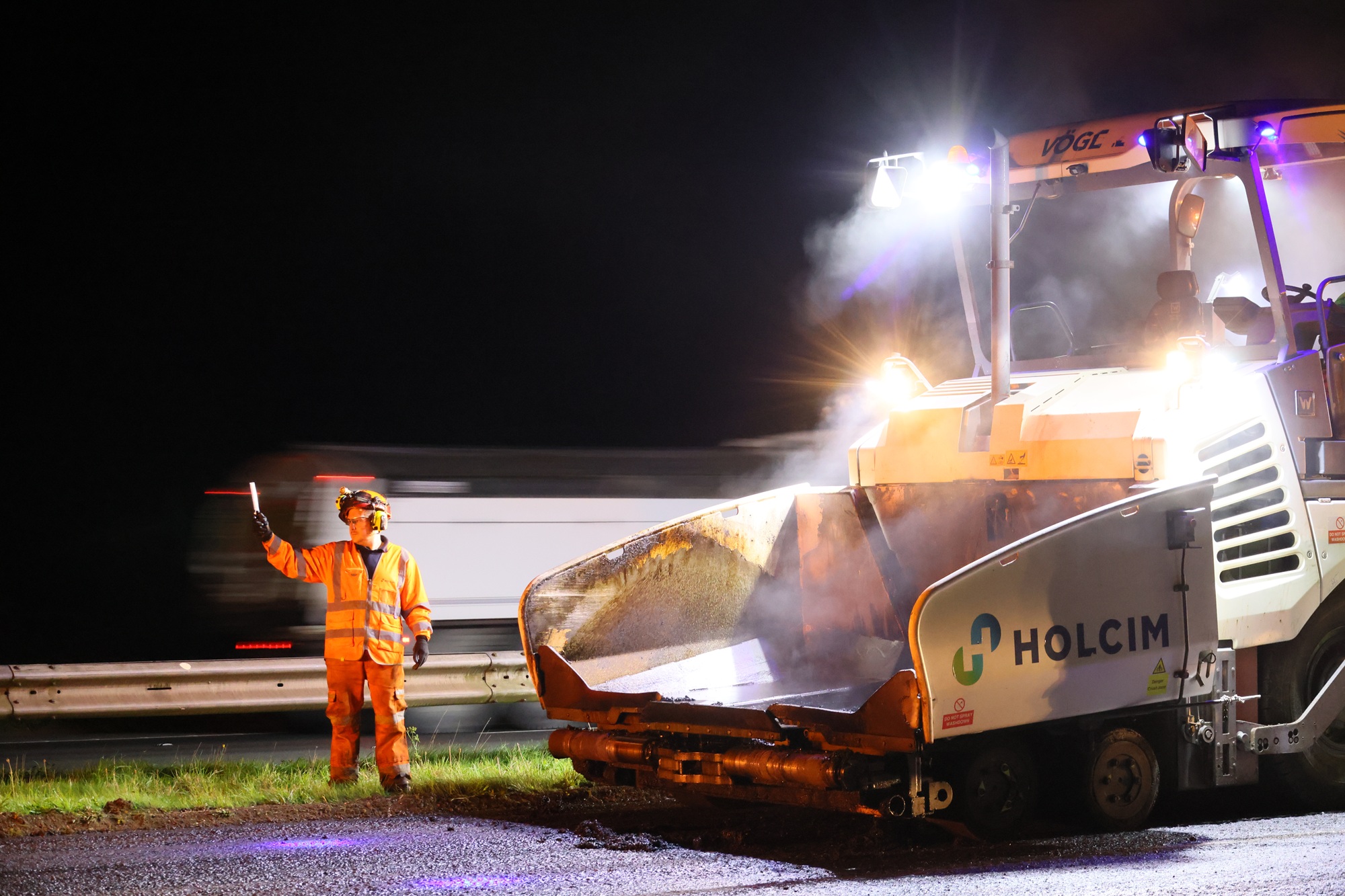
The M5 project saw Topcon’s sophisticated Smooth Ride technology being utilised to control surface levels with high precision and optimised ride quality, boosting both performance and driver comfort whilst reducing future maintenance needs. The LiDAR mapping and 3D road modelling developed by Driven International and MK Surveys guided precision milling using Wirtgen machines, operated by Tripod Crest. This advanced process leaves a smooth surface that is milled to grade for the paving operation. Echelon paving was also used, with pavers working hot-to-hot, ensuring effective bonding of the asphalt surface and eliminating weak joints. This prevents future joint failure caused by moisture penetration as a result of the freeze/thaw process which, typically, results in potholes. With the echelon paving carried out to grade, a smooth and durable surface is achieved, without the uneven areas that would be subject to wear.
Paving onto a surface that is milled to grade helps to reduce material wastage and lowers material costs because the paving operation no longer has to fill uneven areas.
Neil Leake, national technical manager for Contracting at Holcim UK, said: “The M5 has provided the perfect opportunity to showcase the next generation of surface performance – a scheme that brings together low-carbon materials, advanced paving technology and all within the new National Highways specification. It’s a demonstration of how technical excellence and collaboration can deliver real change across the UK’s strategic road network.”
Holcim UK’s extensive laboratory trials, including rutting and ageing tests, confirm that ProLay Ultra meets the performance requirements of the new E21 SMA specification. The product will be approved under CC 202 E/21, reinforcing Holcim’s confidence in its readiness for future contract submissions and National Highways adoption.