Improving the efficiency of operations is key for connected construction. Improving accuracy and productivity while addressing clash detection and reducing the need for reworking and waste from operations can not only speed delivery and boost quality but also improve sustainability. It is a simple fact. Less waste means fewer CO2 emissions.
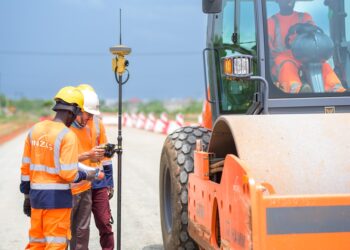
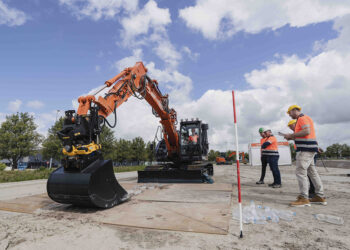
The use of positioning technology in construction has increased in recent years, becoming more democratised and spreading out from use only in certain segments or with larger contractors. Systems are now used in a vast array of applications and with contractors of all sizes, while usability and versatility have been improved. For Topcon, remaining at the forefront of technology and investing in research and development are crucial. But the company has also been keen to ensure that its systems can interact with other technologies.

Oberlander commented that Topcon’s previous president and CEO, Ray O’Connor, had a vision that took the company forward. “Ray O’Connor wanted an open architecture and interoperability among our systems and the industry.”
And he added that this forward-looking approach will continue now that Ivan Di Federico has taken over as CEO, “Ivan Di Federico is an innovator, always looking 10 years ahead. It’s inspiring to have him leading as he gives us freedom to work ahead. He’s putting in a new organisational structure, Topcon 2.0. Topcon is preparing for what is coming.”
The need for an open architecture across industry is acute and there is a recognition that a contractor may have mixed fleets of connected construction tools as well as construction machines. Oberlander said: “We build the software application for who is using it, then recover the data. We ingest that data to glue it in the system to provide a seamless workflow for our customers.” And he added that being able to communicate with the key software providers such as Autodesk or Bentley Systems is also vital.
Oberlander explained that there are no data silos when using technology from Topcon. “We can take the data from Topcon geomatics solutions to construction easily as it’s the same ecosystem.”
A Topcon GPS receiver on a dozer may look different from the unit being used on a tractor. “The core Topcon fundamental technology is used across all platforms making the user experience seamless,” he said.
However, Oberlander said that the hardware tools for connected construction technology from the major players are all fairly similar in what they do. But he said that factors such as functionality, ease of use and service support are more important, commenting: “How do we make the software functional and make it easier to get that job done? It’s about the software experience. The user shouldn’t be concerned on how the software works. They just want to get the crew out and get the job done. We need to simplify the functionality to make that easier.”
He said that Topcon is also making products that are easier to service and maintain, as well as offering greater functionality. Oberlander added: “Topcon 2.0 is not just about markets we’re going into. It’s also about innovative products and improving quality. It’s a revamp of Topcon culture.”
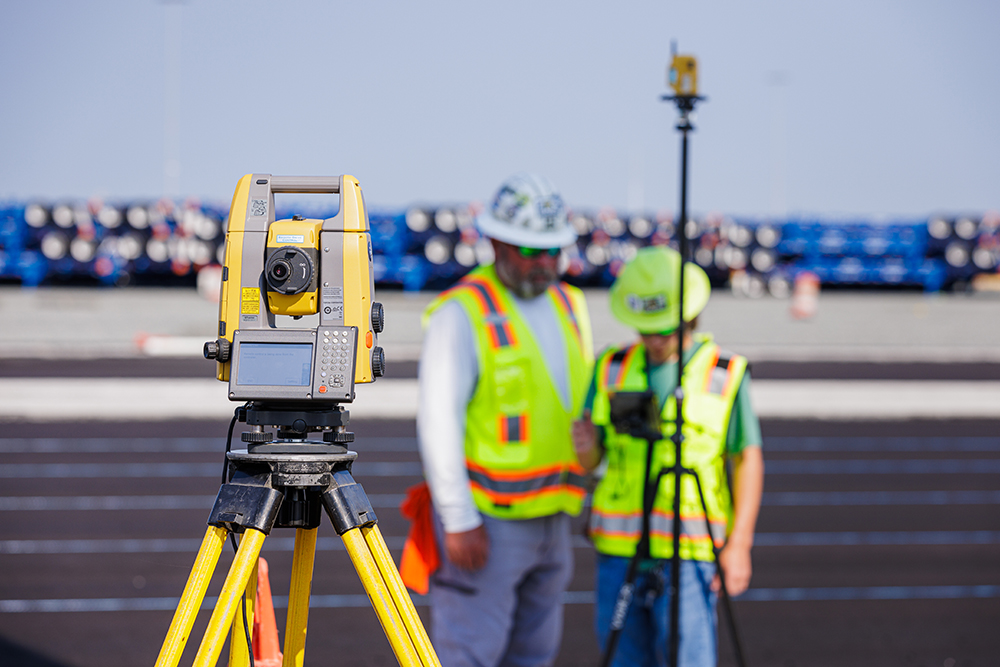
Geomatics plays a key role in the construction industry. Oberlander said: “Geomatics is the beginning, during and end of any project. You need to know where to build that bridge, tunnel, road or building. When the work is done, the client comes and inspects it using geomatics.”
The firm has made a heavy investment into AI and Oberlander said that fitting AI tools on devices such as a total station means that it can learn users’ habits, allowing an improvement in working over time. He explained that while the surveyor has to put in feature codes, the AI software would recognise what tasks are being carried out and also be able to remember the tasks that have been carried out so far.
Meanwhile, Lingobardo said that Topcon is continuing to develop its offering for the concrete-paving and asphalt-paving markets. The company has been offering 3D systems for concrete and asphalt paving for a considerable period now and has the experience of both segments to offer intelligent and sophisticated systems, with new platforms coming to market. Topcon developed technology for asphalt paving initially and then added concrete-paving systems to its portfolio a decade ago. He said: “Depending on the application, Topcon offers various solutions.”
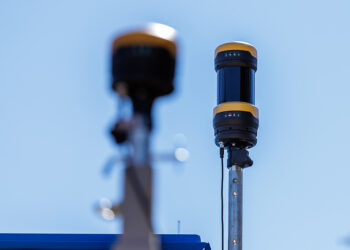
The Millimeter GPS and SmoothRide technologies have been used widely in asphalt paving, being well-proven in applications with a need for premium quality such as racetracks, airport runways and major highways. Further advances continue to be introduced for concrete and asphalt paving and Lingobardo continued: “We’ve recently introduced an update of our intelligent compaction system.”
He explained that the system monitors factors such as positioning, the pass count and surface temperature and commented: “We’re excited for its impact in the market.”
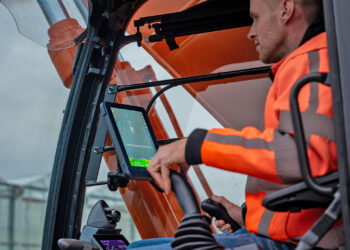
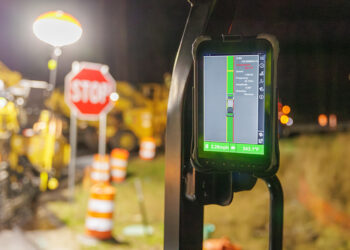
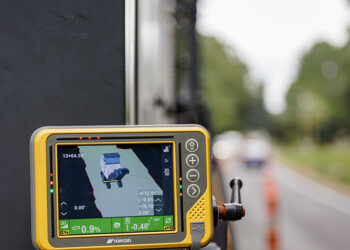
The package is more advanced than previous generation technology but at the same time, is also less costly, has fewer cables and is easier to install. Lingobardo said: “It includes a new wireless tablet giving the operator mounting flexibility.” He continued: “All of our platforms are being updated now.”
An advanced kerb and gutter system offers accurate concrete placement. Millimeter GPS can be used to increase the precision and efficiency of slipforming operations. The system uses both GNSS for horizontal accuracy as well as a rotating laser for vertical accuracy. One laser can control multiple machines and also provide elevation feedback to grade checkers, at the same time. Lingobardo said that this system is popular in industry. “It’s accurate and it’s easy to set up.”
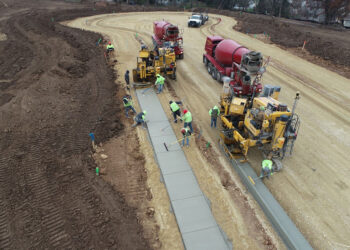
Meanwhile the new MC-Max system includes updated system hardware including a new display. It simplifies the user experience while adding functionality to the customer’s investment.
A key development is the modular sensor stack that can be used for all applications. Lingobardo commented: “This technology is a market differentiator. It simplifies the user experience while adding functionality to the customer’s investment.”
MC-Max also includes new software features such as virtual ski for asphalt and milling applications. The function can be used to improve the road surface without requiring a design. The user can set the ski length and the system will average the depth or thickness in real time, improving workflow efficiency and the longevity of the road surface.
“Workflows and the integration of construction and geomatics technologies aimed at enhancing sustainability and efficiency continue to evolve,” Oberlander said. “Precision is important to every contractor in the way they approach their projects. At Topcon, we’re committed to driving precision innovations forward. We believe Topcon 2.0 will help our customers reach their goals not only in building a better world, but also in leaving a sustainable future for the next generation.”