The global market for articulated haulers remains strong. Clear market leader remains Volvo CE, with its range having been updated entirely during 2025. Caterpillar also retains its significant market share, having also upgraded its line-up in recent times.
A notable development is that Volvo CE has now started manufacturing of its A30 and A40 electric haulers, first unveiled in 2025. The electric articulated haulers are now being produced at Volvo CE’s Braås site in Sweden.
However, there are other brands also selling well in the sector and from firms with somewhat more experience of the ADT market than may appear at first sight. Perhaps the best established of these brands is the Develon range, made in Norway and descended from the Moxy models, one of the pioneers in the ADT field.
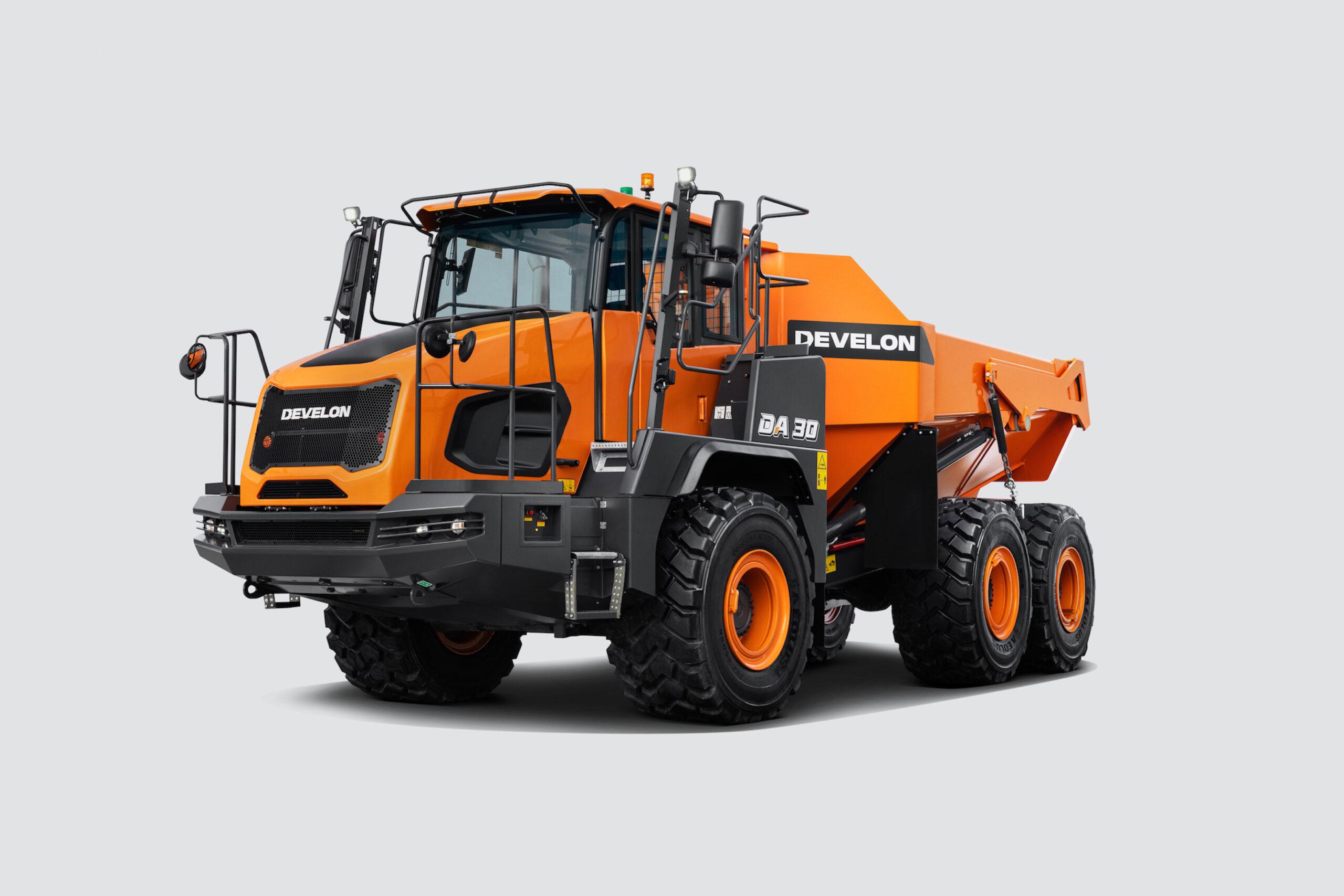
According to Develon, its latest DA30 ADT offers high all-round visibility from the cab, which is designed to maximise operator comfort, productivity and jobsite safety. A key feature of the update is the new high-resolution touchscreen monitor, providing access to machine information, settings and camera views. The large display improves ease of use.
The firm says that the cab layout has been optimised for efficient operation, with well laid out controls and improved ergonomics. Better visibility allows safer working, particularly on busy or confined worksites. To support both ease of use and safety, the updated ADTs from Develon are also equipped with an auto-hold brake function which automatically keeps the machine stationary during dumping, reducing operator workload and improving control.
The DA30 also features a high-performance diesel that meets Tier 4 Final/Stage 5 emissions requirements and demonstrates low fuel consumption. Efficiency is further optimised by the use of a modern driveline.
A novel feature of the Develon ADTs is found on the rear drive, with twin wheels driven by gears in bogies and featuring a single rear differential. This system is said to achieve higher traction than competing ADTs, with the bogies able to move to maintain ground contact and ensure an even tyre profile over the terrain. The bogies, meanwhile, are protected, ensuring they do not suffer damage when the machine is operating in harsh conditions. This concept was first developed by Moxy and has been proven over many years.
Also notable and with its origin in the original Moxy trucks, the design of the dump body is said to ensure effective material retention when lowered, as well as efficient tipping when raised. The body configuration is also said to help optimise weight distribution, further boosting traction on poor ground.
And from John Deere comes an updated haul truck that offers high performance and productivity. The firm’s ADTs developed from a partnership with South African company Bell Equipment in the 1990s but that arrangement ceased in recent years. John Deere has since revamped its ADT designs, using its own technology. Power for the new model comes from one of the firm’s own JD Series diesels, rated at 371kW and meeting the Tier 4 Final Emission requirements. Fuel consumption is said to be low despite the power of the engine, due in part to the sophisticated and efficient driveline supplying power to all six wheels.
Featuring a heaped capacity of 25.2m3, the truck has a maximum payload of 41.8tonnes in its body, which is designed for optimum weight distribution as well as efficient dumping to minimise carryback. When empty, the truck weighs in at 31.5tonnes.
The truck features a high-visibility, high-comfort cab with good ergonomics to allow efficient operation throughout a whole working shift. Safety features are included as standard. The machine is also equipped with John Deere’s advanced telematics package which allows maintenance to be optimised and uptime to be maximised.
In the past, Komatsu had a partnership for ADTs with Moxy but ceased that arrangement decades ago, later developing its own models. The latest is the Komatsu HM460-6 articulated dump truck, which offers an all-new cab with improved visibility, intuitive monitors and new technology to help assist operators throughout long shifts.
Compared to the previous HM400-5 model, its power has increased 9% and torque has improved 23% but there is up to 12% lower fuel consumption. The operator cab has had a 16% increase in glass area, an improved premium seat and intuitive monitor and operator controls.
The HM460-6 is driven by the next-generation Komatsu DBA127 engine, engineered to deliver high power and torque for strong acceleration and sustained travel speeds, even under load. The two-stage turbocharger engine is designed to use 12% less fuel than the prior models.
Ground conditions can be tough for ADT applications, so the new truck comes with the Komatsu Traction Control System. This works in combination with inter-axle and cross-axle differential locks for smooth, trouble-free hauling. The cross-axle differential lock can be manually engaged when needed on slippery terrain.
Komatsu also offers various operator-assist features to make hauling and dumping easier. Cruise control and Automatic Retard Speed Control make maintaining an efficient velocity simple. Dumping can be controlled easily while the machine offers a customisable dumping angle.
Leaving the ADT market however is the Rokbak range built in the Motherwell factory in Scotland and most recently being part of the Volvo CE business. The Rokbak models evolved out of the earlier Terex machines, a pioneer of the ADT concept (Along with Cat/DJB, Moxy and of course Volvo CE), with the firm having introduced its first ADT in 1982. But Volvo CE has now decided to shut down production of the Rokbak ADTs, citing falling sales due to tough economic conditions.