• About
  • Advertise
  • Contact
Friday, July 17, 2026
Newsletter
Global Highways
  • News
  • Products
  • Features
  • Categories
    • Asphalt Milling, Paving & Compaction
    • Concrete Milling, Paving & Compaction
    • Connected Construction
    • Earthmoving & Soil Compaction
    • Engines, Components & Tyres
    • Finance & Funding
    • Highway & Network Management
    • Maintenance
    • Materials
    • Recycling
    • Road Markings, Barriers & Workzone Protection
    • Road Structures
  • Events
    • Events Calendar
    • CONEXPO-CON/AGG 2026
    • Intertraffic Amsterdam 2026
    • bauma 2025
  • Latest Magazine
  • Videos
No Results
View All Results
  • News
  • Products
  • Features
  • Categories
    • Asphalt Milling, Paving & Compaction
    • Concrete Milling, Paving & Compaction
    • Connected Construction
    • Earthmoving & Soil Compaction
    • Engines, Components & Tyres
    • Finance & Funding
    • Highway & Network Management
    • Maintenance
    • Materials
    • Recycling
    • Road Markings, Barriers & Workzone Protection
    • Road Structures
  • Events
    • Events Calendar
    • CONEXPO-CON/AGG 2026
    • Intertraffic Amsterdam 2026
    • bauma 2025
  • Latest Magazine
  • Videos
No Results
View All Results
Home News Green credentials a major issue for Italian buyers of equipment

Green credentials a major issue for Italian buyers of equipment

by tmechkarova
November 5, 2019
in News
Reading Time: 3 mins read
A A
NOV - Samoter Survey for Italy.JPG

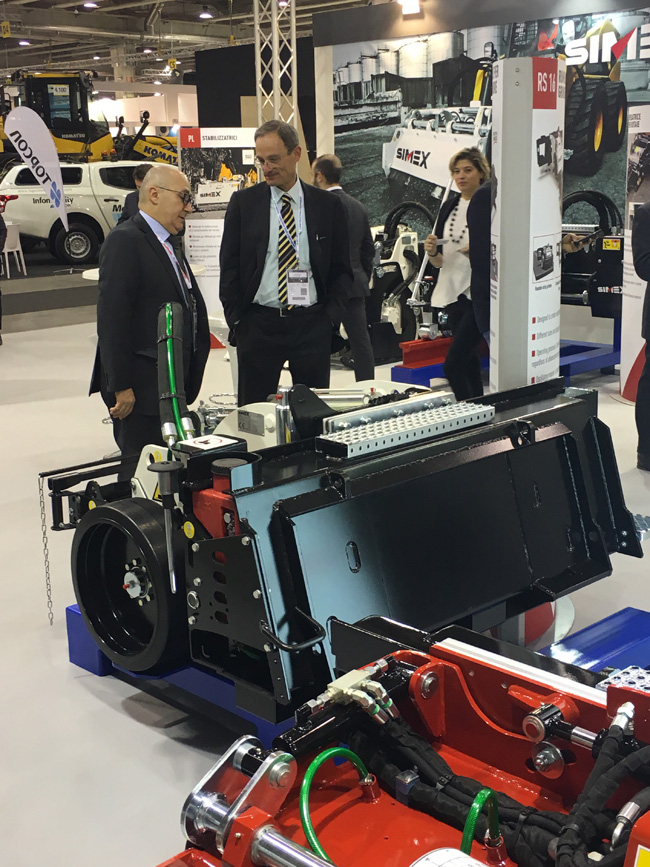
SaMoTer runs concurrently with Asphaltica at the Veronafiere Congress Centre in Verona, Italy, from March 21-25 (photo: SoMoTer 2017)

Some of the main driving forces for purchasing new construction machinery in Italy are better efficiency and green credentials in terms of emissions and noise.

Intelligent machines are coming to play an increasingly central role in the sector, according to the new SaMoTer-Veronafiere survey, published ahead of the exhibition set for March. It found that 16% of users and 31% of hire firms believe green credentials are an important criterion when making purchasing decisions.

Moreover, almost 4% of users (with peaks of 16% in the mining sector) have replaced still-operative conventional plant with s-called smart models.

This survey involved a sample of 514 companies taking in construction companies as well as manufacturing, mining, agricultural or specialist firms.

The construction machinery fleet is estimated at 179,224 vehicles. It largely comprises earth-moving machines (66.1%), lifting equipment (20.7%), road-building (8.2%), concrete (4%) and drilling plant (1.1%). On average, 30% of these vehicles are owned by hire firms, with significant distinctions between various kinds of machine. The rental fleet ranges from as much as 61% for hoisting/lifting vehicles to 2% for concrete plant.

The manufacturing sector is the one that has most up-dated its fleet of vehicles by introducing intelligent machines, followed by large construction companies. The search for more innovative models (67.9%) was the main factor influencing the decision to prefer new technologies.

Geolocation is the most common feature sought among various machine technologies, for both user-owner and rental fleets, while benefits considered to be the most strategic by companies (67.4% of interviewees) focus on safety, as well as environmental sustainability, particularly for large construction companies, the manufacturing sector, multi-utilities and farms.

In the future, companies hope to see an increase in the strategic nature of smart technologies in coming years. Predictive maintenance is acknowledged as one of the most important today and in the future, while electrical engines, according to interviewees, will be the field seeing the most growth.

It is estimated that there are just under 120,000 users of construction machinery, of which more 70% in the earthmoving sector. On average, 78% of the fleet consists of machines purchased new, the remaining 22% being second-hand.

The share for second-hand machinery is particularly high for drilling machines, at more than 40%. For earthmoving, the figure has increased to 22%, from 7% for the 2008 survey.

The decision to resort to rental, compared to the use of owned machinery, has increased to about 30% over the past two years. Small construction companies, nurseries and farms are the business categories that make the most use of rental services.

Owned machines are used on average for 759 hours a year, compared to 281 for plant on hire. As regards earth-moving, the average figure (690 hours) is in line with the 2008 result. Analysing the composition of the machinery pool in relation to propulsion systems, the sample in question indicates a higher incidence of obsolete machines (Stage I and II) among concrete and drilling plant. Earthmoving and road machinery, on the other hand, boast around one-third of the machinery pool in Stages IV and V (recently added).

The average age is around 11 years, albeit with some distinctions: road and earthmoving machines have an average age of around 10 years, while for lifting/hoisting machines the figure is more than 14 years. Among operators, the “youngest” machine pool involves companies operating in waste collection and disposal, excavations and demolitions, as well as large construction companies; the “oldest” are operated small construction companies.

SaMoTer runs concurrently with Asphaltica at the Veronafiere Congress Centre from 21-25 March.

Categories: Finance & Funding
Promoted Content Header
Samoter Asphaltica

Related Posts

A new bridge link will connect Oregon State and Washington State in the US

New $15 billion Interstate bridge between Oregon and Portland

by Mike Woof
July 17, 2026

A new $15 billion bridge will span the Columbia River in the US.

Sustainable road construction from Heidelberg Materials for North Yorkshire

Low carbon road repairs in North Yorkshire

by Mike Woof
July 17, 2026

Innovative road materials from Heidelberg Materials help improve roads in the UK.

A TBM will drive a new tunnel under the the River Thames from Tilbury

Biggest Herrenknecht TBM for £11 billion UK project

by MJ woof
July 16, 2026

The UK's £11 billion Lower Thames Crossing project will use a 5,000tonne TBM supplied by Herrenknecht, the largest of its...

Join our newsletter

The mission of Global Highways is to cover the latest technologies and best practices in all areas of road, bridge and tunnel construction and maintenance, as well as their safe operation and management.

Subscribe to our newsletter

About Us

  • About Us
  • Advertise
  • Contact
  • Terms & Conditions
  • Privacy Collection Notice
  • Privacy Policy

Popular Topics

  • News
  • Features
  • Products
  • Videos
  • Events
  • CONEXPO-CON/AGG 2026
  • Intertraffic Amsterdam 2026
  • bauma 2025

© 2026 All Rights Reserved. All content published on this site is the property of Prime Creative Media. Unauthorised reproduction is prohibited

No Results
View All Results
NEWSLETTER
  • News
  • Products
  • Features
  • Categories
    • Asphalt Milling, Paving & Compaction
    • Concrete Milling, Paving & Compaction
    • Connected Construction
    • Earthmoving & Soil Compaction
    • Engines, Components & Tyres
    • Finance & Funding
    • Highway & Network Management
    • Maintenance
    • Materials
    • Recycling
    • Road Markings, Barriers & Workzone Protection
    • Road Structures
  • Events
    • Events Calendar
    • CONEXPO-CON/AGG
    • Intertraffic Amsterdam 2026
    • bauma 2022
  • Latest Magazine
  • Videos
  • About
  • Advertise
  • Contact

© 2026 All Rights Reserved. All content published on this site is the property of Prime Creative Media. Unauthorised reproduction is prohibited