In the paving sector globally, one of the main issues is sustainability, such as environmental protection and the lowering of CO₂ emissions. This extends down the entire value chain of the paving process, from creating the asphalt mixture at the plant to screeding it right after delivery on a road’s base layer.
But while maintaining a sustainable paving process is important, so too is maintaining the quality of the asphalt.
To enable this, the Asphaltprofi Thermo process from Fliegl offers push-off vehicles that combine perfect insulation with maximum quality and process reliability for asphalt-road construction. The insulating material used for the vehicle body is Fliegl-Isotherm, a lightweight material applied to the outsides of the body so that it is fully enclosed. This composition allows the Asphaltprofi Thermo to achieve outstanding insulation values. The body, floor, front and rear of the vehicle’s container are fully insulated.
Meanwhile, the Fliegl push-off technology is ideal where the use of dump trucks is too risky or physically impossible. It can unload safely, and in a controlled manner, not just asphalt but all kinds of bulk material including stone and sand.
It is one thing to deliver asphalt onsite at the right temperature. It is another thing to move it from the vehicle to the paver itself.
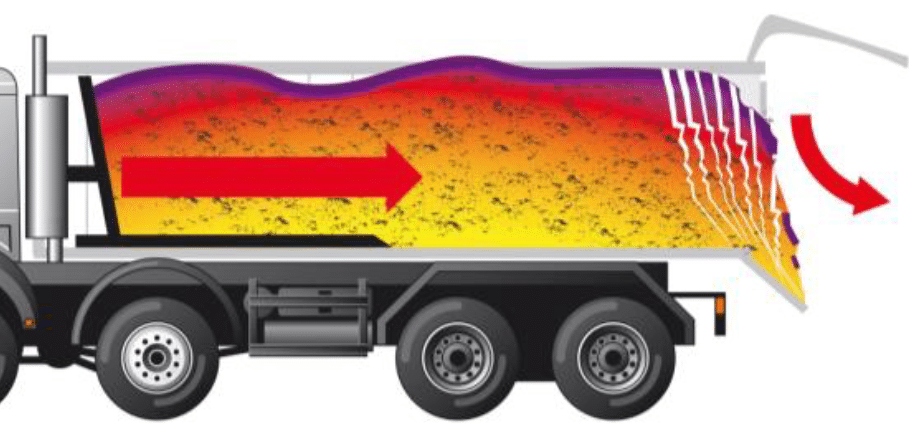
The main difference between a thermally insulated tipping body and a push-off vehicle lies in the way the mix is transferred to the paver. There are slight temperature differences in the loaded building material during transport. A cold layer is created on the surface which is placed in the paver first during the tipping process This results in large temperature differences in the asphalt.
With push-off technology, however, the material is pushed into the paver bit by bit. This means that the material has almost the same temperature composition over the entire duration of the unloading process. It is, therefore, equally tempered. In addition, this “bit by bit-dosing” ensures a continuous homogeneity of the mix.
It is also possible to reduce the temperature in the asphalt-building process provided the asphalt is spread using push-off technology – without asphalt quality suffering as a result. Unlike with the tipper method, the differently tempered asphalt layers do not slide into the paver separately, but homogeneously and at a uniformly high temperature during the entire unloading process.
Temperature fluctuations behind the paving screed are effectively minimised which means that the asphalt is easy to compact and can be installed evenly. As a result, a much better paving quality, and thus a longer durability of the asphalt surfaces, is achieved. With the Asphaltprofi Thermo, the asphalt is delivered in an evenly hot and homogenous manner so that it can be laid in optimum consistency.
Nikola Tesla Airport
A case in point was when a Fliegl Thermo push-off trailer set-up helped optimise asphalt paving at Nikola Tesla Airport in the Serbian capital of Belgrade. The runway was modernised over a distance of almost 7km to further increase the safety and performance of the airport. Precision and efficiency were key for laying down 270,000 tonnes of asphalt on a runway using the ASW Thermo system.
The biggest challenge in large-scale asphalting projects is maintaining a constant temperature of the mix. This is where the Fliegl ASW Thermo comes in, with its thermal insulation that ensures the asphalt remains at the optimum processing temperature throughout the entire transport and paving process. Temperature fluctuations, which can lead to reduced adhesion and cracking, are minimised. As a result, the paving quality is significantly improved and the asphalt pavement lasts longer.
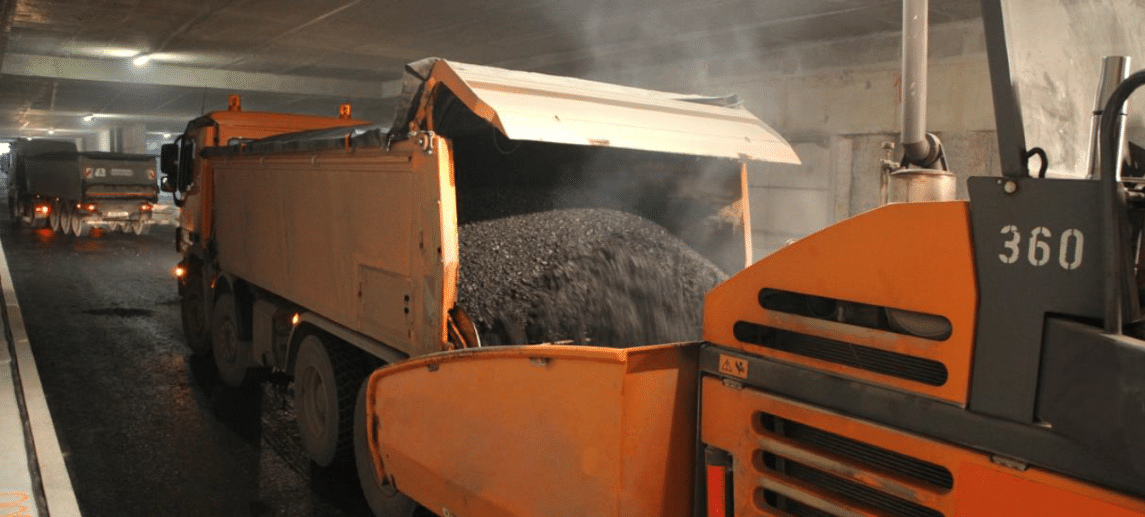
As noted, another highlight of the Fliegl ASW Thermo system is the push-off technology. In contrast to conventional tipper vehicles, it enables controlled and even material discharge. This reduces material losses, prevents compaction problems and ensures precise dosing of the asphalt. In addition, the push-off trailer can also be unloaded in buildings with low ceilings, as well as under bridges that have little clearance for a raised tipper truck.
To recap, the focus is not only on efficiency, but also on safety. There is no risk of the Fliegl ASW Thermo tipping over – an important safety aspect on uneven construction sites. At the same time, the reduced maintenance requirements contribute to a high level of operational- and cost-effectiveness.
Overall, the reduced CO₂ emissions due to a decreased loss of mix and optimised transport enable a more sustainable construction method.
*Fliegl Bau- und Kommunaltechnik is part of the global Fliegl Group, based in Mühldorf am Inn, Germany. The company develops and manufactures products for the building industry and municipal companies. These include dump trucks, transport systems, water barrels, mixers and mixing plants.