Rubber modified bitumen is gaining ground, according to speciality chemicals business Evonik
The intensified search for better road durability and lower traffic noise – both environmental concerns – has meant an increasing market for rubber-modified bitumen.
At the same time, raw material costs for asphalt and specifically for asphalt modification compounds have increased considerably, creating another obstacle to cost-effective road construction.
The stakes are high for getting roads more durable now and in the future.
Within the European Union, vehicle ownership per 1,000 residents has more than doubled since 1975. While truck shipments accounted for about 1,000 billion tonne-kilometres in 1990, they rose to about 1,750 billion in 2015 according to statistics from the EU Commission. These developments represent a major challenge for Europe’s infrastructure.
Meanwhile, in the US, asphalt mixtures containing rubber have been used for decades. Long-term studies have demonstrated a significant improvement in road durability, according to Evonik, a global speciality chemicals producer.
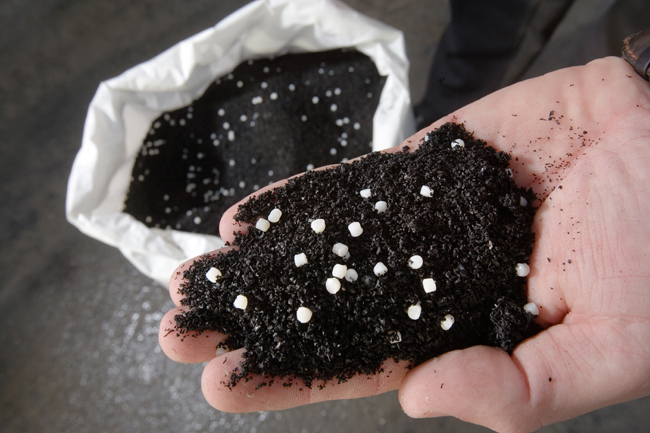
“The market for elastomer-modified, for example rubber-containing road surfaces, has been growing in Europe over the past years as well,” said Frank Lindner, Evonik’s senior business manager for the company’s VESTENAMER additive process. VESTENAMER turns recycled and scrap tyres into a modern construction material for durable roads.
Evonik developed VESTENAMER in the late 1970s as a processing aid for the rubber industry. Polyoctenamer, which is produced in the Marl Chemical Park, resolves a number of challenges associated with compounding and processing rubber. It is used to this day because of its positive characteristics in the interaction with other rubbers.
In addition to the tyre market, the product plays a part in the manufacture of rubber items such as hoses, clutch linings, roller coatings and an assortment of molded parts.
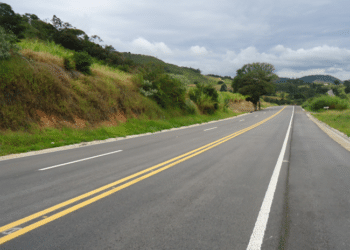
VESTENAMER’s resulting rubber powder is frequently used in porous asphalt – also known as low-noise asphalt – that cuts down on traffic noise by 1-2dB, notes Lindner. This is highly significant because in human perception, a reduction of 3dB is comparable to cutting the traffic volume in half, he explained.
“The positive properties are obvious since the material significantly reduces cracking, ruts and potholes in the road surface, which in turn extends road service life.”
Every year, just over 19 million tonnes of scrap tyres are generated worldwide – including more than 3.6 million tonnes in Europe alone. Twenty years ago, much of the annual scrapped tyre volume was incinerated to generate energy. But more and more are being processed into granulate.
“Reusing recycled tyres secures valuable resources,” said Thomas Engenhorst, sustainability strategy manager in Evonik Resource Efficiency*, part of Evonik. “Tyres are not classified as waste, but are considered a valuable material, which may not, for example, be disposed of in landfills. This use eliminates the disposal question.” Instead of being on top of the road as part of a vehicle, they are now within the road itself, “in the form of an elastomer or rubber powder in the surface”.
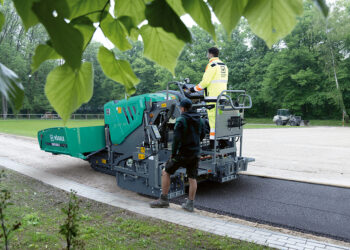
As part of a test track in the German town of Paderborn, the local road Detmolder Strasse was resurfaced in 2012 in compliance with the European Union Waste Directive. Half of the new asphalt mixture consisted of milled material, that being asphalt granulate, from the old road. The new mixture formulation also included rubber powder and VESTENAMER. For every 100m of track, around 80 scrap tyres were turned into an elastomer-modified road surface, along with recycling the old asphalt.
A study by the Institute for Energy and Environmental Research in Heidelberg, Germany provides further information about the eco-balance. Every tonne of recycled rubber powder saves around 2.7 tonnes of carbon dioxide which otherwise would have been generated during incineration. The use of recycled rubber significantly reduces the carbon footprint.
The application of VESTENAMER is a clean affair in many respects, according to the company. Emissions of volatile and semi-volatile compounds, including hydrocarbons and sulphur compounds, are much lower in road surfaces containing rubber than in conventional, polymer-modified asphalt types.
Evonik notes that the process additive also reduces the migration of organic compounds that are washed out by rain to eventually reach the groundwater. A study by the Munich-based analytic laboratories FABES Forschungs on behalf of Evonik found that the use of VESTENAMER reduces overall groundwater burden.
In 2013, the Road and Transportation Research Association added rubber-modified bitumen and asphalt types to German regulations for road construction.
*Evonik Resource Efficiency produces high performance materials and specialty additives for environmentally friendly as well as energy-efficient systems to the automotive, paints and coatings, adhesives, construction and many other industries. Evonik Resource Efficiency employs about 10,000 people and generated sales of around €5.4 billion in 2017.