• About
  • Advertise
  • Contact
Friday, July 17, 2026
Newsletter
Global Highways
  • News
  • Products
  • Features
  • Categories
    • Asphalt Milling, Paving & Compaction
    • Concrete Milling, Paving & Compaction
    • Connected Construction
    • Earthmoving & Soil Compaction
    • Engines, Components & Tyres
    • Finance & Funding
    • Highway & Network Management
    • Maintenance
    • Materials
    • Recycling
    • Road Markings, Barriers & Workzone Protection
    • Road Structures
  • Events
    • Events Calendar
    • CONEXPO-CON/AGG 2026
    • Intertraffic Amsterdam 2026
    • bauma 2025
  • Latest Magazine
  • Videos
No Results
View All Results
  • News
  • Products
  • Features
  • Categories
    • Asphalt Milling, Paving & Compaction
    • Concrete Milling, Paving & Compaction
    • Connected Construction
    • Earthmoving & Soil Compaction
    • Engines, Components & Tyres
    • Finance & Funding
    • Highway & Network Management
    • Maintenance
    • Materials
    • Recycling
    • Road Markings, Barriers & Workzone Protection
    • Road Structures
  • Events
    • Events Calendar
    • CONEXPO-CON/AGG 2026
    • Intertraffic Amsterdam 2026
    • bauma 2025
  • Latest Magazine
  • Videos
No Results
View All Results
Home Features The environmental case for geosynthetics

The environmental case for geosynthetics

Huesker, a global manufacturer of geosynthetics and technical textiles, explains how incorporating geosynthetic material can boost a project’s environmental credentials*.

by Sarah Biswell
August 8, 2022
in Features
Reading Time: 4 mins read
A A
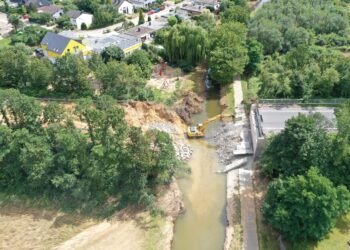
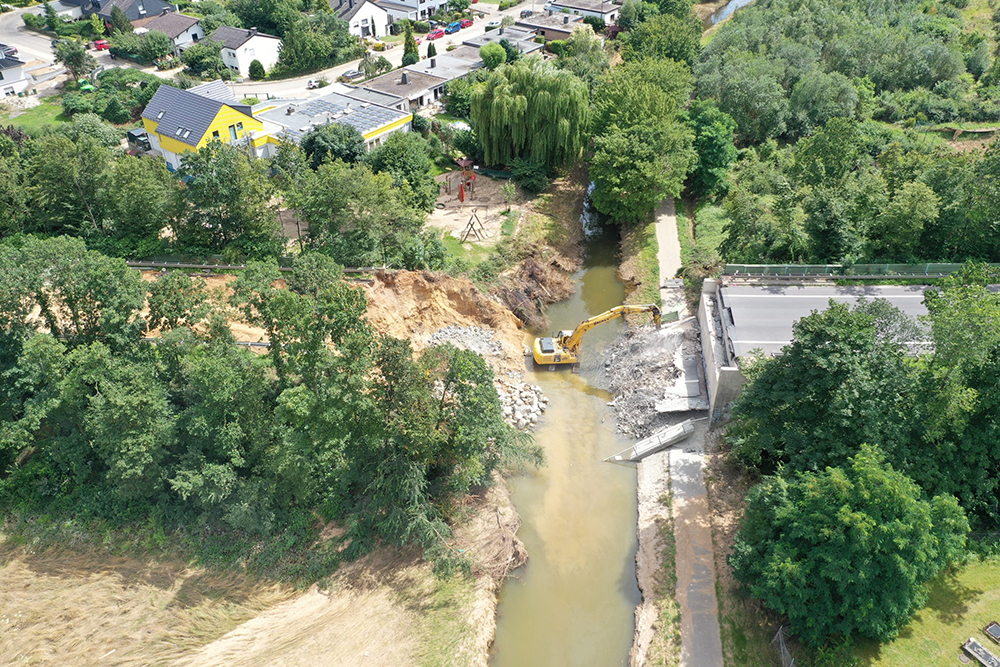
The Swistbach Bridge in Heimerzheim, Germany, was destroyed by floods in July 2021 (image courtesy Heitkamp BauHolding)

The Swistbach Bridge in Heimerzheim, Germany, was destroyed by floods in July 2021 (image courtesy Heitkamp BauHolding)

For example, urgently needed temporary utility roads, construction roads and work platforms can be quickly and safely constructed with geogrids or reinforcing mesh – even in very soft soils. Temporary storage of waste and contaminated sludge is also possible thanks to geosynthetic contaminant barriers, filters and sludge dewatering hoses.

The construction of the new Swistbach Bridge in Heimerzheim, 30km from Cologne, is a case in point. The bridge, which carries the L182 highway over the Swistbach River, was completely destroyed due to flooding, resulting in the need for a totally new structure. After a record construction time of just three months, the new bridge was reopened to traffic last December.
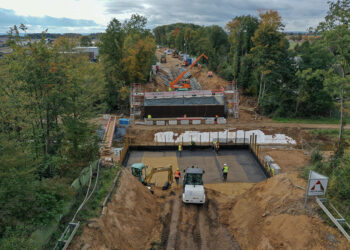
Construction crews reconstructed the Swistbach Bridge's two abutments using geogrid-reinforced earth (image courtesy Heitkamp BauHolding)
Construction crews reconstructed the Swistbach Bridge’s two abutments using geogrid-reinforced earth (image courtesy Heitkamp BauHolding)

The Swistbach Bridge has not only been built to be withstand similar extreme weather, but it is also has a larger span by more than 4m, reaching 24.3m between the abutments. This allows the riverbed to pass through an opening 4m wider so flooding is less likely. All this was made possible by the innovative fast construction method Heitkamp Schnellbruecke system, developed by German construction group Heitkamp BauHolding using geosynthetics from Huesker. The load-bearing columns of the system – the abutments – are made of composite flexible geogrids and locally available soils. They form the long-term safe load-bearing heavy-duty elements of the bridge.

Constructions of geosynthetic-reinforced earth basically allows very fast building of bridge abutments. Unlike in Germany, reinforced-earth structures have been among the standard construction methods used for the majority of infrastructure projects in the Netherlands for a very long time. By using geogrid and earth construction, build time of the abutments was reduced from up to three months to just 10 days. By using fewer resources and transporting less material, there was also a CO2 saving. But overall, it was the excellent cooperation between the two companies that led to rapid construction.

Huesker, for example, was able to provide the structural calculations for the abutments, alkali-resistant Fortrac geogrids and non-wovens in a very short time thanks to its many years of experience, including in 2019. Heitkamp was working on a bridge replacement over the A3 near Emmerich am Rhein in the north-west federal state of North Rhine-Westphalia. The Heitkamp Schnellbaubruecke system was used there and led to it being recognised as a standard construction method in Germany.

Sustainability

But economical and rapid construction are only part of what is needed when responding to reconstruction of damaged infrastructure. Other factors such as sustainability play an increasingly significant role: the materials

used, the service life of the new structure, aesthetics and environmental impact including disruption to animal habitat and migration patterns. It is, therefore, not surprising that more and more proven construction methods are being replaced by alternative, more resource-efficient solutions such as a geosynthetic system.
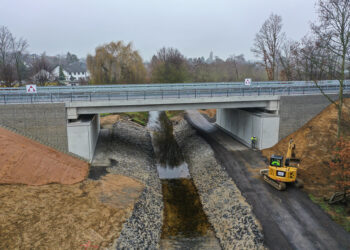
The Swistbach Bridge shortly before  its opening in December 2021 (image courtesy Heitkamp BauHolding)
The Swistbach Bridge shortly before its opening in December 2021 (image courtesy Heitkamp BauHolding)

Where smooth concrete walls were used to line canals or river banks, geotextiles are now used. Research has found that there has been an issue with how a smooth surface, rather than an irregular surface, does not allow micro-organisms and small flora to accumulate and survive.

Also, when they have accumulated and taken hold, they can have a positive effect on regulating effect on the flow properties of the canal water or river.

Dams and dykes are built in such a way that their surfaces can be overgrown and colonised by local nature, thus blending into the landscape as naturally as possible. Construction of erosion-proof spillways and stormwater retention basins to mitigate the effects of local heavy rainfall are possible with geosynthetic building materials.

It is also proven that, in direct comparison with conventional construction methods, build times using geosynthetics can be shortened – apart from providing a better environmental balance and improving a structure’s life cycle. The reduction of building materials, such as concrete or asphalt, and the reusability of existing soils not only conserve resources, but also requires less transport, which makes the entire construction process significantly faster.

Overall, the use of geosynthetics in flood protection enables numerous added values for people and the economy in reconstruction and flood prevention.

Promoted Content Header
Huesker VIEW COMPANY
Huesker offers a novel solution to prevent erosion of infrastructure in coastal areas
Products

Erosion protection from Huesker

July 12, 2022
The Swistbach Bridge in Heimerzheim, Germany, was destroyed by floods in July 2021 (image courtesy Heitkamp BauHolding)
Products

Huesker: the case for geosynthetics

April 19, 2022
A new Huesker road repair product is now available made from recycled materials
Products

Sustainable road rehabilitation

April 20, 2021
HUESKER recycled plastic
Products

HUESKER’s new geogrid made from recycled materials

February 14, 2020

Related Posts

One of the tasks involved flipping bottles up from the ground (Image: Hitachi Construction Machinery Europe/HCME)

Europe’s best operators get ready for the LANDCROS Operator Challenge Final

by Sarah Biswell
July 10, 2026

More than 90 of Europe's most skilled excavator operators have showcased their skills in recent months by taking part in...

Road repairs work

The importance of road maintenance

by Staff Writer
July 10, 2026

Gülay Malkoc discusses the importance of investing in road maintenance.

The new 24litre engine from DEUTZ is designed for high-load genset applications - (image: Deutz)

High power generation from Deutz

by Mike Woof
July 8, 2026

Deutz is offering a rugged new engine to suit challenging power generation installations

Join our newsletter

The mission of Global Highways is to cover the latest technologies and best practices in all areas of road, bridge and tunnel construction and maintenance, as well as their safe operation and management.

Subscribe to our newsletter

About Us

  • About Us
  • Advertise
  • Contact
  • Terms & Conditions
  • Privacy Collection Notice
  • Privacy Policy

Popular Topics

  • News
  • Features
  • Products
  • Videos
  • Events
  • CONEXPO-CON/AGG 2026
  • Intertraffic Amsterdam 2026
  • bauma 2025

© 2026 All Rights Reserved. All content published on this site is the property of Prime Creative Media. Unauthorised reproduction is prohibited

No Results
View All Results
NEWSLETTER
  • News
  • Products
  • Features
  • Categories
    • Asphalt Milling, Paving & Compaction
    • Concrete Milling, Paving & Compaction
    • Connected Construction
    • Earthmoving & Soil Compaction
    • Engines, Components & Tyres
    • Finance & Funding
    • Highway & Network Management
    • Maintenance
    • Materials
    • Recycling
    • Road Markings, Barriers & Workzone Protection
    • Road Structures
  • Events
    • Events Calendar
    • CONEXPO-CON/AGG
    • Intertraffic Amsterdam 2026
    • bauma 2022
  • Latest Magazine
  • Videos
  • About
  • Advertise
  • Contact

© 2026 All Rights Reserved. All content published on this site is the property of Prime Creative Media. Unauthorised reproduction is prohibited