California-based DIMAAG is pushing the envelope for the off-highway equipment sector, developing innovative electrification and charging solutions.
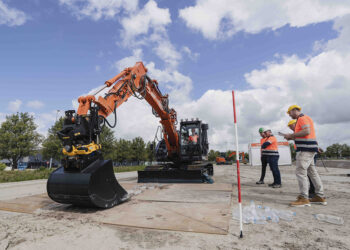
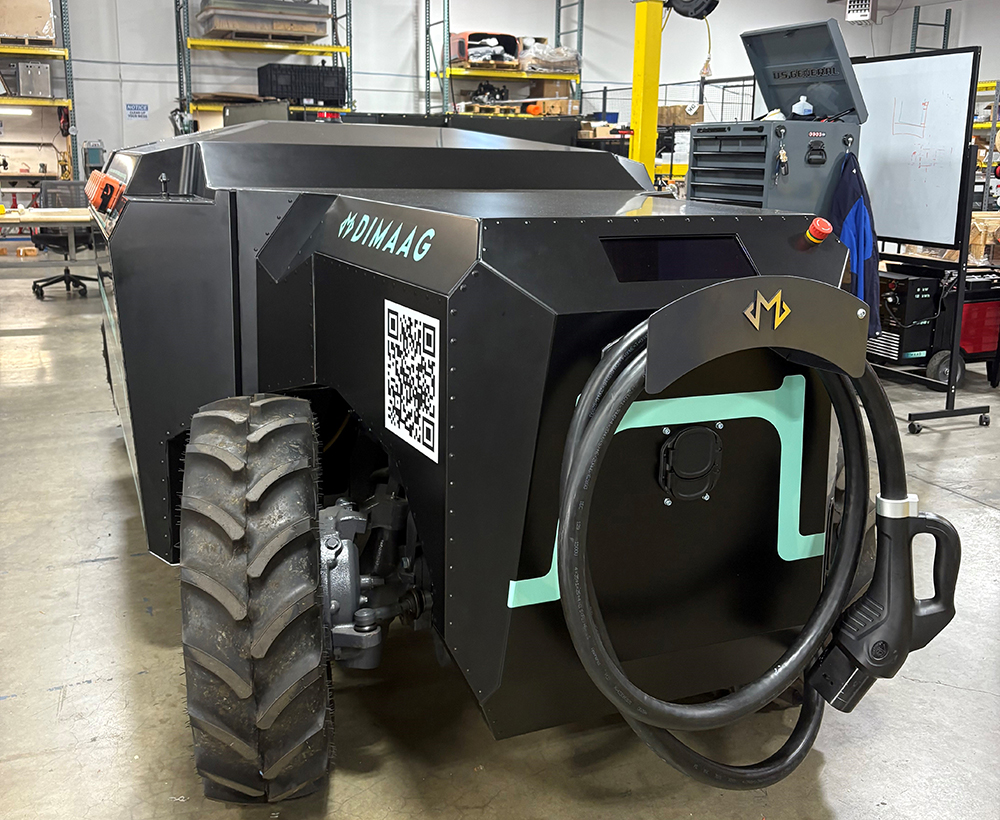
At the bauma construction machinery exhibition in Munich in early 2025, the firm unveiled its novel mobile charging solution, the Mobile Megawatt Charging System (MWCS) at the Komatsu Electrification Display. This innovative machine can boost the versatility of electric construction machines. A novel rough-terrain vehicle, the MWCS can drive itself to charge electric equipment at their point of use when required. Remote control is fitted but the machine also has the option of autonomous control. According to the firm, the MWCS offers a fast, and practical way to charge off-road electric work vehicles. It features innovative technology for high-power, fast charging on a mobile vehicle. The machine is intended for off-highway use at construction sites, quarries or mines, but has been developed to be extremely rugged, allowing it to cope with tough conditions.
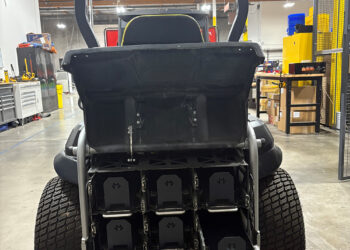
Aimed at use with heavy machinery such as construction or quarry equipment, DIMAAG’s MWCS offers the potential to address power-supply challenges in the field.
The 4WD, independent traction control unit is effectively a giant booster battery on wheels according to the company. With 1MW fast-charging capability, this can recharge an electric construction machine in just 15 minutes, while an operator takes a periodic break. The unit itself can then be recharged overnight for use again the following day.
DIMAAG says that the unit benefits from its patented active thermal-management technology that boosts safety and life-cycle to deliver improved total cost of ownership.
The company also claims that its MWCS offers manoeuvrability in tough off-road conditions including high gradients, and can charge multiple machines onsite.
Deepak Pingalay, chief commercialisation officer at DIMAAG, said “Our autonomy is specifically designed for off-road use. You have to have smart navigation that understands the environment.”
However, the MWCS is just one of the company’s advanced technologies. In addition to the headquarters in Fremont, California, the firm also has a facility in Bengaluru, India, that focuses on software development and machine-learning systems while it has a facility in Japan that specialises in application engineering for autonomy and robotics.
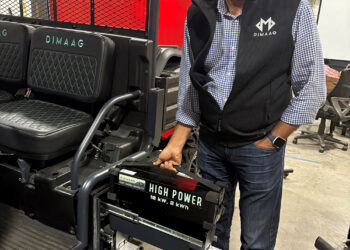
Pingalay explained that the firm started as an AI company, but has since broadened its scope, now specialising in electrification solutions, AI, autonomy and robotics. Ian Wright, a former co-founder of Tesla, is the engineering brain behind the technology and working with DIMAAG he wants to make an impact in the electrification of off-road vehicles. He added that the company can offer technology development and fast prototyping and added, “That significantly shrinks the development time for our customers.”
The company has many patents while its experience with AI has been of benefit and Pingalay said, “We also use AI in battery-pack design and battery management.”
Kubota, the Japanese multinational, was a customer for DIMAAG’s AI technology at first but then asked the California firm to help fully design an autonomous electric tractor. This was made ready quickly and Pingalay said, “Kubota’s EV tractor benefited from a fast, highly accelerated development process.”
In addition to the autonomous electric Kubota tractor, DIMAAG has also developed a swappable fast-charging electric power package for a mini excavator from Hitachi, a ground-care machine, an off-road buggy and an electric generator. The firm has also developed electric solutions for demolition equipment while some projects are underway with other machine manufacturers at the moment, although these are not being revealed at this stage.
The electrification solution for Hitachi is based on one of its zero-tailswing mini excavator models. Sadha Kameswaran, vice president business development at DIMAAG, explained: “Hitachi gave us good CAD models so we were able to see the space available clearly and deliver a prototype vehicle to them in 12 weeks.”
The prototype was exhibited at the bauma show in Munich in 2025. The firm has fitted a battery pack with six swappable modules in the Hitachi ZX17 mini excavator, although it can operate with just two of the units if required. Kameswaran said, “We worked with the engineering team to keep the zero tailswing and it is being launched in the market by Hitachi in 2027.”
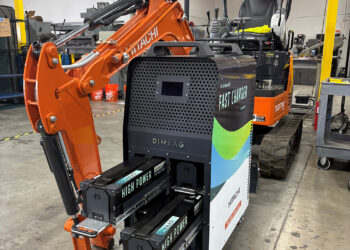
The power systems have been developed along modular lines. Pingalay said, “Companies want standard solutions that go across several industries.”
This is why DIMAAG has developed the swappable battery systems. These could be offered by a rental firm as part of the service for customers as data from the batteries can be monitored continuously, providing alerts ahead of time when a new unit will be required. The inverter and motors have been designed and developed by DIMAAG. The power systems have been proven already in other machines. The battery modules weigh 18kg apiece and each module delivers 10kW power, so with 12 of the units, this can deliver 120kW power. With 12 modules, the battery-pack capacity will be 24kWh.
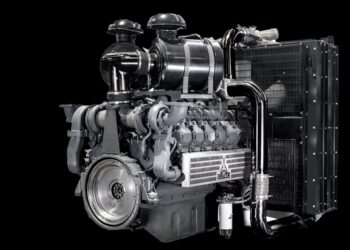
DIMAAG’s electric technology features an important innovation that is key to the system and Kameswaran said, “We have a unique cooling technology that’s all integrated.”
DIMAAG’s innovative DC-DC converter units are said to be significantly more compact than those of any competing systems, being just 20% of the average size. This is because of the advanced cooling system that the firm has developed. However, development of the MWCS concept continues.
The autonomous charging machine unveiled at bauma carries a 220kWh battery pack but the firm will offer a newer version with a different chassis and a battery pack capacity of 300kWh. Kameswaran said, “It will be able to charge a 20 tonne excavator in 15 minutes.”
Content produced in association with DIMAAG