The perception among many is that the roads sector is old-fashioned and unwilling to change. However, there were plenty of examples of innovation and transformation on the agenda for the second E&E Event, held in Vienna this month.
In particular, decarbonisation, digitalisation and diversification are shaping the roads sector, as they are for many sectors globally.
Organised jointly by Eurobitume, which represents bitumen producers and the European Asphalt Pavement Association (EAPA) which represents national associations and equipment and materials suppliers, the E&E Events aim to focus on challenges and trends for the bitumen and asphalt industry. “The philosophy is to bring high-level people together, from the industry and experts from outside it, to discuss the hot topics in a more informal setting,” explained Carsten Karcher, EAPA secretary general.
A poll of the 330-plus attendees, conducted at the beginning of the conference, showed that less than 20 per cent thought the industry was leading the way on transformation. But the conference clearly demonstrated that there are organisations out there at the cutting edge.
Decarbonisation in action
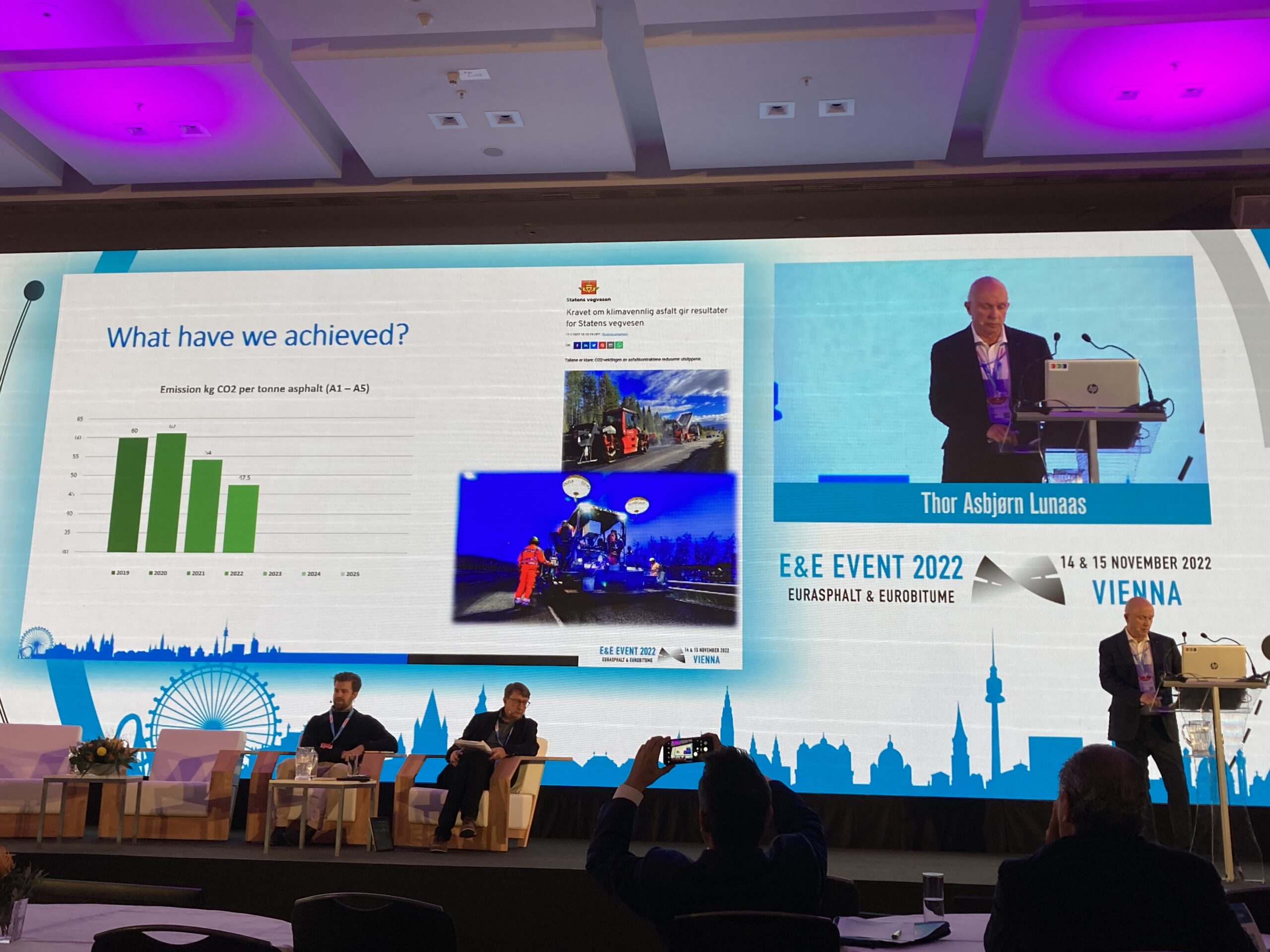
Perhaps the most inspiring presentation of the opening session came from Thor Asbjørn Lunaas, chief engineer at Statens vegvesen, the Norwegian Public Roads Administration. Lunaas showed how the authority was driving down emissions in both new-build and maintenance programmes by changing the way it procures its contracts and giving contractors.
One striking example is that tenders are now assessed and adjusted by Statens vegvesen on carbon cost as well as capital cost; the lowest bidder in carbon cost does not have its tender price adjusted. But all the others will have 5 NOK (€0.5) added on for every kilogram of carbon emissions they come in above the lowest carbon bidder. “It really hurts if you come in with the lowest bid and then lose because you aren’t the lowest on carbon,” one contractor commented.
Philippe Moseley, a policy officer in the Construction Unit of the European Commission’s DG GROW department, told the conference how the Commission was trying to accelerate a green transition within the sector.
Current activities include an update of the Construction Products Regulation so that Environmental Product Declarations (EPDs) become mandatory and the creation of a transition pathway document, to be published in its final form next year.
Mosely also underlined one of the big barriers for change within the wider construction sector – as well as the roads sector – and perhaps the reason why it is perceived as traditional: 99.9 per cent of the European Union’s 5.3 million construction companies are SMEs – small to medium-sized enterprises.
Blake Wellman, a director at Monitor Deloitte, shared some early findings of a survey of 95 senior and specialist people from the industry looking into barriers and opportunities for decarbonisation in the road sector – one of a series of such surveys it has been conducting for Shell in recent years. The study identified 13 barriers to decarbonisation including inconsistent definitions and methodology, outdated materials standards and the fact that projects are conducted one at a time with a focus on budget and programme.
However, Wellman commented that the roads sector does seem to be aware of the task ahead: “Everybody could tell us what their decarbonisation plans were.”
Digital challenges
Heading up a session on digitalisation, Slovenko Henigman, president of the Slovenian Asphalt Pavement Association, provided an overview of the first International Asphalt 4.0 Conference which was held in Madrid in September. “The technology exists and is being implemented in some places,” said Henigman. Nordic countries appeared to be leading the way.
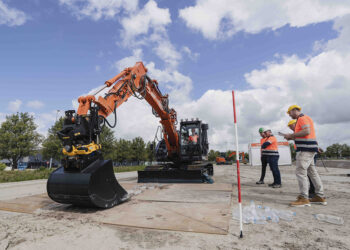
From the wide range of topics discussed at the Madrid conference, two presentations were given again at the E&E Event. Leandro Harries, a researcher from the Technical University of Darmstadt presented on research to automate the role of the screed man. Meanwhile, Aida Marza Beltran, a standardisation technician from Becsa, reported on the real-time monitoring of CO2 emissions during warm mix asphalt production.
Digitalisation will, of course, impact heavily on the way that roads are used. This was a topic addressed by EAPA’s technical director Breixo Gomez in a session on future mobility.
Gomes explained how transitions to autonomous vehicles and platooning could impact on the wear and durability of road surfaces and structures. Because there will be less so-called wandering by vehicles around the carriageway, loading will be concentrated in the same areas of the road pavement. “We have solutions for heavily trafficked motorways of urban areas, for industrial areas like ports, harbours and airports, so we are prepared,” said Gomes.
Though active mobility wasn’t a topic covered at the conference, a presentation from Mark Beaumont – the fastest person to cycle round the world – reminded us that future roads must also cater for much lighter vehicles.
Bitumen is technology
Like most parts of the construction sector, one of the road industry’s biggest challenges is how to attract more young people. At its last congress, E&E decided that a good way to find out would be to ask some young people what they thought should be done. To that end, E&E invited 20 “Future Leaders” to attend for free and at the Vienna event, the group reported back.
Among the young leaders’ suggestions were that the road construction sector should be positioned as part of the technology sector and that its innovations should be more widely shared into other sectors. “A lot of us who came from other industries or who had just started didn’t know how many innovations there were,” commented Navid Hashemigad, postdoctoral researcher at the University of Antwerp, who presented on the group’s findings with Becsa’s Aida Marza Beltran and Shahin Eskandarsefat, a senior researcher at Iterchimica.
Bernhard Hofko, an associate professor and road materials specialist at the Vienna University of Technology, said that the industry could attract clever young people by asking them to solve its most difficult problems. “Smart people like challenges,” he said.
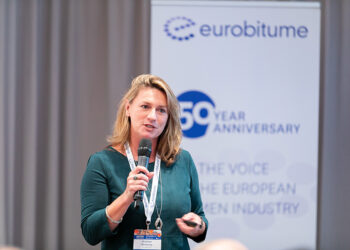
In the closing session of the conference, Eurobitume director general Siobhan McKelvey reported on a branding and communications study conducted earlier in the year by a specialist agency. Here too, emerging messages included the need to talk in more depth and detail about bitumen. As one of those surveyed said, “Bitumen is the unsung hero of our modern world”.
Exhibitors
A tour of exhibitors was a reminder that this industry has long been promoting the principles of decarbonisation and the circular economy – lower temperatures at the mixing plant, products that deliver longer lives for roads and treating waste as a resource.
There was much interest in bio-based products, rejuvenators and binder replacement materials. If these are produced by plants or trees that grow for a number of years, taking in carbon dioxide as they do so, their carbon contribution to a mix can be negative.
Cargill’s global technical manager Hassan Tabatabaee gave a detailed and well-attended technical presentation during the first day’s lunch break on biobased additives and how they can be assessed and compared. Cargill was promoting its Anova range of asphalt solutions for rejuvenation, warm mix and other applications.
Nynas was talking about its newly launched Nypol RE binder, a polymer modified binder. It contains biogenic material to give lower embodied carbon in manufacture and give a longer life to the road. Shell’s CarbonSink, launched earlier this year, replaces a proportion of a binder with a biogenic material and is under trial in many countries after early applications in the UK and China.
Among the products promoted by Sripath Technologies at the E&E Event was ReLIXER, its biobased rejuvenator. With established markets in the US and Asia, the company now has trials and projects in Europe and other parts of the world.
Chemical company Evonik was promoting a product that allows crumb rubber to be more easily used to modify asphalt mixes, improving its properties too. Vestenamer granules are added to the mix so that the rubber better reacts with the bitumen, making the mix less sticky, more workable and easier to compact.