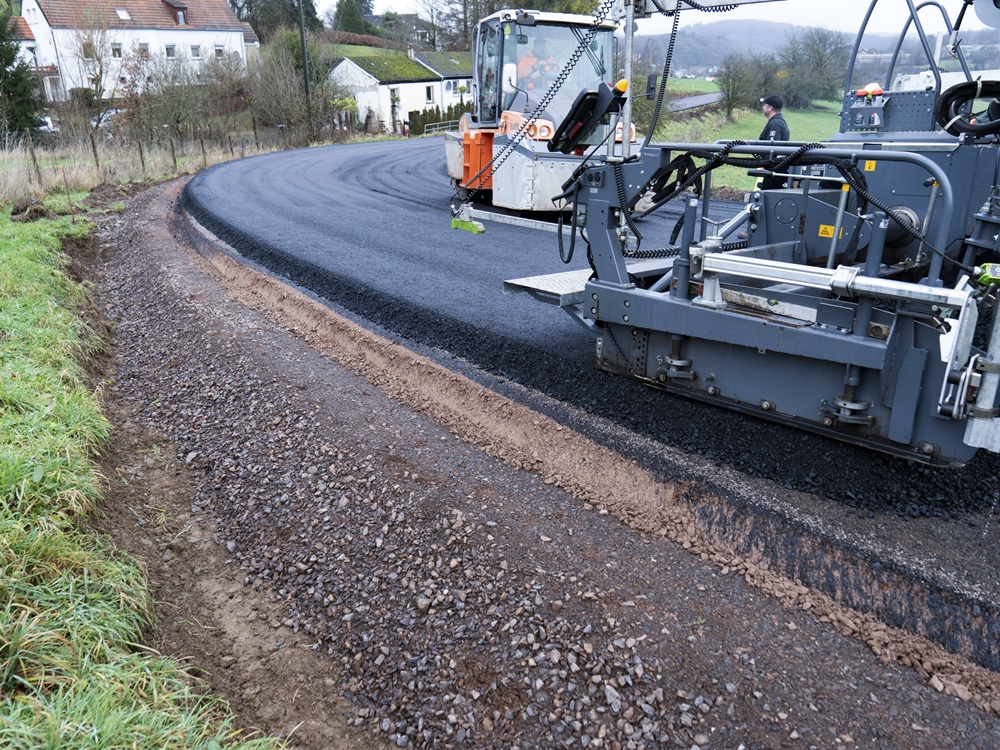
A 1km section of the B268 road in Zerf, Rhineland Palatinate, has been upgraded with the help of the digital Smart Pave technology from Vögele. This was the first project for which the lead contractor used the latest Smart Pave digital control system from Vögele.
The 1km road section required extensive rehabilitation, with the paving of two new base layers, a binder course and the asphalt concrete surface layer. For the first time, the Lehnen Group used the Smart Pave digital paving control system with its Vögele SUPER 1800-5 X paver for paving widths of 6.5-9.5m. The integrated system automatically controls the paving width, position and direction of a road paver based on virtual references.
The project in Zerf demonstrated the advantages of the new solution even before paving began. Using Smart Pave meant the surveying work was simpler, with less preparation work required. Using Smart Pave eliminates the need for time-consuming marking work and increases process reliability. The firm’s surveyor used a Field Rover survey pole to record the coordinates and positioning data of the area to be paved. This was used to generate a CAD model of the road on the basis of the data which was uploaded to the Planner in the John Deere Operations Center. After automatic error analysis, the data was transferred wirelessly and directly to the firm’s road paver via the John Deere Operations Center, the Wirtgen Group’s central construction site management system.
The paver was then guided along the specified route using only the virtual references, without any need for the installation of additional aids. Two integrated John Deere StarFire satellite antennae on the canopy of the SUPER 1800-5 X determined the position of the machine, enabling precise control. A mobile RTK modem was also used to improve the positioning accuracy using a correction signal provided by a local base station. As the screed width was adjusted automatically, the operator could concentrate on the paving process. The precise control of the paver prevents paving of excess widths, thereby saving material and cutting costs. As there was no need to check the edges and the screed width from the roadside, Smart Pave also improved the safety of the paving crew, a useful feature when working close to live traffic.
The first use of the new solution on a construction site impressed the entire team from the Lehnen Group. The firm said that the Smart Pave technology allowed it to carry out preparatory work on a computer in digital form, independent of weather conditions, allowing greater versatility on the construction site.
The Smart Pave system offers several advantages according to the Wirtgen Group, including the elimination of marking-out tasks for surveyors. This technology also allows the paver operator to concentrate on the quality of the paving process while boosting safety for the entire paving crew, particularly for night working or with jobs alongside live traffic. In addition, the system ensures that the machine steers precisely and that screed width is optimised, reducing materials usage. Overall, the system is said to deliver better paving accuracy and process safety. The package is simple to use because all the hardware components are integrated into the road paver.